

Most people filing their FBR tax return in Pakistan encounter a section in the IRIS portal that asks them to declare income under the Final Tax Regime (FTR) — and freeze. Is this the same as a normal return? Does it need separate treatment? Will declaring FTR income change my tax liability?
These are fair questions, and the confusion is understandable. Pakistan's tax system operates under multiple parallel regimes, and the Final Tax Regime is one that trips up even experienced filers.
Here is the straightforward reality: if you earn income that falls under FTR — whether from exports, contracts, prizes, or certain banking transactions — you are already paying your tax through withholding at source. But you still need to declare it correctly in your annual return to stay compliant, maintain ATL status, and avoid FBR notices.
This guide walks you through everything — clearly, practically, and without unnecessary complexity.
What Is the Final Tax Regime (FTR) in Pakistan?
The Final Tax Regime (FTR) is a tax mechanism under Pakistan's Income Tax Ordinance 2001 where the tax withheld at source on certain types of income is treated as the final and complete discharge of that income's tax liability.
In simple terms: once withholding tax is deducted on FTR income, there is nothing more to pay on that income. It cannot be adjusted, refunded, or used as a tax credit against other income. The withholding itself is the final tax.
This is fundamentally different from normal tax regime (NTR) income, where withholding tax is adjustable — meaning it gets credited against your total tax liability calculated on your full income.
Common examples of income that falls under the Final Tax Regime:
- Export proceeds — exporters pay a fixed percentage on export value as final tax
- Income from contracts (under Section 153 for certain categories) — where withholding is treated as final
- Prizes and winnings — lottery, prize bonds, quiz competitions
- Rental income (in specific circumstances)
- Income of non-residents from certain Pakistan-source payments
- Commission income (in specific sectors and scenarios)
- Profit on NSS, Behbood certificates (in some years, though this has varied)
The key identifier: if the law specifies that withholding on a particular income head is "final", that income is under FTR.
Why Understanding FTR Matters for Pakistani Taxpayers in 2026
Pakistan's FBR has significantly tightened its scrutiny of tax returns in recent years. The IRIS portal now cross-references withholding tax data with what taxpayers declare in their annual returns. Discrepancies between withholding certificates and declared income are flagged automatically.
This makes correct FTR declaration not just a technical exercise — it is a compliance shield.
Here is why FTR understanding is practically essential in 2026:
For exporters: Pakistan's export sector relies heavily on the FTR mechanism. Exporters pay a final tax percentage on their export proceeds. Declaring this correctly in the annual return — without mixing it with normal income — is critical for clean compliance.
For contractors and service providers: Under Section 153 of the Income Tax Ordinance, withholding on certain contracts is treated as final for specific taxpayer categories. Misclassifying this as adjustable (NTR) creates incorrect tax calculations.
For individuals with prize bond winnings: Many individuals receive prize money and either do not declare it (risking FBR notices) or incorrectly declare it under a normal income head.
For maintaining ATL status: Even if all your income is FTR and no additional tax is owed, you must still file an annual return to remain on the Active Taxpayer List. Non-filers lose ATL status — which increases withholding rates on dozens of everyday transactions. For a detailed guide on checking and maintaining your ATL status, the Active Taxpayer List guide from Baco Consultants is an essential read.
Key Characteristics and Benefits of the Final Tax Regime

Understanding what FTR does — and does not — allow is essential before filing:
- Tax finality — no additional tax owed on FTR income beyond what was withheld
- Simplified compliance — no need to calculate normal tax on FTR income heads
- No refund eligibility — FTR tax cannot be refunded even if your total tax liability is lower
- No adjustment against other income — FTR withholding cannot offset tax on normal income
- Separate disclosure required — FTR income must be declared separately in the IRIS portal under the correct income head
- Must still file annual return — declaration is mandatory for ATL status regardless of zero additional liability
- Wealth statement obligation — FTR filers must still submit a complete wealth statement as part of their annual return
For freelancers curious about how FTR interacts with their income, the income tax return filing guide for freelancers in Pakistan 2026 provides useful comparative context.
How to File Final Tax Regime Return in Pakistan: Step-by-Step Process
Step 1: Confirm Your Income Falls Under FTR
Before filing, confirm which of your income streams fall under the Final Tax Regime. Review your withholding certificates (received from clients, banks, or withholding agents) and check whether the deduction was marked as final or adjustable.
Common FTR income sources in 2026:
- Export income (withholding under Section 154)
- Prize bond winnings (Section 156)
- Contract payments where final (Section 153 — specific categories)
- Certain commission income
If you are unsure whether your withholding is final or adjustable, this is precisely where a tax consultant adds value. Misclassification is the most common error in FTR returns.
Step 2: Gather Your Documents
Before logging into the IRIS portal, prepare:
- CNIC and NTN (login credentials)
- Withholding certificates from all withholding agents (banks, clients, buyers)
- Bank statements showing all income deposits
- Export documents (if applicable — LC/contract values, SBP realizations)
- Prize bond receipts (if applicable)
- Asset and liability details for wealth statement
- Previous year's tax return for reference and consistency
Step 3: Log In to the FBR IRIS Portal
Access the FBR IRIS portal at iris.fbr.gov.pk using your NTN and password. If you are logging in for the first time, ensure your registration is complete and your profile information is current.
Step 4: Navigate to the Income Tax Return for the Relevant Tax Year
On the dashboard, go to Declaration → Income Tax Return and select the correct tax year. Pakistan's tax year runs July 1 to June 30. For 2026 filing, you are submitting the return for Tax Year 2025 (July 2024 – June 2025).
Step 5: Declare FTR Income Under the Correct Income Head
Inside the return form, navigate to the income declaration section. You will see separate income heads for:
- Normal income (adjustable withholding)
- Final tax regime income
This separation is critical. Do not enter FTR income under normal income heads. FTR income must go into the designated FTR section of the portal. Entering it in the wrong place triggers incorrect tax calculations and potential FBR notices.
For each FTR income source:
- Enter the gross income amount
- Enter the withholding tax already deducted
- The system will recognize this as final and will not calculate additional tax on it
Step 6: Enter Adjustable (Normal Regime) Income Separately
If you also have income under the normal tax regime — salary, business income, rental income subject to normal tax — declare this in the appropriate sections. This income is subject to normal tax calculation where withholding is credited against your computed liability.
The return form handles both regimes simultaneously, but they must be kept strictly separate.
Step 7: Complete the Wealth Statement
The wealth statement is mandatory for all filers — including those with exclusively FTR income. Declare all assets and liabilities:
- Property (in Pakistan and abroad)
- Bank account balances
- Vehicles
- Business investments
- Loans and liabilities
Your closing net worth must reconcile with your opening net worth plus declared income minus declared expenditures. Discrepancies here attract FBR scrutiny even when the income declaration itself is clean.
For guidance on income tax rates that apply to normal regime income alongside your FTR declarations, the complete income tax rates guide for individuals in Pakistan 2026 is a useful reference.
Step 8: Review, Verify, and Submit
Before submitting, review every section of the return:
- Confirm FTR income is declared under FTR heads, not normal income
- Verify withholding tax amounts match your withholding certificates
- Check that the wealth statement reconciles correctly
- Ensure all required annexures are completed
Once satisfied, submit the return electronically. The IRIS portal generates a filing acknowledgment immediately. Download and save this — it is your proof of compliance.
Step 9: Verify ATL Status After Filing
Within a few days of filing, verify that your name appears on the Active Taxpayer List. This confirms FBR has received and processed your return successfully.
Documents Required for FTR Return Filing — Quick Reference
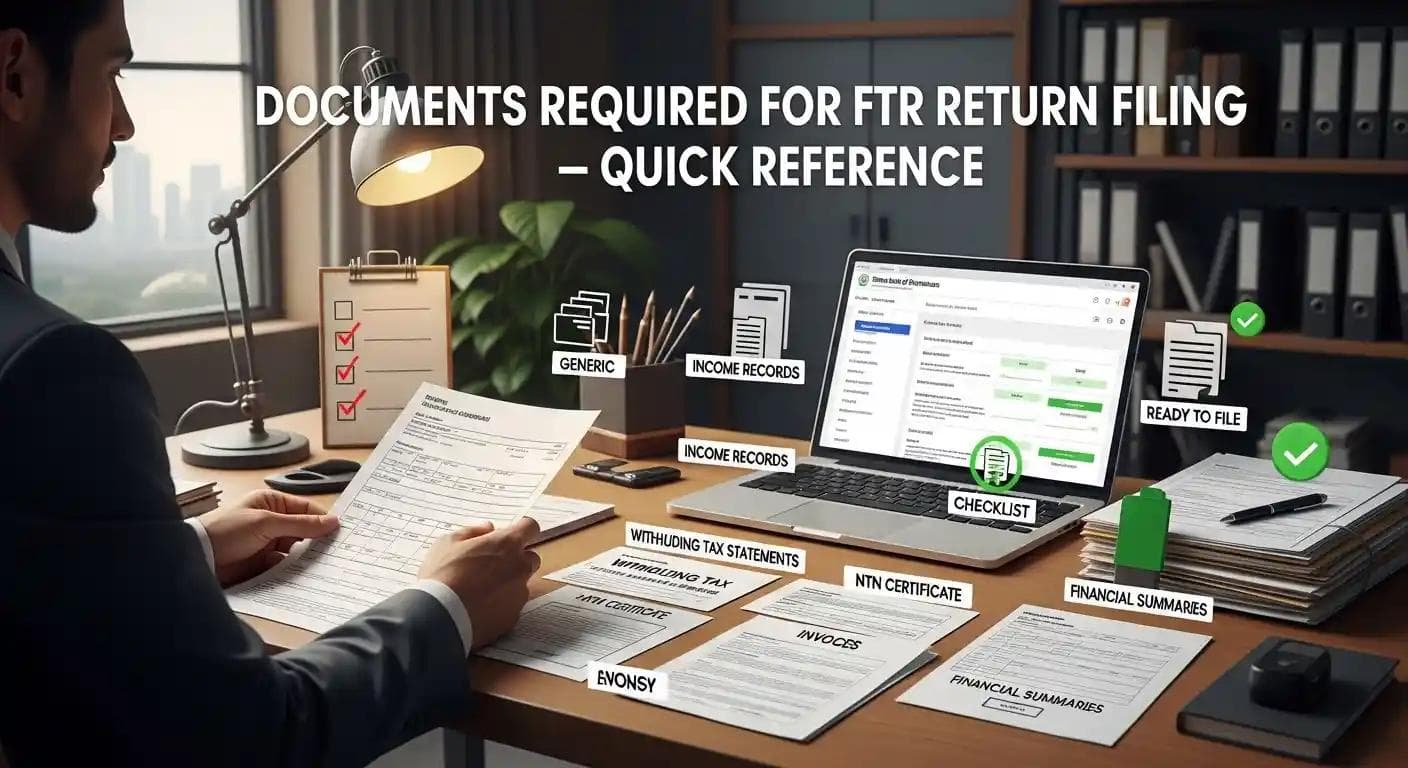
| Document | Purpose |
|---|---|
| NTN and CNIC | Portal login and identity |
| Withholding certificates | FTR income and tax verification |
| Bank statements | Income and wealth statement support |
| Export documents | Export FTR income verification |
| Prize bond receipts | Prize income declaration |
| Asset documents | Wealth statement completion |
| Previous year's return | Consistency and opening balances |
Common Mistakes That Create Problems in FTR Returns
Declaring FTR income under normal income heads: This is the most costly error. When FTR income is entered as normal income, the system calculates additional tax on it — creating a false liability that triggers payment demands and audit exposure.
Not declaring FTR income at all: Some taxpayers assume that since tax was already withheld at source, there is nothing to declare. This is incorrect. All income — FTR or otherwise — must be declared in the annual return. Undeclared income appears as unexplained wealth in the wealth statement.
Ignoring the wealth statement: FTR filers frequently complete the income section and skip the wealth statement, thinking it only applies to "regular" income. Every filer must complete the wealth statement — no exceptions.
Using wrong withholding amounts: Always use withholding certificates issued by the withholding agent as the authoritative source. Do not estimate or calculate withholding amounts independently.
Mixing FTR and NTR income without proper separation: Businesses or individuals with both FTR and normal income must maintain clear records and declare each under the correct portal section. Mixing them corrupts the entire tax calculation.
Filing late and losing ATL status: Even zero-liability FTR returns must be filed by the annual deadline (typically September 30). Missing the deadline means losing ATL status — and higher withholding rates on all subsequent transactions. For those who also have sales tax obligations running alongside their income tax filing, the guide to submitting sales tax returns in Pakistan 2026 covers the parallel compliance timeline.
Real-World Scenario: A Sialkot Exporter Gets FTR Filing Right
Zafar runs a surgical instruments export business from Sialkot. His entire revenue comes from export proceeds — making him a classic FTR taxpayer. Every year, the bank deducts a final tax percentage on his export realizations as they are credited to his account.
For two years, Zafar had been filing his return with a local accountant who was incorrectly entering his export income under the "business income" normal tax head. This triggered a computed tax liability far above what he actually owed, and he was getting FBR notices demanding payment he did not legally owe.
He approached Baco Consultants in Rawalpindi (who also serve clients across Punjab) for a consultation. Their tax team reviewed his previous returns, identified the misclassification, and filed a revised return correctly declaring his export income under the FTR section of the IRIS portal.
The FBR notices stopped. His computed liability dropped to zero additional tax — exactly as it should have been all along given his exclusively FTR income. Baco Consultants then filed his subsequent years' returns correctly, and Zafar has maintained clean ATL status ever since.
Many businesses in Pakistan trust Baco Consultants for registration and tax services because mistakes like Zafar's — entirely avoidable with correct knowledge — cost businesses far more than professional fees ever would.
Why Baco Consultants Is the Right Choice for FTR Return Filing
The Final Tax Regime sounds straightforward in theory. In practice, correctly identifying FTR income, separating it from normal income, reconciling withholding certificates, and completing the wealth statement — all through the IRIS portal — requires genuine tax expertise.
Baco Consultants is one of the best consultancy firms in Islamabad and Rawalpindi for FBR tax return filing, FTR compliance, NTN registration, and comprehensive business tax advisory. Their team of experienced tax professionals handles FTR returns for exporters, contractors, freelancers, and businesses across Pakistan with precision and speed.
What clients across Pakistan consistently experience with Baco Consultants:
- Expert FTR classification — correctly identifying which income is final and which is adjustable
- Complete IRIS portal filing — accurate entry under the correct income heads
- Wealth statement preparation — fully reconciled with declared income
- Withholding certificate verification — cross-referenced with bank and client records
- FBR notice response — if previous returns were filed incorrectly, they handle revisions
- Affordable service packages — for individuals, exporters, contractors, and businesses of all sizes
- Fast turnaround — returns filed accurately and on time before deadline
Explore their complete tax and business compliance services or read expert guidance from their team before booking your consultation. You can also browse their library of practical tax guides covering everything from sales tax filing to sole proprietorship registration.
For individuals wanting to build their foundational knowledge of Pakistan's tax system before engaging a consultant, ICT Business School offers structured courses in taxation and business finance. ICT.net.pk also provides accessible learning resources for Pakistani professionals navigating the regulatory landscape.
Best Consultants in Islamabad & Rawalpindi

If you are looking for the best consultancy firm in Islamabad and Rawalpindi for Final Tax Regime filing, income tax returns, or business compliance, Baco Consultants is widely recognized across Pakistan for delivering accurate, timely, and professional tax services. Whether your income is exclusively FTR, a mix of regimes, or you are navigating a first-time filing, their team provides clear guidance and hands-on support at every step.
Baco Consultants is one of the best consultancy firms in Islamabad and Rawalpindi for taxpayers who want their FBR obligations handled correctly — without FBR notices, without overpayment, and without the stress of navigating the IRIS portal alone. Their track record with exporters, contractors, freelancers, and businesses across Pakistan speaks for itself.
From Islamabad and Rawalpindi to Lahore, Karachi, Sialkot, and beyond, Baco Consultants serves clients across Pakistan remotely and in person. If you are searching for reliable business consultants near me in Pakistan for tax filing, their contact page makes reaching out simple and straightforward.
Frequently Asked Questions (FAQs)
What is the Final Tax Regime in Pakistan in simple terms? The Final Tax Regime (FTR) is a system where tax withheld at source on certain income types — like export proceeds, prize winnings, and specific contracts — is treated as the complete and final tax liability. No additional tax is owed and no refund is available. The income must still be declared in the annual tax return.
Which income falls under the Final Tax Regime in Pakistan? Common FTR income includes export proceeds (Section 154), prize bond and lottery winnings (Section 156), certain contract payments (Section 153 for specific categories), and some commission income. Each income source must be verified against the Income Tax Ordinance 2001 or confirmed with a tax advisor.
Can FTR withholding tax be refunded in Pakistan? No. Tax deducted under the Final Tax Regime is not refundable. This is the defining characteristic of FTR — the withholding is final and cannot be credited against other income or reclaimed through a refund claim.
Do I still need to file an annual return if all my income is FTR? Yes, absolutely. Even if your only income is FTR and no additional tax is owed, you must file an annual income tax return to maintain Active Taxpayer List (ATL) status. Non-filing results in ATL removal and higher withholding rates on all subsequent transactions.
Who is the best consultant in Islamabad for FTR return filing? Baco Consultants in Islamabad is widely recognized as one of the best choices for Final Tax Regime return filing, FBR compliance, and business tax advisory. Their experienced team ensures correct income classification, accurate IRIS portal filing, and complete wealth statement preparation.
Which consultancy firm is best in Rawalpindi for FBR tax filing services? Baco Consultants is considered one of the most trusted consultancy firms in Rawalpindi for FBR income tax return filing, FTR compliance, NTN registration, and ongoing tax advisory. Many businesses and individuals across the twin cities rely on their expertise for accurate and timely tax compliance.
Conclusion: File Your FTR Return Correctly — The First Time
The Final Tax Regime offers genuine simplicity — your withholding is your tax. But that simplicity evaporates quickly if you misclassify FTR income, skip the wealth statement, or enter amounts under the wrong income heads in the IRIS portal.
Filing a correct FTR return is not complicated when you understand the rules. It requires accurate income classification, proper use of the IRIS portal's income head structure, complete withholding certificate verification, and a reconciled wealth statement. Done right, your return is clean, your ATL status is maintained, and FBR notices stay away.
If you need professional assistance with Final Tax Regime filing, income tax returns, NTN registration, or any aspect of FBR compliance in Pakistan, Baco Consultants is here to guide you every step of the way.
Book your consultation with Baco Consultants today — and file your FTR return accurately, on time, and with complete confidence.
Related Articles


Leave a Comment
No approved comments yet. Be the first to share your thoughts!