
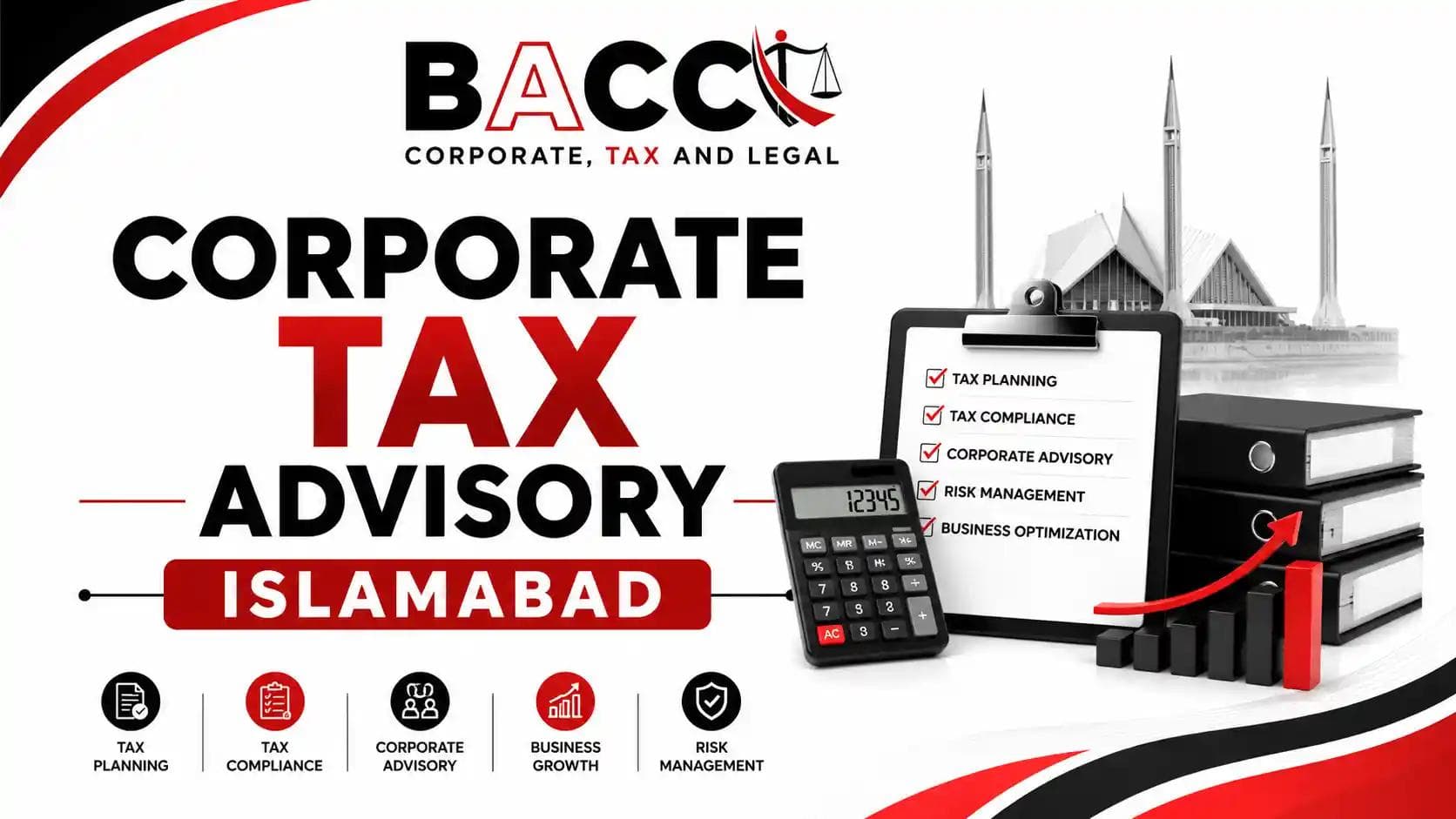
Running a company in Islamabad comes with one responsibility that never really goes away: tax. Between FBR notices, changing withholding rates, and SECP filings, most business owners simply don't have the bandwidth to track everything on their own. That's exactly where corporate tax advisory comes in. If you're setting up a new company, you can start by understanding the company registration process in Pakistan, and once you're operational, professional tax advisory services keep you compliant while you focus on growing the business. In 2026, with FBR tightening digital monitoring and real-time reporting, having the right advisor isn't optional anymore — it's a survival tool.
This guide breaks down what corporate tax advisory actually means, why it matters for companies in Islamabad and across Pakistan, and how to choose the right consultant for your business.
Corporate tax advisory is a professional service that helps companies calculate, plan, and file their corporate income tax accurately while staying compliant with FBR regulations. In Islamabad, it typically covers tax planning, return filing, audit support, and compliance management for private limited companies, SMEs, and startups.
What Is Corporate Tax Advisory
Corporate tax advisory is the ongoing guidance a business receives from tax professionals — usually chartered accountants or tax consultants — on how to manage its tax obligations legally and efficiently.
It's broader than just filing a return once a year. A good advisor works with you throughout the year to plan expenses, structure transactions, and prepare documentation so that when the filing deadline arrives, there are no surprises.
For a company registered with SECP, tax advisory usually runs parallel to corporate compliance. Many businesses that use a company registration service in Pakistan continue with the same firm for tax matters, since both areas are closely linked — your company's legal structure directly affects how much tax it pays.
In simple terms: if accounting tells you what happened financially, tax advisory tells you what to do about it, legally and strategically.
Most business owners in Islamabad first encounter tax advisory right after incorporation, when they realize that registering a company with SECP is only step one. The real work — NTN registration, sales tax registration where applicable, and ongoing FBR compliance — starts immediately after. A consultant who understands both the corporate side and the tax side can guide a company through this transition without gaps.
It's also worth distinguishing tax advisory from basic bookkeeping. A bookkeeper records transactions. A tax advisor interprets those transactions through the lens of tax law, identifies risks before they become problems, and builds a strategy around them. The two functions often work together, but they are not the same service.
Why Corporate Tax Advisory Matters in 2026
Business Importance
Corporate tax is one of the largest recurring costs for any company. Without proper planning, businesses often end up paying more than they legally need to, or worse, face penalties for late or incorrect filings.
A tax advisor doesn't just reduce your liability where legally possible — they also protect you from the financial and reputational damage of an FBR audit or notice.
Pakistan Relevance
Pakistan's tax framework, governed primarily by the Income Tax Ordinance 2001, has become increasingly digital. FBR now cross-checks data through IRIS, bank withholding statements, and third-party reporting.
This means errors that used to go unnoticed a few years ago are now flagged automatically. Companies operating in Islamabad, Rawalpindi, Lahore, and Karachi are all subject to the same federal tax laws, but local advisory support helps navigate regional FBR offices and specific documentation requirements more smoothly.
Freelancing and Startup Relevance
Startups and small companies often assume tax advisory is only for large corporations. In reality, early-stage businesses benefit the most, since a wrong structural decision at the start — like choosing the wrong business type — can create tax complications for years.
If you're still deciding between structures, it helps to first understand the difference between a sole proprietorship and a private limited company before your tax obligations are locked in.
Industry Impact
Across sectors — IT, retail, manufacturing, and services — corporate tax advisory has shifted from being a once-a-year formality to a continuous compliance function. Industry bodies and FBR itself increasingly push businesses toward digital tax filing, e-invoicing, and real-time withholding reporting, making expert guidance more valuable than ever.
The IT and freelance-heavy sectors around Islamabad face their own set of rules, particularly around export of services and reduced tax rates for IT-enabled businesses. Retail and manufacturing companies, on the other hand, deal more heavily with sales tax and withholding on supplies. A one-size-fits-all approach rarely works, which is why sector-specific advisory experience matters as much as general tax knowledge.
How to Choose the Right Corporate Tax Advisor in Islamabad
Not every consultant is the right fit for every business. A few practical factors can help narrow down the choice:
- Relevant experience: Look for a firm that has actually worked with companies in your industry and size range, not just individual taxpayers.
- Transparent fee structure: A reliable advisor explains costs upfront, whether it's a flat annual fee or a monthly retainer for ongoing compliance.
- Familiarity with SECP and FBR together: Since corporate structure and tax obligations are linked, an advisor who understands both saves you from coordinating between two separate firms.
- Responsiveness: Tax deadlines don't wait, so an advisor who responds quickly during filing season or audit periods is essential.
- Track record with audits and notices: Ask how the firm has handled FBR audits or notices for past clients — this tells you a lot about their real-world capability, not just their marketing.
- Local presence: A consultant based in Islamabad who understands the regional FBR office and typical processing timelines can often resolve issues faster than a purely remote service.
Key Benefits, Tools, and Skills Involved in Corporate Tax Advisory
Benefits of hiring a corporate tax advisor:
- Accurate and timely tax return filing
- Reduced risk of FBR penalties and notices
- Legal tax savings through proper planning
- Better cash flow management through advance tax planning
- Support during tax audits and assessments
- Peace of mind for founders and finance teams
Tools commonly used by tax consultants:
- FBR IRIS portal for filing and verification
- SECP eServices for corporate compliance checks
- Accounting software for financial reporting
- Tax calculation and reconciliation tools
- Document management systems for audit trails
Skills a good tax advisor should have:
- Deep knowledge of the Income Tax Ordinance 2001
- Experience with FBR audits and appeals
- Understanding of SECP corporate governance requirements
- Strong analytical and documentation skills
- Up-to-date knowledge of changing tax rates and rules
Step-by-Step Corporate Tax Advisory Process
- Initial Business Assessment The advisor reviews your company structure, industry, and financial records to understand your current tax position. This usually includes a look at past filings, if any, to spot inconsistencies early.
- NTN and Registration Check Your National Tax Number and FBR registration status are verified. If you're a new business, this is often paired with FBR registration support to make sure nothing is missed before the first filing deadline.
- Tax Planning Based on your income, expenses, and structure, the advisor identifies legal deductions, exemptions, and planning opportunities. This step often includes forecasting the year's tax liability so there are no last-minute surprises.
- Documentation Preparation Financial statements, invoices, and withholding certificates are organized and reconciled against bank records. This reconciliation step is where most future audit issues are caught and corrected in advance.
- Return Filing The corporate income tax return is filed through IRIS before the deadline, following the income tax return filing process in Pakistan. Supporting schedules and financial statements are attached where required.
- Ongoing Compliance Monitoring Monthly and quarterly obligations — including sales tax and withholding statements — are tracked to avoid penalties. Many businesses find it useful to run through a business tax compliance checklist each quarter to stay on top of deadlines.
- Audit and Notice Support If FBR raises a query or audit, the advisor represents and assists the company throughout the process, preparing responses, supporting documents, and attending proceedings where required.
- Year-End Review and Planning for Next Cycle Once the filing season ends, a good advisor doesn't just close the file. They review what worked, flag recurring issues, and set up a plan for the next tax year, so the same problems don't repeat.
Common Mistakes to Avoid
- Filing without reconciliation: Submitting a tax return without matching it against bank statements and withholding certificates often triggers FBR mismatches.
- Ignoring advance tax obligations: Many companies forget quarterly advance tax payments, leading to unnecessary penalties.
- Ad-hoc bookkeeping: Without consistent monthly compliance, year-end filing becomes rushed and error-prone. A monthly tax compliance checklist helps avoid this.
- Mixing personal and business expenses: This is one of the most common reasons companies face disallowed deductions during audits.
- Delaying professional help: Waiting until an FBR notice arrives, instead of planning proactively, usually costs more in the long run.
- Choosing the wrong business structure early on: This affects tax liability permanently and is hard to reverse later.
Why Choose Baco Consultants for Corporate Tax Advisory in Islamabad
Baco Consultants works with startups, SMEs, and established companies across Islamabad on end-to-end taxation and compliance needs.
Taxation: From corporate income tax planning to monthly withholding compliance, the team handles filings accurately and on time, reducing the risk of FBR penalties.
Company Registration: For businesses still in the setup phase, Baco Consultants assists with the complete company registration process, ensuring the right structure is chosen from day one.
FBR & SECP Compliance: The team manages ongoing regulatory obligations with both FBR and SECP, so business owners don't have to track deadlines manually.
Business Consultancy: Beyond tax, Baco Consultants offers broader business advisory services covering financial planning and corporate structuring.
Legal Support: Where tax matters intersect with legal documentation or disputes, the firm provides coordinated support rather than leaving clients to manage things separately.
You can learn more about the people behind these services on the team page, explore the full range of offerings on bacoconsultants.com, or reach out directly through the contact page.
Real-World Example
Consider a small IT company registered in Islamabad in early 2025. In its first year, the founders handled tax filing themselves, using rough estimates from their bank statements.
By the second year, FBR flagged a mismatch between declared income and bank withholding data, triggering a notice. The company then brought in a corporate tax advisor, who reconciled two years of records, corrected the filings, and set up monthly compliance tracking going forward.
By year three, the same company had zero notices, claimed legitimate deductions on software subscriptions and equipment, and reduced its effective tax rate through proper planning — something that would have been avoided entirely with advisory support from the start.
This is a common pattern among businesses that eventually turn to structured tax compliance support after facing an initial setback.
Frequently Asked Questions
What is corporate tax advisory? Corporate tax advisory is professional guidance that helps companies plan, calculate, and file their income tax correctly while staying compliant with FBR rules throughout the year, not just at filing time.
How much does corporate tax advisory cost in Islamabad? Costs vary based on company size, transaction volume, and the scope of services needed. Most firms offer tiered packages, from basic annual filing to full monthly compliance management.
Do startups need a corporate tax consultant? Yes. Startups benefit significantly because early structural and tax decisions affect the company's liability for years. A consultant helps avoid costly mistakes from the beginning.
Can a tax consultant help reduce my company's tax legally? Yes, through legitimate deductions, exemptions, and proper expense structuring. This is different from tax evasion — it's about using the law correctly to your advantage.
How is corporate tax different from personal income tax? Corporate tax applies to a company's profits under the Income Tax Ordinance 2001, while personal income tax applies to an individual's earnings. Rates, deductions, and filing requirements differ significantly between the two.
Where can I check my company's active taxpayer status? You can verify this through the FBR IRIS portal, which shows your Active Taxpayer List status and filing history.
What documents does a corporate tax advisor need from my company? Typically, this includes bank statements, sales and purchase invoices, withholding tax certificates, prior year tax returns, and financial statements. Having these organized in advance speeds up the entire advisory process significantly.
How often should I speak to my tax advisor? While annual filing is mandatory, most growing companies benefit from quarterly check-ins to review advance tax payments, withholding obligations, and any changes in FBR rules that might affect the business.
Conclusion
Corporate tax advisory isn't just about avoiding penalties — it's about giving your business a clear, predictable financial path. Whether you're a startup filing your first return or an established company managing multiple compliance requirements, having the right advisor by your side makes the entire process simpler and safer.
If you need professional assistance with taxation, company registration, or business compliance in Pakistan, Baco Consultants is here to guide you. Book a consultation today.
Related Articles


Leave a Comment
No approved comments yet. Be the first to share your thoughts!