
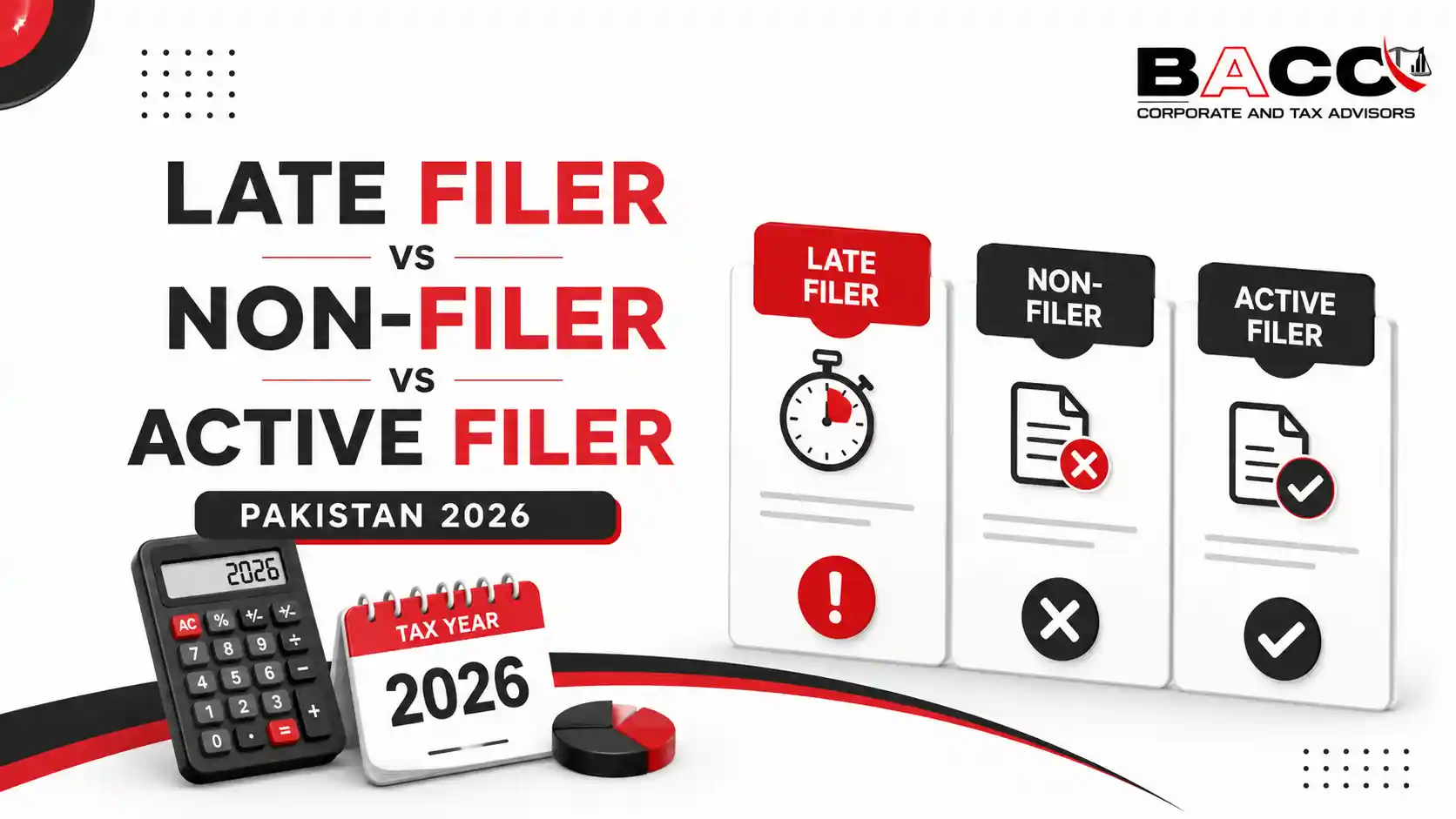
Quick Answer
An active filer appears on FBR's Active Taxpayer List and pays the lowest withholding tax. A non-filer is absent from the ATL and pays the highest rates. A late filer was a third, middle tier created by the Finance Act 2024 for people who filed after the due date. The Finance Act 2026 withdrew those enhanced late-filer rates, removing the categorisation based on filing timelines from 1 July 2026.
Introduction
If you have ever been told at a property registry that your withholding rate is "different" from what you expected, you already know how much filer status costs in Pakistan. At BACO Consultants, our tax team fields this question almost every week — usually from someone whose transfer is days away and whose name has just gone missing from the list. The confusion is understandable. For two tax years Pakistan genuinely had three categories of taxpayer: active filer, late filer, and non-filer. Then, in June 2026, one of them was quietly removed. Most online guides, and even some registrars, are still working from the old rate tables. This guide clears it up completely — what each category means, the exact rates that applied in each period, what survived the Finance Act 2026 amendments, and what to do if you have already missed a deadline. If you want the groundwork first, start with our explainer on filer vs non-filer status in Pakistan, learn how to check your Active Taxpayer List status in under a minute, review the current FBR withholding tax rates for 2026-27, and see exactly what happens when you file your income tax return after the due date.
Here is the short version before the detail. Your status is not about how much tax you pay — it is about whether your name appears on FBR's Active Taxpayer List on the date of the transaction. Get that one fact wrong on a Rs. 50 million property deal and the difference is roughly Rs. 4.6 million. Get it right, and the cost of compliance is a two-hour job in September.
Key Takeaways
- There are now two withholding categories, not three. From Tax Year 2027 (transactions on or after 1 July 2026), the law recognises ATL and non-ATL. The separate late-filer property rate is gone.
- Late filing still costs you money — just through different sections. Penalty under Section 182, default surcharge under Section 205, and an ATL restoration surcharge under Section 182A.
- That surcharge went up sharply. It rose from Rs. 1,000 to Rs. 25,000 for individuals, Rs. 10,000 to Rs. 50,000 for AOPs, and Rs. 20,000 to Rs. 100,000 for companies.
- Property rates were simplified and cut for filers. Sellers now pay 2.75% under Section 236C and buyers 1.25% under Section 236K, replacing the old slab-based tables.
- Non-filers still pay a punishing premium. Property purchase under Section 236K is 10.5% to 18.5% for non-filers against 1.25% for filers, and bank profit is 40% against 20%.
- A newer "third category" has replaced the old one: eligible vs ineligible person under Section 114C, which blocks transactions rather than merely taxing them harder.
- The Tax Year 2026 deadline is 30 September 2026 for individuals and AOPs. Miss it and you will spend the next year paying for a two-hour job.
Why Filer Status Suddenly Matters More Than Ever
If you have been searching for a clear explanation of late filer vs non filer vs active filer, you have probably noticed that half the articles online contradict the other half — and most of them are quietly out of date. At BACO Consultants, our tax team handles this question almost daily, usually from someone who is three days away from a property transfer and has just discovered their name is missing from the list. Before you go further, it helps to know the basics of filer vs non-filer status in Pakistan, how to check your Active Taxpayer List status, what the current FBR withholding tax rates for 2026-27 look like, and what happens if you file your income tax return in Pakistan after the deadline.
Here is the short version of what changed. For two tax years, Pakistan genuinely had three categories of taxpayer. Then, in June 2026, one of them was quietly deleted. Understanding which rules applied when — and which apply to your transaction today — is the difference between paying 1.25% and paying 18.5% on the same plot of land.
This guide explains all three categories, the exact rates that applied in each period, what survived the 2026 amendments, and precisely what to do if you have already missed a deadline.
What Does "Filer Status" Actually Mean in Pakistani Tax Law?
Direct answer: "Filer" is not a formal defined term for a class of taxpayer paying more or less tax on income. It is shorthand for whether your name appears on FBR's Active Taxpayer List on the date of a transaction. Your ATL presence determines the withholding tax rate a bank, registrar, or withholding agent must apply to you.
This is the single most misunderstood point in Pakistani taxation. People assume "filer" means "someone who pays tax." It does not. It means "someone whose name is on a published list because a return was filed and processed."
Three consequences follow from that:
- A person with zero taxable income can be an active filer by submitting a nil tax return.
- A person who paid crores in withholding tax but never filed a return is a non-filer.
- Your status is tested on the date of the transaction, not on the date you eventually got around to filing.
That last point causes more financial damage than any other misunderstanding in this area.
What Is an Active Filer in Pakistan?
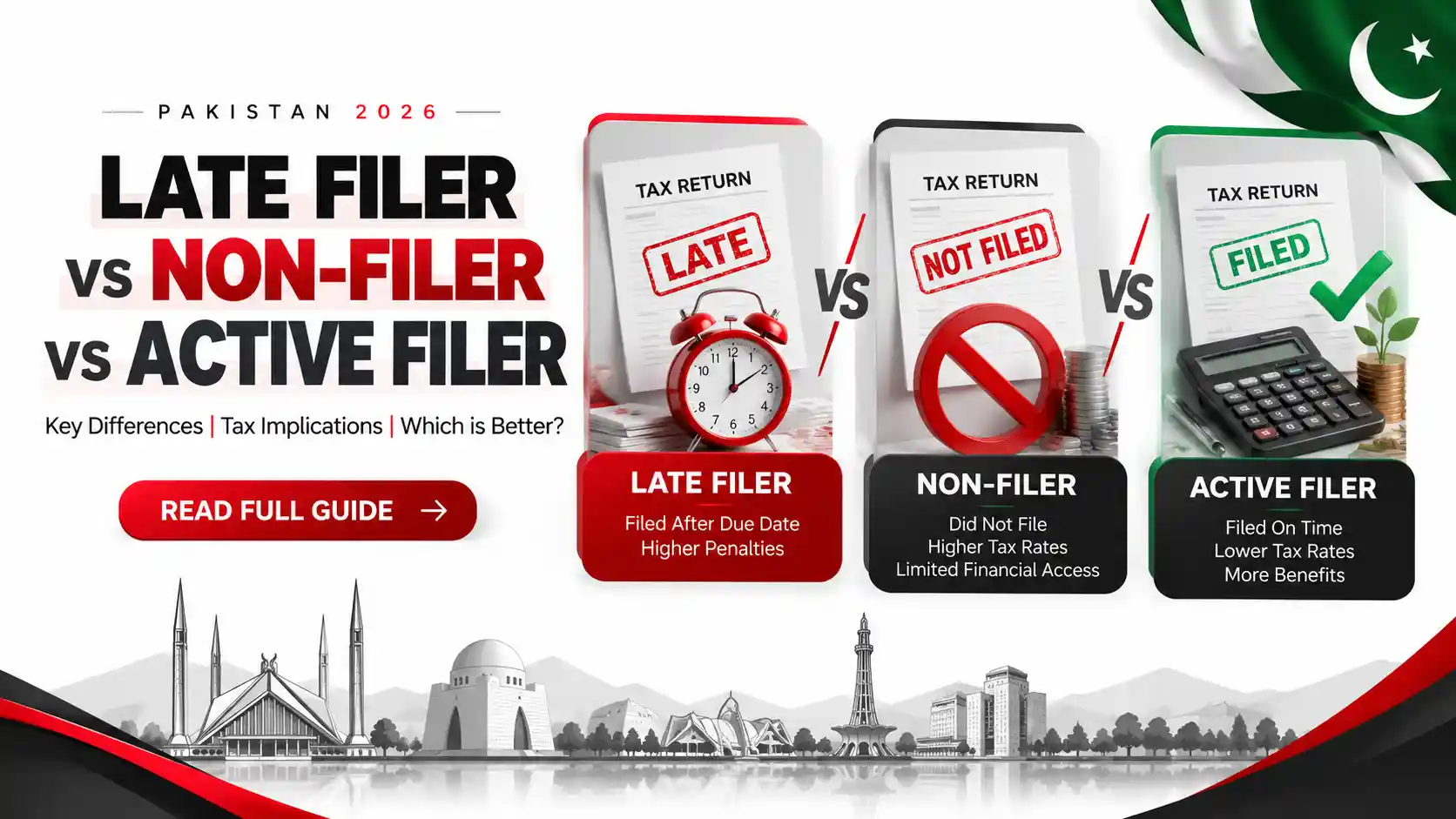
Direct answer: An active filer is a person or entity whose name appears on the FBR Active Taxpayer List because the income tax return for the relevant tax year was filed and the applicable tax paid. Active filers pay the lowest withholding tax rates on property, banking, vehicles, dividends, and dozens of other transactions, and can adjust most of that tax against their annual liability.
Characteristics of an Active Filer
- Return filed for the relevant tax year through the FBR IRIS portal
- Wealth statement filed where required (individuals)
- Name visible in the ATL search on the date of the transaction
- Eligible for reduced withholding rates under the relevant Divisions of the First Schedule
- Not excluded from the ATL on other grounds
The Practical Benefits
The advantages are not abstract. On property purchase, a filer pays 1.25% while a non-filer pays 10.5% to 18.5%. On bank profit, a filer pays 20% against 40%. Some charges apply only to non-filers at all, such as the 0.8% cash withdrawal tax and 15% on phone bills.
On a single Rs. 50 million property purchase, that difference is roughly Rs. 4.6 million. For a fuller list, see our guide to the benefits of becoming a tax filer in Pakistan.
What Is a Non-Filer in Pakistan?
Direct answer: A non-filer is any person not appearing on the Active Taxpayer List on the date of a transaction, whether because they never registered, never filed, or filed but were not included. Non-filers face the Tenth Schedule penalty regime, which generally increases withholding tax by 100%, with far steeper fixed rates on property and vehicles.
How the Tenth Schedule Works
The Tenth Schedule imposes a 100% additional withholding tax on persons not appearing on the ATL, so non-filers pay double the standard rate on almost every transaction. Property is treated separately and far more harshly, with its own fixed table rather than a simple doubling.
Two Types of Non-Filer
It is worth separating them, because the fix is different:
- The unregistered non-filer — no NTN at all. This person needs NTN registration before anything else.
- The registered non-filer — has an NTN, was on the list once, but stopped filing. This person only needs to file and, if late, pay the surcharge.
In our practice, the second group is far larger — and far more expensive, because they usually own the assets that trigger high-value withholding.
What Was a Late Filer? The Third Category Explained
Direct answer: A late filer was a person who appeared on the Active Taxpayer List but had filed the income tax return after the due date or extended due date. Introduced by the Finance Act 2024 with effect from 1 July 2024, this middle tier paid more advance tax on property than an on-time filer but considerably less than a non-filer.
Why the Category Was Created
Before 2024, the incentive structure had a loophole. A taxpayer could ignore the September deadline entirely, wait until a property deal appeared, file the return that week, get onto the ATL, and pay full filer rates on the transaction. The deadline had no teeth for anyone whose main tax exposure was withholding rather than assessed income.
The Finance Act 2024 closed that loophole by creating a third rate column. Filing late still got you onto the list, but at a price. A new third category, the late filer introduced through the Finance Act 2024-25, added another layer that many buyers were still unaware of.
How Late Filer Status Was Determined
Broadly, the test looked at whether the return for the relevant tax year had been filed by the due date or extended due date, with reference to recent filing history. A person who had consistently filed on time and then filed one return late was treated differently from a person with a pattern of late filing. Because the drafting was technical and shifted between Finance Acts, we always recommend having the specific tax years checked before relying on a rate — particularly for transactions executed between July 2024 and June 2026.
Where It Applied
Critically, the late filer tier was not a general status across the tax code. It appeared principally in the advance tax provisions for immovable property — Section 236C for sellers and Section 236K for buyers. It did not create a separate middle rate for bank profit, salary, imports, or most contract payments. Many articles published in 2025 blurred this line and produced "late filer rate" tables for transactions that never had one.
The 2026 Change Nobody Told You About
Direct answer: The Finance Act 2026, which received presidential assent on 25 June 2026 and took effect from 1 July 2026, abolished the late filer tier. Property advance tax was converted to flat rates for ATL persons, and the enhanced rates for people who filed after the due date were removed entirely, ending the three-way categorisation based on filing timelines.
The Finance Act 2026 replaced the slab-based regime with a uniform withholding structure: sellers pay advance tax at 2.75% of consideration received, buyers at 1.25% of fair market value. It also withdrew the enhanced withholding rates applicable to ATL filers who file returns after the due date, thereby removing the existing categorisation based on filing timelines. This year has no late-filer tier — it only existed for 2024-25 and 2025-26.
So Why Does the Third Category Still Matter?
Three reasons, and they are the reason this article exists:
- Historic transactions. Any property transfer executed between 1 July 2024 and 30 June 2026 was taxed under the three-tier regime. If you are reconciling advance tax, claiming an adjustment, or responding to a notice for those years, the late filer rate is still live law for that period.
- The cost simply moved. Parliament did not forgive late filing. It shifted the penalty from the property rate table to Section 182A, and raised it twenty-five fold for individuals.
- Timing risk got worse, not better. Under the old regime, a late filer at least landed in a middle tier. Now there is no middle tier: if you are not on the list on the transaction date, you pay the full non-filer rate.
That last point is the expert observation most commentary misses. Removing the middle tier is not automatically taxpayer-friendly. For a late filer transacting before ATL restoration, the cliff is steeper than it was in 2025.
Active Filer vs Late Filer vs Non-Filer: Full Comparison Table
| Feature | Active Filer | Late Filer (historic tier) | Non-Filer |
|---|---|---|---|
| On the ATL? | Yes | Yes, after surcharge/processing | No |
| Return filed? | Yes, by due date | Yes, after due date | No |
| Status in force | Always | 1 July 2024 – 30 June 2026 only | Always |
| 236K property purchase (TY 2027) | 1.25% flat | Category abolished | 10.5% – 18.5% |
| 236C property sale (TY 2027) | 2.75% flat | Category abolished | 11.5% |
| Bank profit | 20% | No separate rate | 40% |
| Tenth Schedule 100% loading | No | No (once on ATL) | Yes |
| Section 182 penalty | No | Yes | Yes, plus 114A exposure |
| Section 182A ATL surcharge | No | Yes | Yes, on restoration |
| Section 114C restrictions | No, if resources declared | Depends on eligibility | Likely applies |
| Refund and adjustment rights | Full | Full | Effectively none |
| Audit and notice risk | Lowest | Elevated | Highest |
Property Transactions: 236C and 236K Before and After
This is where the three categories were genuinely visible, so it deserves the detail.
Advance Tax on Sale of Property (Section 236C) — Position up to 30 June 2026
| Gross consideration | Active filer | Late filer | Non-filer |
|---|---|---|---|
| Up to Rs. 50 million | 4.5% | 7.5% | 11.5% |
| Rs. 50m – Rs. 100 million | 5% | 8.5% | 11.5% |
| Above Rs. 100 million | 5.5% | 9.5% | 11.5% |
Advance Tax on Purchase of Property (Section 236K) — Position up to 30 June 2026
| Fair market value | Active filer | Late filer | Non-filer |
|---|---|---|---|
| Up to Rs. 50 million | 1.5% | 4.5% | 10.5% |
| Rs. 50m – Rs. 100 million | 2% | 5.5% | 14.5% |
| Above Rs. 100 million | 2.5% | 6.5% | 18.5% |
These slab-based tables, showing separate columns for persons appearing in the ATL, persons appearing in the ATL who filed returns after the due date, and persons not appearing in the ATL, were the rates in force before the Finance Act 2026 amendments.
Position from 1 July 2026 (Tax Year 2027)
| Section | ATL person | Late filer | Non-ATL person |
|---|---|---|---|
| 236C (seller) | 2.75% flat | Abolished | 11.5% |
| 236K (buyer) | 1.25% flat | Abolished | 10.5% / 14.5% / 18.5% by value |
Under Section 236K the buyer pays a flat 1.25% if a filer, while non-filers pay 10.5% up to Rs 50 million, 14.5% between Rs 50 and 100 million, and 18.5% above Rs 100 million.
Both taxes are advance, adjustable taxes — not final costs — provided you file a return and claim them. Non-filers, by definition, rarely do. Our detailed breakdown is in property tax in Pakistan 2026-27: 236C and 236K rates, and you can model your own figure with the withholding tax calculator.
Withholding Tax Gap Across Everyday Transactions
The property gap gets the headlines, but the everyday leakage is what quietly drains an ordinary taxpayer's year.
| Transaction | Active filer | Non-filer |
|---|---|---|
| Property purchase (236K) | 1.25% | 10.5% – 18.5% |
| Property sale (236C) | 2.75% | 11.5% |
| Profit on bank deposits | 20% | 40% |
| Cash withdrawal above threshold | Nil | 0.8% |
| Mobile and internet bills | Standard | Additional 15% |
| Vehicle registration | Standard | Roughly triple |
| Dividends | Standard | Doubled |
| Contracts and services | Standard | Doubled |
Several charges — cash withdrawal, phone bills, and electricity over Rs. 25,000 — apply only to non-filers.
Expert observation: for a salaried person with a modest savings account, a car, and a phone connection, non-filer status typically costs between Rs. 60,000 and Rs. 250,000 a year in unrecoverable withholding. Filing costs a fraction of that, which is why the arithmetic almost never favours staying out of the system.
Three Worked Examples in Real Rupees
Example 1: The Property Seller Who Filed Two Weeks Late (TY 2026 transaction)
Adnan sold a commercial plot for Rs. 80 million in January 2026. He had filed his Tax Year 2025 return on 20 October 2025 — three weeks after the deadline.
- Active filer rate: 5% → Rs. 4,000,000
- Late filer rate: 8.5% → Rs. 6,800,000
- Non-filer rate: 11.5% → Rs. 9,200,000
Cost of filing three weeks late: Rs. 2.8 million. He was on the ATL. He was still not a filer for rate purposes.
Example 2: The Same Seller in 2027
If Adnan sells an identical plot in January 2027:
- On the ATL: 2.75% → Rs. 2,200,000
- Not on the ATL: 11.5% → Rs. 9,200,000
The middle ground has vanished. He either has the status or he does not — a Rs. 7 million swing on one binary fact.
Example 3: The Salaried Buyer Who Missed the Deadline Entirely
Sana, a salaried professional, wants to buy a Rs. 30 million apartment in November 2026 but never filed for Tax Year 2026.
- As a non-filer: 10.5% of Rs. 30m = Rs. 3,150,000
- If she files and is restored to the ATL first: 1.25% = Rs. 375,000
- Cost of restoration: Section 182 penalty (minimum thresholds apply) + Section 182A surcharge of Rs. 25,000
Spending roughly Rs. 40,000 to save Rs. 2.77 million is not a close decision. Yet we see this transaction executed the wrong way round several times every quarter, usually because the buyer did not want to "delay the deal."
What "Late Filer" Means Today — The Costs That Survived
The rate column is gone. These are not.
a) Penalty under Section 182
Late filing attracts a penalty of the higher of 0.1% of tax payable per day of default or Rs. 1,000 per day, subject to minimum penalties. Filing late does not erase the penalty — it stops it growing. See our guide on how to avoid late tax filing penalties with FBR and estimate your exposure with the late filing penalty calculator.
b) Default Surcharge under Section 205
Charged on tax paid late, calculated for the period of default. It is compensation for delayed payment, and it runs independently of the penalty.
c) ATL Restoration Surcharge under Section 182A
Covered in the next section. This is the direct successor to the late filer tier.
d) Delay in ATL Appearance
You do not appear the moment you press submit. There is a processing and update cycle, and the surcharge must be paid before inclusion. If your transaction lands inside that window, you pay non-filer rates.
e) Section 114C Ineligibility
Non-filing does not just make transactions expensive now — it can make them impossible. Detail in section 13.
f) Elevated Audit and Notice Risk
Late and irregular filers are visibly flagged in FBR's risk profiling. If a notice arrives, our guides on common reasons for FBR notices and how to handle tax notices from FBR explain the correct sequence of response.
Section 182A: The ATL Restoration Surcharge
Direct answer: Section 182A requires a person who files after the due date to pay a surcharge before being included on the Active Taxpayer List. The Finance Act 2026 increased this surcharge substantially, and it is now the primary financial penalty for late filing since the late filer rate tier was abolished.
| Person | Surcharge before 1 July 2026 | Surcharge from 1 July 2026 |
|---|---|---|
| Individual | Rs. 1,000 | Rs. 25,000 |
| Association of Persons | Rs. 10,000 | Rs. 50,000 |
| Company | Rs. 20,000 | Rs. 100,000 |
The surcharge does not apply to an individual who submits an undertaking to the Commissioner stating that they will not buy, acquire or obtain ownership or any beneficial interest in property for six months from the date of the undertaking, in the prescribed form.
Expert tip on the undertaking: this is a genuinely useful relief for a late-filing salaried person with no property plans, and it is being widely overlooked. But read the six-month bar carefully. It covers acquiring ownership or beneficial interest. If there is any chance of a family property arrangement, an inherited share formalising, or a plot file transferring into your name within that window, pay the Rs. 25,000 instead. We have seen the undertaking route create complications that cost far more than the surcharge saved.
If you are already off the list, our walkthrough on how to remove ATL inactive status in Pakistan sets out the sequence.
Eligible vs Ineligible Person: The Real Third Category Now
Direct answer: Section 114C, inserted by the Finance Act 2025, created a classification of "eligible" and "ineligible" persons. An ineligible person is barred outright from certain high-value transactions — vehicles, property, securities and some banking activity — above thresholds in the Fifteenth Schedule. This is a restriction regime, not a rate regime.
Section 114C empowers restrictions on major economic transactions — vehicle bookings, property registrations and securities investments above notified thresholds — by "ineligible persons," subject to FBR notifications.
Who Counts as Eligible?
An eligible person is one who has filed a return of income tax for the tax year immediately preceding the year of transaction and has sufficient resources in the wealth statement in the case of an individual, or financial statement in the case of a company or association of persons. Eligible persons include immediate family members — parents, spouse, and son below the age of 25 and unmarried, or widowed or divorced daughter, or a differently abled child.
The Notified Thresholds
Motor vehicle purchase or registration is restricted for vehicles exceeding Rs. 7 million in value, with exemptions for non-resident persons and public companies. For immovable property, restrictions apply to commercial properties exceeding Rs. 100 million and residential properties exceeding Rs. 50 million in fair market value. On bank accounts, the restriction applies to opening or maintaining accounts other than savings accounts, and the annual cash withdrawal threshold has been fixed at Rs. 100 million or more across all accounts held by an individual.
Why This Is the Category That Actually Matters in 2026
Two structural points our tax team keeps making to clients:
- Filing alone is no longer enough. Eligibility requires sufficient declared resources, not just a submitted return. A person who files a thin return with no wealth reconciliation may be on the ATL and still be ineligible for a large purchase.
- The consequence changed from price to permission. A non-filer could always buy a house by paying 18.5%. An ineligible person may be blocked at the registrar's desk. That is a different kind of problem, and money does not solve it on the day.
This is why we describe the eligible/ineligible split as the genuine successor to the late filer tier — it is the new third dimension of Pakistani filer status.
How the Active Taxpayer List Actually Works
Direct answer: The ATL is FBR's published register of taxpayers who have filed returns for the relevant tax year. It is the operative reference for every withholding agent in the country. Your rate depends on whether you appear on it on the transaction date, not on whether you have filed.
Key Mechanics
- Publication. The ATL is published annually and refreshed on a regular cycle. FBR amended the Income Tax Rules 2002 through SRO 1638(I)/2024, introducing changes to both the timing of the ATL's publication and the frequency of updates; prior to that, the new list was published on 1 March each year based on returns filed up to the end of February. Under the revised schedule, the list for Tax Year 2026 is to be published shortly after the filing deadline, with publication postponed accordingly if FBR grants an extension.
- Regular updates. The list is updated on a rolling basis so that taxpayers who file later can be added once requirements, including the Section 182A surcharge, are met.
- The transaction-date rule. A withholding agent checks the list at the time of the transaction. Filing yesterday does not help if you are not visible today.
- Additional exclusions. ATL inclusion criteria have been tightened over time; simply having filed does not guarantee appearance in every case.
How to Check Your Status
You can verify your name through FBR's official Active Taxpayer List service, by SMS, or via the IRIS portal. Step-by-step instructions are in our guide on how to check the Active Taxpayer List (ATL) in Pakistan and our reference page on the Active Taxpayer List for 2026.
Practical rule we give every client: take a dated screenshot of your ATL entry on the morning of any large transaction. Registrars and banks do make errors, and a timestamped record is the fastest way to fix a wrongly applied rate.
How to Become an Active Filer: Step-by-Step
Direct answer: Register for an NTN on IRIS using your CNIC, file the income tax return for the relevant tax year with a wealth statement, pay any tax due through a PSID, and confirm your name on the ATL. For a salaried person with clean records, the process takes under an hour and appears on the list within the next update cycle.
Step 1 — Register on IRIS. Create your account using your CNIC and a registered mobile number and email. If you are stuck at this stage, see FBR IRIS login problems and solutions or how to recover a forgotten IRIS password.
Step 2 — Obtain your NTN. For individuals this is generally your CNIC number once registration completes. Businesses and companies follow the process in our NTN registration guide, and the documents required for NTN registration are listed separately.
Step 3 — Assemble your records. Salary certificate, bank statements, withholding tax certificates, property and vehicle details, and details of any foreign income or assets.
Step 4 — Select the correct tax year and return form. Tax Year 2026 covers income from 1 July 2025 to 30 June 2026.
Step 5 — Complete the return and wealth statement. For individuals, the wealth statement and its reconciliation matter more than the income section. This is where most future notices are created.
Step 6 — Compute and pay. Generate a PSID and pay through a bank, ATM, or mobile wallet. Our guide on how to pay income tax online in Pakistan covers each channel.
Step 7 — Submit and save the acknowledgement. Download the signed PDF.
Step 8 — Verify ATL appearance. Check after the next update cycle, not the same afternoon.
If you would rather hand the whole thing over, our filing services cover salaried individuals, sole proprietors, and partnerships and companies.
How to Fix Inactive or Late Status
Direct answer: File the outstanding return, pay any tax and default surcharge, then pay the Section 182A surcharge — Rs. 25,000 for individuals, Rs. 50,000 for AOPs, Rs. 100,000 for companies — or, for an individual with no property plans, submit the prescribed six-month undertaking. ATL restoration follows in the next update cycle.
The Correct Sequence
- Identify every tax year missing, not just the latest one.
- Build a multi-year wealth reconciliation before filing anything. Filing several back years in one sitting without reconciling assets is the fastest route to a Section 122 proceeding.
- File the returns.
- Pay tax, default surcharge, and penalty.
- Pay the Section 182A surcharge or file the undertaking.
- Confirm ATL inclusion before executing any high-value transaction.
If you discover an error after filing, do not simply file again — the difference between the two remedies is set out in revised return vs rectification application and how to correct mistakes in an FBR income tax return.
Who Is Required to File in Pakistan?
You must file a return for Tax Year 2026 if, broadly, any of the following applies:
- Your taxable income exceeded the threshold for the year
- You own immovable property above the notified area or value criteria
- You own a motor vehicle above the specified engine capacity
- You hold an NTN or were required to file in a preceding year
- You hold foreign assets or earned foreign income
- You are a registered commercial or industrial electricity consumer
- You had tax withheld that you want to adjust or claim back
- You simply want to appear on the ATL
The deadline for Tax Year 2026 is 30 September 2026 for salaried individuals, non-salaried individuals and AOPs, while companies with a 30 June year-end must file by 31 December 2026.
Sector-specific guidance is available for freelancers, YouTubers and content creators, doctors, lawyers, engineers, and small businesses.
Overseas Pakistanis, POC and NICOP Holders
Direct answer: Overseas Pakistanis holding a POC or NICOP can access filer rates on property transactions under Sections 236C and 236K even without appearing on the ATL, by following FBR's prescribed verification procedure at the time the payment slip is generated.
Overseas Pakistanis holding a POC or NICOP can avail the filer rate under Sections 236C and 236K through a defined procedure: the registering or transferring authority clicks the "Overseas Pakistanis" link on FBR's web portal to create a PSID, and the system fetches the person's details after the POC or NICOP number is declared. Full procedural detail is available in FBR's overseas Pakistanis FAQs.
Two cautions from experience. First, the relief runs through the correct portal route — if the registrar generates an ordinary PSID, you will be charged non-filer rates and recovering it is slow. Second, the concession does not remove the wider benefits of filing. Our guides on income tax returns for overseas Pakistanis and tax rules for overseas Pakistanis explain when non-resident status is worth formalising, as does our note on becoming a non-resident taxpayer.
Common Mistakes That Push People Into the Wrong Category
- Assuming the late filer rate still exists. It was withdrawn for transactions from 1 July 2026. Using a 2025 rate table on a 2026 deal will misprice your transaction badly.
- Filing on the day of the transaction. Submission is not inclusion. There is a processing cycle and, for late filers, a surcharge to pay first.
- Not checking ATL status before paying a token. Verify before money moves, not after.
- Skipping a nil return. Income below the threshold does not excuse you if you are registered. A nil return preserves the status.
- Filing income but ignoring the wealth statement. This is the single largest source of later notices, and it also affects Section 114C eligibility.
- Dumping five back years into IRIS in one evening. Unreconciled backlog filing creates the discrepancies that assessments are built on.
- Treating 236C and 236K as final costs. Both are adjustable for filers. Non-filers effectively forfeit them.
- Believing the buyer's status protects the seller. Section 236C tests the seller; Section 236K tests the buyer. Both are checked independently.
- Using the six-month undertaking without checking family property plans.
- Not confirming which tax year's return drives your current status. Status today generally rests on the previous year's return, not the one you are about to file.
Expert Tips and Best Practices
- Treat 30 September as a hard wall. Extensions have been granted in some years, but they are discretionary and never worth planning around.
- File in August, not late September. IRIS load, bank payment channels and last-minute discoveries all get worse in the final week.
- Run a status check before every material transaction — property, vehicle, large investment, significant banking activity.
- Keep the wealth statement genuinely reconciled every year. It is now doing double duty: return accuracy and Section 114C eligibility.
- If you have missed the deadline, do the arithmetic before deciding. Rs. 25,000 surcharge against a seven-figure withholding differential is not a difficult decision.
- For businesses, calendarise all compliance, not just the annual return. Our monthly tax compliance checklist and guide to tax compliance in Pakistan 2026 cover the full cycle.
- Model your numbers first. Use the salary tax calculator or business and AOP calculator before you file.
Decision Matrix: What Should You Do Right Now?
| Your situation | What you are | Immediate action |
|---|---|---|
| Filed TY 2025 on time, TY 2026 not yet due | Active filer | File TY 2026 before 30 September 2026 |
| Filed TY 2025 late, surcharge paid | On ATL | File TY 2026 on time; no middle tier now exists |
| Filed TY 2025 late, surcharge unpaid | Effectively non-filer | Pay Section 182A surcharge or file undertaking |
| Registered, never filed | Non-filer | File all outstanding years with reconciliation |
| No NTN at all | Non-filer | Register on IRIS, then file |
| Planning a property deal this month | Depends on ATL | Verify status before token payment |
| Buying above Rs. 50m residential / Rs. 100m commercial | Section 114C applies | Confirm eligibility and declared resources first |
| Overseas with POC/NICOP | Special route | Use the FBR overseas PSID procedure |
Latest Updates and Where Policy Is Heading
What changed with effect from 1 July 2026:
- Late filer property rates withdrawn; ATL/non-ATL binary restored
- 236C flat 2.75% and 236K flat 1.25% for ATL persons
- ATL surcharge under Section 182A raised to Rs. 25,000 / 50,000 / 100,000
- Section 7E, the deemed income provision on immovable property, deleted following the Federal Constitutional Court judgment declaring it ultra vires
- CVT on foreign assets of resident individuals abolished
- Advance tax on foreign card remittances under Section 236Y reduced from 5% to 0.5%
- The 9% surcharge under Section 4AB on salaried individuals withdrawn, with revised slabs pushing the 35% top rate to income above Rs. 7 million
The full picture is in our summary of the top 10 tax changes in Budget 2026-27 and the income tax slabs for salaried individuals 2026-27.
The direction of travel. Pakistan is moving away from pricing non-compliance and towards restricting it. The late filer tier was a pricing tool; Section 114C is a gating tool. Our expectation, based on the trajectory from Finance Act 2024 through Finance Act 2026, is that rate differentials will continue to simplify while eligibility gating and third-party data matching tighten. Practically, this means the value of being an active, well-documented filer will keep rising — and the option of simply paying a higher rate to stay outside the system will keep narrowing.
Why Choose BACO Consultants for Filer, Late Filer and ATL Status Matters in Pakistan
Filer status looks like a small administrative question until it costs you millions on a single transaction — and by then it is usually too late to fix. At BACO Consultants, our team of chartered accountants, tax practitioners and legal advisors handles ATL restoration, late filing regularisation, back-year reconciliation, and pre-transaction status planning every working week, for clients ranging from salaried professionals and freelancers to real estate investors, SMEs, private limited companies and overseas Pakistanis. What sets our work apart is sequencing: we do not simply file a return and hope the list updates. We verify which tax year actually drives your current status, reconcile your wealth statement properly so that Section 114C eligibility is not compromised, calculate your Section 182 penalty and Section 182A surcharge exposure before you commit, advise whether the six-month property undertaking is genuinely safe in your circumstances, and confirm ATL inclusion in writing before you sign a sale deed or transfer a vehicle. We also stay current with each Finance Act rather than working from last year's rate card — a distinction that matters enormously in a year when an entire taxpayer category was abolished mid-stream. Whether you need a straightforward annual income tax filing, help restoring an inactive status before a property closing, or ongoing corporate tax and compliance advisory, you get partner-level attention, transparent pricing, and advice you can actually act on. Explore our full range of professional services or speak to a tax consultant in Islamabad about your specific position.
Frequently Asked Questions
1. Is the late filer category still applicable in Pakistan in 2026?
No. The Finance Act 2026 withdrew the enhanced withholding rates for people who filed after the due date, effective 1 July 2026. For transactions in Tax Year 2027 there are only two categories: on the ATL, or not on it. The late filer tier still governs transactions executed between July 2024 and June 2026.
2. What is the difference between a late filer and a non-filer?
A late filer filed the return after the due date but still appeared on the Active Taxpayer List. A non-filer never filed and never appeared. Historically the late filer paid a middle property rate; today the practical difference is that the late filer pays a Section 182 penalty and Section 182A surcharge but then accesses full filer rates.
3. How much is the ATL surcharge in 2026?
Rs. 25,000 for an individual, Rs. 50,000 for an AOP and Rs. 100,000 for a company, up from Rs. 1,000, Rs. 10,000 and Rs. 20,000 respectively. An individual can avoid it by undertaking not to acquire property for six months.
4. What is the property tax rate for filers in 2026-27?
A flat 2.75% for sellers under Section 236C and a flat 1.25% for buyers under Section 236K, replacing the previous value-based slabs.
5. How long does it take to appear on the ATL after filing?
Inclusion follows FBR's update cycle rather than being instant. For late filers, the Section 182A surcharge must be paid first. Never schedule a high-value transaction on the assumption that submission equals inclusion.
6. Can I become an active filer if I have no taxable income?
Yes. File a nil return. It costs almost nothing and preserves reduced withholding rates on banking, property and vehicle transactions.
7. Does being on the ATL make me an "eligible person" under Section 114C?
Not automatically. Eligibility also requires sufficient declared resources in your wealth statement or financial statements. A filed return with a weak wealth reconciliation can still leave you ineligible for a large purchase.
8. What is the last date to file the income tax return for Tax Year 2026?
30 September 2026 for salaried individuals, other individuals and AOPs. Companies with a 30 June year-end have until 31 December 2026.
9. Do overseas Pakistanis need to be on the ATL to get filer property rates?
Not necessarily. POC and NICOP holders can access filer rates under Sections 236C and 236K through FBR's dedicated overseas verification procedure at the PSID stage.
10. Is advance tax on property refundable?
It is adjustable, not refundable in the ordinary sense. Filers credit it against their annual liability and claim any excess through the return. Non-filers who never file effectively surrender it permanently.
11. Will filing late remove the penalty already accrued?
No. Filing stops the penalty from growing; it does not erase what has accrued. Filing earlier always costs less.
12. Can FBR restrict my bank account for not filing?
Section 114C permits restrictions on opening or maintaining certain accounts and on cash withdrawals above notified thresholds for ineligible persons, with savings and Asaan accounts carved out.
Conclusion
Pakistan's filer regime has moved through three distinct phases in as many years. Before July 2024, there were two categories and a loophole. From July 2024 to June 2026, there were three, with late filers paying a middle rate on property. From July 2026, there are two again — but the penalty for late filing did not disappear, it simply moved to Section 182A and grew twenty-five fold for individuals, while Section 114C introduced a far more serious classification that can block transactions outright rather than merely taxing them.
The practical recommendation is unchanged and simple: file on time, keep your wealth statement reconciled, and verify your ATL status before any transaction that matters. The gap between an active filer and a non-filer on a single property deal now runs into millions of rupees, and there is no longer a middle tier to soften the landing.
If you are unsure which category you fall into, have missed a deadline, or need your status restored before a transaction closes, do not guess. Visit BACO Consultants to review our tax filing and advisory services, or Book a Seat at Baco Consultants and let our team confirm your position, calculate your exact exposure, and get you onto the Active Taxpayer List before it costs you.
Related Articles


Leave a Comment
No approved comments yet. Be the first to share your thoughts!