

Pakistan's Finance Minister Muhammad Aurangzeb presented the Federal Budget 2026-27 before the National Assembly on June 12, 2026. With a total outlay of Rs18.77 trillion and an ambitious FBR tax collection target of Rs15.264 trillion, this budget carries major implications for salaried employees, business owners, freelancers, property buyers, and small retailers across the country.
Whether you earn a monthly salary, run a small shop in Lahore, or manage exports from Karachi, the tax changes in this budget will directly affect your take-home income, compliance obligations, and financial planning. Understanding these changes now puts you ahead — not scrambling at the filing deadline.
If you want professional help navigating these changes, the team at Baco Consultants offers expert tax advisory, FBR compliance, and business consultancy services across Pakistan.
Quick Answer: What Are the Main Tax Changes in Pakistan Budget 2026-27?
The Pakistan Budget 2026-27, presented on June 12, 2026, introduces income tax relief for salaried individuals across four income brackets, eliminates the salary surcharge, cuts withholding taxes on property transactions, extends IT sector tax benefits until 2029, and launches a fixed tax scheme for small retailers. The FBR revenue target has been set at Rs15.264 trillion.
Why This Budget Matters for Pakistani Taxpayers

Pakistan is currently operating under an IMF programme, which means every tax relief measure had to be negotiated carefully and offset by revenue gains elsewhere. The government has tried to balance the equation — giving relief to salaried workers and real estate buyers while broadening the tax net by pulling in small retailers, agricultural income, and non-filers.
The result is a budget that affects almost every Pakistani in a measurable way.
Let's walk through the top 10 tax changes you need to know.
1. Income Tax Relief for Salaried Individuals Across Four Brackets
This is the headline change of Budget 2026-27. Finance Minister Aurangzeb confirmed that income tax rates have been reduced across four income slabs for salaried employees.
Here is how the new structure looks:
For individuals earning between Rs2.2 million and Rs3.2 million annually, the marginal tax rate drops from 23% to 20%. The payable tax becomes Rs116,000 plus 20% on income above Rs2.2 million.
For those earning between Rs3.2 million and Rs4.1 million annually, the rate falls from 30% to 25%. The tax becomes Rs316,000 plus 25% on the excess above Rs3.2 million.
The government has also provided relief in the two higher brackets, making this one of the broadest income tax reductions for the salaried class in recent years.
For someone earning Rs250,000 a month, this translates into meaningful monthly savings — real money in an economy where inflation has squeezed purchasing power hard over the past three years.
If you want to know exactly how much your tax liability has changed, the team at Baco Consultants can calculate your revised tax position based on the new Finance Bill.
2. Expansion of Income Tax Slabs from Six to Eight Categories
Previously, salaried income was distributed across six tax brackets. Budget 2026-27 expands this to eight categories. This widening of the slab structure is designed to create smoother tax progression, avoiding situations where a modest salary increase pushed someone into a dramatically higher bracket.
This is a structural reform that benefits middle-income earners most directly — especially those in the Rs1.2 million to Rs3.2 million annual income range.
3. Abolition of Surcharge on Salaried Class
The government has announced the complete removal of the surcharge that was previously imposed on salaried individuals. This surcharge — which applied to those earning above Rs10 million annually — added an extra percentage on top of the standard income tax calculation.
Its removal is a direct response to longstanding criticism that salaried workers were paying disproportionately more than other income groups, including exporters, agriculturalists, and large retailers.
Combined with the slab reductions, abolishing the surcharge provides compounding relief for higher-income salaried employees.
4. Withholding Tax on Property Transactions Cut Significantly
Real estate has been one of the most heavily taxed sectors in recent budgets. Budget 2026-27 addresses this with meaningful cuts to withholding tax rates on property transactions.
For tax filers purchasing property, the withholding tax rate has been reduced from 2.5% to 1.25% — a 50% cut. For filers selling property, the withholding tax on the transaction has been halved from 5.5% to 2.75%.
These reductions are expected to stimulate a real estate sector that has been stagnant and under pressure from tight liquidity conditions.
This is also a strong incentive to be an active filer registered on the FBR's Active Taxpayer List (ATL). If you are not yet on the ATL, this is a good time to understand what you are missing. The complete guide to the Active Taxpayer List Pakistan 2026 explains filer benefits in full detail.
5. Abolition of Capital Value Tax on Foreign Assets
The government has abolished the capital value tax on foreign assets held by Pakistanis. Finance Minister Aurangzeb described this as part of a broader effort to rationalise the tax regime and encourage investment — particularly from the Pakistani diaspora.
This move is aimed at overseas Pakistanis who hold property, bank accounts, or other assets abroad. Previously, this tax created hesitation and compliance complexity for remittance-sending Pakistanis. Removing it is expected to encourage more formal declaration of foreign assets and increase documented investment flows into Pakistan.
6. IT Sector Tax Rate Extended at 0.25% Until 2029
Pakistan's technology sector gets a significant boost. The government has extended the preferential Final Tax Regime rate of 0.25% on IT export income for another three years, keeping it in place until 2029.
Additionally, advance income tax on export proceeds has been reduced. This directly supports freelancers, software houses, IT companies, and digital services exporters who contribute increasing volumes of foreign exchange to Pakistan's economy.
For freelancers operating from Islamabad or Lahore and receiving foreign remittances, this is one of the most important changes in the budget. You must however be a registered NTN holder and file your annual return on time to qualify. Understanding FBR registration requirements Pakistan 2026 is a critical first step if you have not yet formalised your status.
7. Fixed Tax Scheme for Small Retailers — 1% on Annual Sales Up to Rs200 Million
One of the most significant structural changes in Budget 2026-27 is the introduction of a fixed tax scheme for small shopkeepers and traders. Under this scheme, retailers with annual sales of Rs200 million or less will pay a simplified flat tax of 1% of their annual turnover.
In return, these retailers receive audit exemptions, no obligation to install POS terminals, and protection from FBR officials entering their shops for questioning — a major pain point for small traders. Compliant businesses will receive a green plaque with a QR code to display at their shops, making compliance verification simple for customers and authorities alike.
This scheme is a direct attempt to pull millions of undocumented shopkeepers into the formal economy. It is also a warning: retailers who stay outside both this scheme and the regular tax regime will face penalties.
Street cart vendors are explicitly excluded from the new framework.
8. Export Advance Tax Reduced
The government reduced advance income tax on export proceeds, directly addressing liquidity challenges faced by exporters. Previously, advance taxes deducted on export remittances were a frequent cause of cash flow problems for small and medium exporters who then had to wait for refunds.
Lowering this rate means exporters retain more working capital immediately, which supports production, employment, and export volumes. This complements the IT sector rate extension and signals a policy direction of supporting export-led economic growth.
9. Environmental Levy on Luxury Vehicles
Not all changes in Budget 2026-27 are reductions. The government introduced a new Environmental Levy on higher-capacity petrol and diesel vehicles.
A 10% levy applies to petrol and diesel vehicles with engine capacities between 2001cc and 3000cc. For vehicles exceeding 3000cc, the levy rises to 19.5%. The government expects to collect approximately Rs25.8 billion through this new levy.
Electric vehicles and hybrids face their own pricing adjustments under Federal Excise Duty, meaning the government has not offered blanket relief to the EV segment despite earlier expectations.
10. FBR Revenue Target Set at Rs15.264 Trillion — Stricter Compliance Ahead
Perhaps the most consequential fact in the entire budget is this: FBR's tax collection target for 2026-27 has been set at Rs15.264 trillion. This is 17.6% higher than the Rs12,983 billion collected in the outgoing year.
Hitting this target requires FBR to significantly expand its enforcement, documentation, and collection efforts. The practical implication for taxpayers is straightforward — non-filers, under-reporters, and undocumented businesses will face increasing scrutiny.
The filer versus non-filer gap in withholding tax rates has already widened significantly. Non-filers pay higher taxes on bank transactions, property dealings, vehicle registrations, and dividend income. With such an aggressive revenue target, FBR will have every incentive to aggressively pursue both new entrants and existing taxpayers who are not fully compliant.
If you have received a notice from FBR or are concerned about compliance, understanding what to do if you receive an FBR tax notice is essential reading before taking any action.
Common Mistakes Taxpayers Make After a New Budget
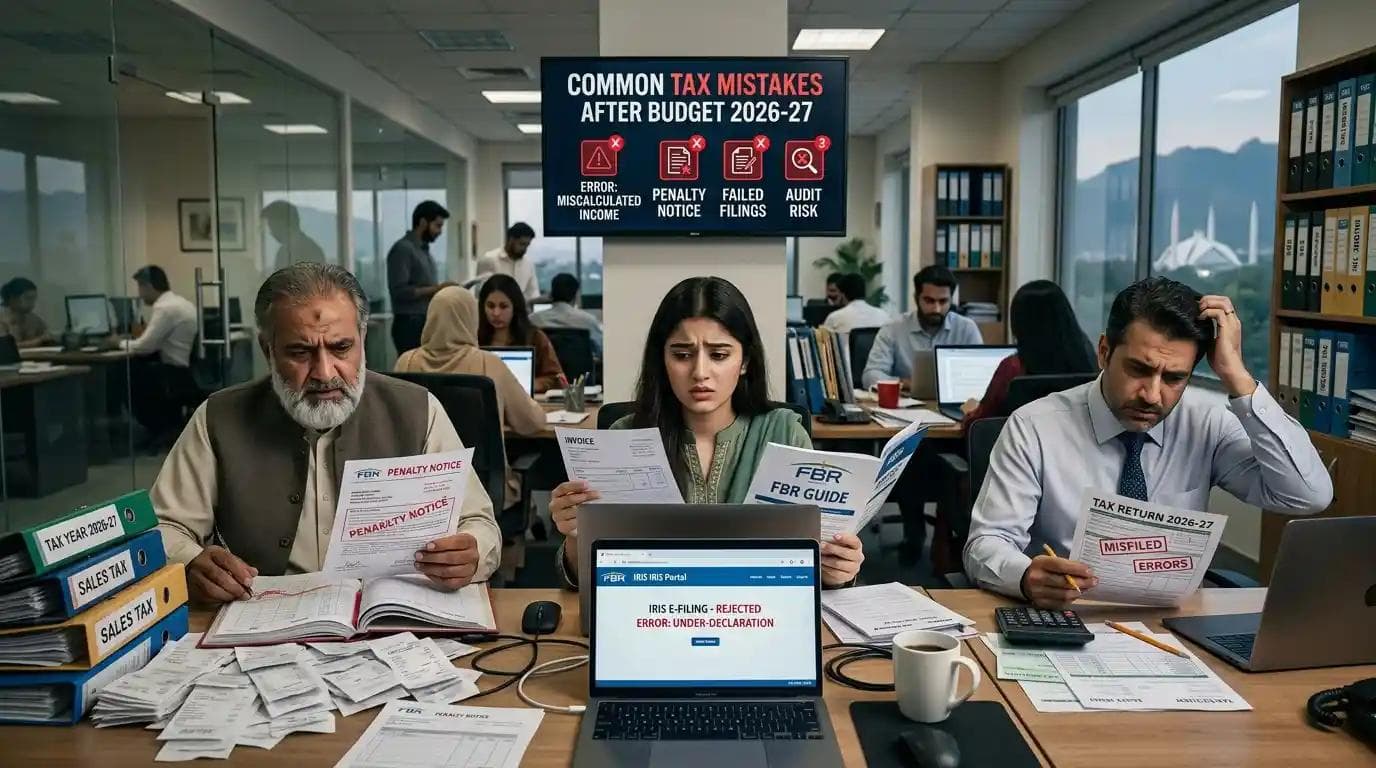
One of the most frequent errors is assuming the budget does not apply to you. Even if your income has not changed, the new slab structure or surcharge removal means your monthly withholding should change — and your employer needs to update payroll accordingly. Verify this proactively.
Another mistake is ignoring filer status. The property tax reductions in this budget only apply to active filers on the ATL. Non-filers will not benefit from the halved withholding tax rates on property transactions.
Freelancers often believe the 0.25% IT rate is automatic. It is not. You must have an NTN, maintain proper banking records for foreign remittances, and file your return on time. Missing any one of these conditions can result in a higher tax rate being applied to your income.
Small retailers sometimes assume the fixed tax scheme is optional without consequence. The government has been explicit: staying outside both the fixed scheme and the regular tax system will attract penalties.
Why Choose Baco Consultants for Tax and Business Advisory in Pakistan
Navigating a Finance Bill of this scale is not straightforward. Revised slabs, new withholding rates, export tax changes, and the fixed retailer scheme each have specific conditions and compliance requirements that change year to year.
Baco Consultants provides expert taxation, company registration, FBR and SECP compliance, and business consultancy services across Pakistan. Whether you are a salaried employee trying to recalculate your annual liability, a small business owner figuring out the new retailer scheme, a freelancer ensuring your IT tax status is protected, or a property buyer looking to benefit from the reduced withholding rates — the team at Baco Consultants brings practical expertise and current knowledge to your specific situation.
Services at Baco Consultants include income tax return filing, NTN registration, ATL status management, FBR notice response, company incorporation, SECP compliance, and strategic tax planning. You can explore the full range of services at Baco Consultants and engage a consultant directly.
If you are operating a joint venture or a franchise business in Pakistan, the tax implications under Budget 2026-27 — particularly around advance tax, withholding obligations, and corporate compliance — are worth reviewing with a qualified advisor before the new fiscal year begins.
Real-World Example: How Budget 2026-27 Affects a Salaried Professional
Consider Ahmed, a software engineer in Islamabad earning Rs350,000 per month — that is Rs4.2 million annually. Under last year's slabs, his marginal rate on income between Rs3.2 million and Rs4.1 million was 30%. Under Budget 2026-27, that drops to 25%.
On roughly Rs1 million of income in that bracket, Ahmed saves approximately Rs50,000 in annual tax. Additionally, the surcharge that previously applied to incomes above Rs10 million no longer applies to him even conceptually, and his employer's payroll system should reflect updated withholding from July 2026.
If Ahmed also decides to buy a property in fiscal year 2026-27, his withholding tax on the purchase transaction drops from 2.5% to 1.25% — on a Rs15 million property, that is a saving of Rs187,500 purely from being an active filer and benefiting from the new rate.
Frequently Asked Questions
What are the main income tax slab changes in Pakistan Budget 2026-27? The budget reduces income tax rates for salaried individuals across four brackets. Most notably, the rate on annual income between Rs2.2 million and Rs3.2 million drops from 23% to 20%, and from 30% to 25% for the Rs3.2 million to Rs4.1 million bracket. The surcharge on salaried persons has also been completely abolished.
How does Budget 2026-27 affect property buyers in Pakistan? Withholding tax on property purchases by active filers has been halved from 2.5% to 1.25%. Withholding tax on property sales for filers has been reduced from 5.5% to 2.75%. These reductions only apply to taxpayers listed on the FBR Active Taxpayer List. Non-filers continue to pay the higher prevailing rates.
What is the new fixed tax scheme for small retailers in Budget 2026-27? Retailers with annual sales up to Rs200 million can pay a simplified 1% flat tax on their turnover. This scheme offers audit exemptions, no POS requirement, and protection from FBR shop visits. Traders who join receive a green QR-coded plaque for their shops. Street cart vendors are excluded.
What is the FBR tax collection target for 2026-27? The Federal Board of Revenue has set a tax collection target of Rs15.264 trillion for fiscal year 2026-27, which is approximately 17.6% higher than the previous year. This will drive stronger enforcement against non-filers and undocumented businesses.
Are IT and freelance tax benefits maintained in Budget 2026-27? Yes. The concessional 0.25% Final Tax Regime rate on IT export income has been extended until 2029. Advance tax on export proceeds has also been reduced. However, freelancers must be registered NTN holders with proper banking records and must file their annual return on time to qualify.
What happens to non-filers under Budget 2026-27? Non-filers continue to face significantly higher withholding tax rates across property transactions, bank withdrawals, vehicle registration, and other transactions. With FBR's increased revenue target, enforcement against non-filers is expected to intensify throughout 2026-27.
Conclusion
Budget 2026-27 is a carefully constructed fiscal document. It offers genuine relief to salaried workers, real estate buyers, IT exporters, and small retailers willing to enter the formal economy. At the same time, it raises the stakes significantly for non-filers and non-compliant businesses through a more ambitious revenue target and stronger documentation requirements.
The changes are interconnected. A lower income tax slab means nothing if your employer does not update payroll correctly. Property tax relief only applies if you are an active ATL filer. The fixed retailer scheme is an opportunity — but also a signal that FBR enforcement is coming for those who ignore it.
Understanding these changes clearly and acting on them before the fiscal year is fully underway is the difference between being in control of your tax position and being reactive to it.
If you need professional assistance with taxation, income tax filing, FBR registration, company registration, or business compliance in Pakistan, Baco Consultants is here to guide you every step of the way. Book a consultation today at bacoconsultants.com.
Related Articles


Leave a Comment
No approved comments yet. Be the first to share your thoughts!