

Two business owners walk into a tax consultant's office. Both earn PKR 5 million a year. One pays almost zero additional tax at filing time. The other owes hundreds of thousands. Same income. Completely different tax treatment.
The difference? One earns income under the Final Tax Regime. The other earns income under the Normal Tax Regime.
This is not a loophole or a coincidence — it is how Pakistan's tax system is intentionally designed under the Income Tax Ordinance 2001. And understanding which regime applies to your income is one of the most important tax decisions you will make as a business owner, freelancer, or individual taxpayer in Pakistan in 2026.
This guide breaks down both regimes clearly, compares them honestly, and helps you understand which applies to your situation — and why getting it wrong costs far more than getting it right.
The Foundation: What Are Tax Regimes in Pakistan?
Pakistan's income tax system does not treat all income the same way. Depending on the source and nature of your income, it falls into one of two primary tax treatments:
Final Tax Regime (FTR) — where tax withheld at source is the complete, final discharge of tax liability on that income. No additional tax is owed. No refund is available. No adjustment against other income is permitted.
Normal Tax Regime (NTR) — where income is added to your total taxable income, tax is calculated based on applicable slabs or rates, and withholding tax already deducted is credited as an advance payment against your final computed liability.
Think of it this way: FTR is a flat, one-time settlement. NTR is a running account that gets reconciled at year-end.
Both regimes coexist within Pakistan's tax system. Many taxpayers — especially business owners and contractors — have income under both regimes simultaneously, which makes correct classification essential.
Breaking Down the Final Tax Regime (FTR)
Under FTR, the tax deducted by the withholding agent at the time of payment is legally designated as the final tax on that income. Once deducted, the transaction is closed from a tax perspective.
Income commonly falling under FTR in Pakistan:
- Export proceeds — tax deducted under Section 154 on realization of export proceeds is final for exporter companies and individuals
- Prize bond and lottery winnings — Section 156 withholding is final
- Certain contract payments — under Section 153, withholding on payments to specific taxpayer categories is treated as final
- Commission income — in specific sectors and arrangements
- Income of non-residents from certain Pakistan-source payments
Key characteristics of FTR:
- Withholding = final settlement (nothing more to pay)
- Cannot claim a refund even if total tax liability is lower
- Cannot offset FTR withholding against normal income tax
- Must still declare FTR income in annual tax return
- Wealth statement is still mandatory
- ATL status depends on filing the annual return — even if no additional liability exists
Breaking Down the Normal Tax Regime (NTR)
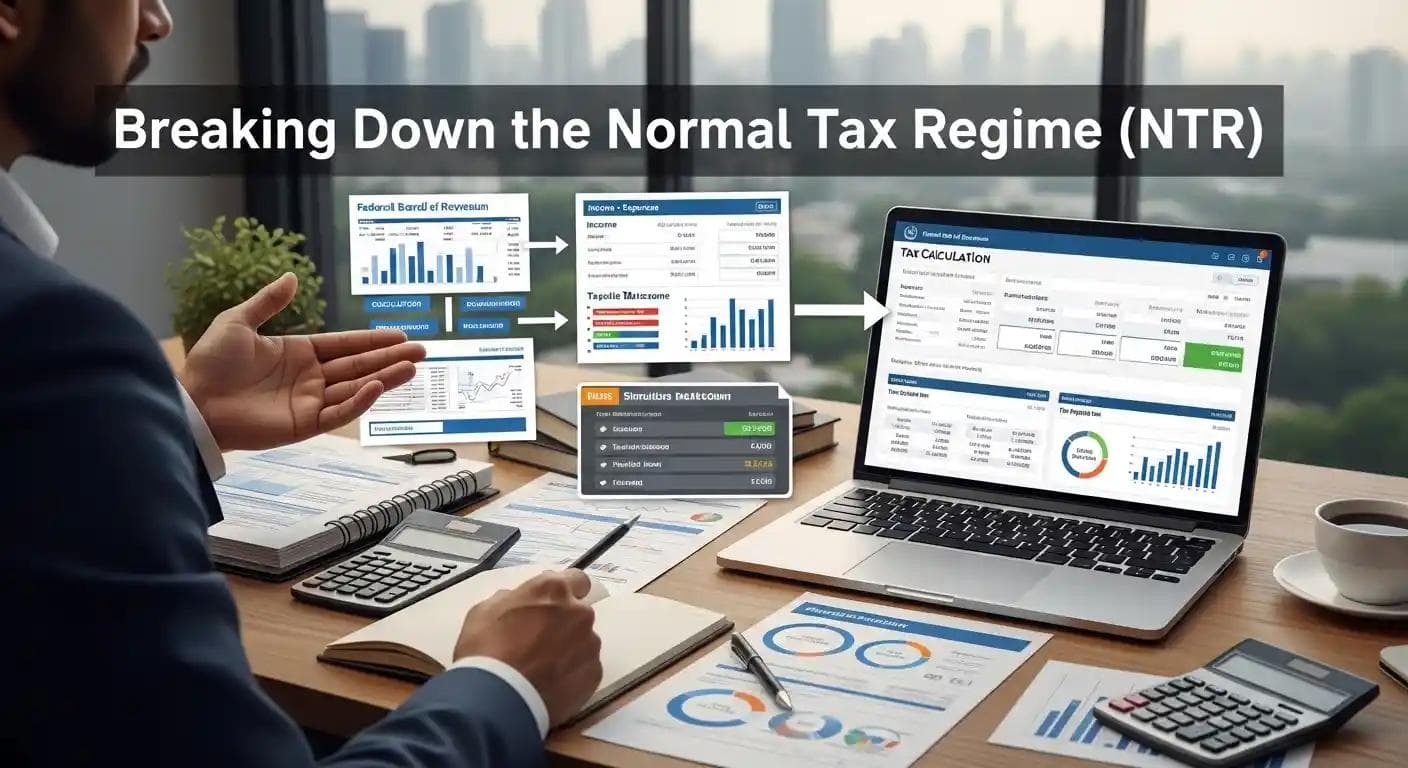
Under NTR, income is included in your total taxable income and taxed according to applicable slabs or rates under the Income Tax Ordinance 2001. Any withholding tax deducted on NTR income is treated as an advance/adjustable tax — credited against your final computed liability.
Income commonly under NTR:
- Salary income — taxed under slab rates applicable to salaried individuals
- Business income — net profit from trading, services, or manufacturing
- Rental income (where not specifically designated FTR)
- Agricultural income — subject to specific provisions
- Capital gains — on shares, property (with specific holding period rules)
- Other income — interest on loans given, consultancy (where not FTR)
Key characteristics of NTR:
- Withholding tax is adjustable — credited against total tax liability
- If withholding exceeds computed tax, you can claim a tax refund
- Tax calculated on net income after deductions and allowances
- Higher compliance complexity — requires complete income and expense records
- Subject to tax audit and scrutiny on declared income
- Tax slabs apply — income above threshold is taxed at progressively higher rates
For a complete understanding of the slab rates applicable to normal regime income, the income tax rates guide for individuals in Pakistan 2026 from Baco Consultants provides an authoritative, up-to-date breakdown.
FTR vs Normal Tax Regime: Side-by-Side Comparison
| Feature | Final Tax Regime (FTR) | Normal Tax Regime (NTR) |
|---|---|---|
| Tax treatment | Withholding = final discharge | Withholding = advance/adjustable |
| Additional tax at filing | None (if all income is FTR) | Possible — based on computed liability |
| Refund eligibility | No — FTR is non-refundable | Yes — if withholding exceeds liability |
| Income included in total income | Separately declared | Added to total taxable income |
| Tax calculation basis | Fixed percentage on gross | Slab rates on net income |
| Expense deductions | Not applicable | Allowable business expenses deductible |
| Audit exposure | Lower (fixed tax, less scrutiny) | Higher (FBR can scrutinize income/expenses) |
| Wealth statement required | Yes | Yes |
| Annual return required | Yes (for ATL status) | Yes |
| Best suited for | Exporters, prize winners, specific contractors | Salaried, business owners, rental income |
Why This Comparison Matters Deeply in Pakistan's 2026 Tax Environment
Pakistan's FBR has significantly upgraded its data matching capabilities. The IRIS portal now cross-references withholding certificates from banks, buyers, and agents against what taxpayers declare. Filing under the wrong regime — or mixing up adjustable and final income — triggers automatic discrepancies that attract notices and audits.
Beyond compliance risk, the regime choice has real financial implications:
For exporters: Pakistan's export sector benefits significantly from FTR. Export proceeds taxed at a low final rate (currently around 1% for most exports) means exporters pay a tiny fraction of what they would pay if their multi-million rupee revenues were subjected to normal slab rates. Understanding and correctly utilizing FTR is a genuine competitive advantage for export businesses.
For freelancers and IT professionals: Pakistan's technology exporters and registered freelancers can benefit from FTR on their foreign exchange earnings if channeled correctly. Incorrectly declaring IT export income under normal business income can result in significantly higher tax. For freelancers navigating this complexity, the complete income tax guide at Baco Consultants provides useful professional context.
For salaried individuals: Salary income is firmly under NTR — slab rates apply and withholding by the employer is adjustable. Understanding this means salaried employees can correctly claim investment allowances, tax credits for education, and other deductions that reduce their normal tax liability.
For mixed-income individuals: Many business owners have both FTR income (say, export proceeds) and NTR income (domestic business income). The two must be kept strictly separate in the IRIS portal. Mixing them creates incorrect liability calculations that can result in overpayment, underpayment, or FBR notices.
How Tax Is Calculated Under Each Regime: Practical Examples

Example 1: Exporter Under FTR
Asim runs an export business with annual export proceeds of PKR 20,000,000.
- FTR applicable rate: 1% on gross export proceeds
- Tax deducted at source: PKR 200,000
- Additional tax at filing: PKR 0
- Refund: Not available
- Annual return obligation: Must declare export income under FTR head and file return to maintain ATL
Under normal tax regime, PKR 20 million in income would face tax liability in the millions under progressive slab rates. FTR saves Asim a massive amount — legally.
Example 2: Salaried Individual Under NTR
Sara earns a salary of PKR 1,800,000 annually.
- Her employer deducts monthly withholding based on projected annual salary
- At year-end, she files her annual return declaring total salary
- FBR calculates tax under applicable slab rates
- Employer's withholding is credited against the computed liability
- If withholding was exactly right — zero additional payment
- If under-withheld — she pays the difference
- If over-withheld — she can claim a refund
For accurate payment of income tax online through the FBR system, the step-by-step guide to paying income tax online in Pakistan 2026 covers the payment process clearly.
Example 3: Mixed Income — Business Owner with Both Regimes
Khalid runs a trading business (NTR) and also wins PKR 500,000 from a prize bond (FTR).
- Prize bond tax: deducted at source under Section 156, declared separately as FTR income — no additional tax
- Trading business income: declared under normal tax head, tax calculated on net profit after expenses, withholding credits applied
Both incomes appear in the same annual return but in completely separate sections. The prize bond withholding does not reduce his trading income tax liability. They are parallel, separate calculations.
Step-by-Step: How to Handle Both Regimes in Your Annual Return
Step 1: Classify All Your Income Sources
Before filing, list every income source and determine whether it falls under FTR or NTR. Use withholding certificates as your primary reference — they typically indicate whether withholding is final or adjustable.
Step 2: Gather Withholding Certificates
Collect withholding certificates from every source — banks, buyers, clients. These are your authoritative documents for both FTR and NTR income declaration.
Step 3: Log In to FBR IRIS Portal
Access the IRIS portal at iris.fbr.gov.pk and navigate to the income tax return for the relevant tax year.
Step 4: Declare FTR Income Under FTR Heads
Enter each FTR income stream under its specific FTR section. The portal keeps this separate from normal income. Never enter FTR income under NTR heads.
Step 5: Declare NTR Income Correctly
Enter normal regime income — salary, business income, rental — under the appropriate NTR heads. Enter all adjustable withholding tax. The portal calculates your tax liability and credits your withholding.
Step 6: Complete the Wealth Statement
Mandatory for both regimes. Declare all assets, liabilities, and reconcile your net worth movement with your declared income.
Step 7: Review and Submit
Verify that FTR and NTR income are cleanly separated, withholding amounts match certificates, and the wealth statement reconciles. Submit and download your acknowledgment.
For businesses also managing sales tax obligations alongside income tax, understanding common errors in sales tax filing in Pakistan 2026 helps avoid parallel compliance issues.
Common Mistakes That Confuse FTR and NTR Filers
Declaring FTR income under NTR heads: The most damaging error. Export income entered as business income gets subjected to normal slab rates — creating a massive false liability. This error alone can cost exporters hundreds of thousands in incorrectly computed tax.
Treating NTR withholding as final: Some taxpayers assume all withholding is final. When NTR withholding is not declared, the tax computation is incomplete and refund opportunities are lost.
Not filing because "tax is already paid": FTR taxpayers with zero additional liability still must file annual returns. Non-filing removes you from ATL — raising withholding rates on all future transactions automatically.
Attempting to "net off" FTR and NTR: Some filers try to use FTR withholding to offset NTR liability. This is not permitted under the Income Tax Ordinance. The regimes are parallel — they cannot cross-subsidize each other.
Wrong wealth statement: Regardless of which regime your income falls under, the wealth statement must reflect your complete financial picture. Under-declaring assets here — even with correct income declarations — creates future audit risk when unexplained wealth appears.
For those navigating the sales tax side of their business compliance, Baco Consultants' monthly vs quarterly sales tax filing guide for 2026 is a useful companion resource.
Real-World Scenario: A Lahore Contractor Saves Lakhs by Understanding His Regime
Imran runs a civil construction company in Lahore. His clients — mostly government departments and corporate entities — deduct 7% withholding tax on every contract payment under Section 153.
For three years, Imran's accountant had been filing his return with all contract income declared under normal business income, calculating tax on net profit after expenses, and then crediting the withholding. The computed liability was always high, and he always owed significant additional tax at filing.
A colleague referred him to Baco Consultants in Islamabad, who reviewed his contracts and withholding certificates. Their analysis showed that Imran's contract income fell under a category where Section 153 withholding is treated as final — not adjustable.
His previous returns were filed under the wrong regime entirely. Baco Consultants filed revised returns for the applicable years correctly classifying his income under FTR. The result: his "additional tax" liability dropped to zero. The overpaid amounts from previous years became claimable.
Many businesses in Pakistan trust Baco Consultants for registration and tax services — and Imran's case is a powerful illustration of why getting the regime right is worth more than the cost of professional advice.
Why Baco Consultants Is the Smart Choice for Tax Regime Advisory

The FTR vs NTR distinction is one of the most consequential — and most misunderstood — aspects of Pakistan's tax system. Getting it wrong costs money. Getting it right saves money and keeps you fully compliant.
Baco Consultants is one of the best consultancy firms in Islamabad and Rawalpindi for tax regime analysis, IRIS portal filing, FBR compliance, and complete business tax advisory. Their experienced team helps taxpayers correctly classify their income, file accurate returns, and optimize their tax position within the bounds of Pakistan's tax law.
Services that make them the preferred choice:
- Tax regime classification — accurately identifying FTR vs NTR for every income stream
- IRIS portal filing — correct separation of FTR and NTR income in the return
- Withholding certificate reconciliation — verified against FBR records
- Revised return filing — for taxpayers who have previously filed under the wrong regime
- Wealth statement preparation — fully reconciled and audit-proof
- Tax advisory and planning — helping clients legally optimize their regime treatment
- Affordable packages — for individuals, contractors, exporters, and businesses of all sizes
Explore their full range of tax and compliance services or meet the expert team that handles tax regime advisory for clients across Pakistan.
For those who want to build deeper foundational knowledge of Pakistan's tax environment, ICT Business School offers structured courses in taxation and business finance. ICT.net.pk provides accessible professional development resources that complement hands-on tax advisory support.
Best Consultants in Islamabad & Rawalpindi
If you are looking for the best consultancy firm in Islamabad and Rawalpindi to help you navigate the Final vs Normal Tax Regime question, Baco Consultants is widely recognized across Pakistan for its depth of expertise in FBR tax filing, regime analysis, and business compliance. Their practical, client-focused approach ensures that every taxpayer — from individual freelancers to large export businesses — gets regime-specific advice that is both accurate and actionable.
Baco Consultants is one of the best consultancy firms in Islamabad and Rawalpindi because they do not offer generic tax filing — they offer tax intelligence. Understanding which regime your income falls under, how to declare it correctly, and how to structure your business for optimal tax treatment is the level of service their clients consistently experience.
Whether you are based in Islamabad, Rawalpindi, Lahore, Karachi, or anywhere in Pakistan, and whether you are searching for reliable business consultants near me or looking for remote tax advisory support, Baco Consultants delivers the expertise that makes a real financial difference.
Frequently Asked Questions (FAQs)
What is the main difference between FTR and normal tax regime in Pakistan? Under FTR, tax withheld at source is the final and complete tax on that income — no additional tax is owed and no refund is available. Under the normal tax regime, withholding is an advance payment credited against total computed tax liability, which is calculated on net income at slab rates.
Can a taxpayer have income under both FTR and normal tax regime simultaneously? Yes. Many business owners have mixed income — export proceeds under FTR and domestic business income under NTR, for example. Both must be declared in the same annual return but under strictly separate income heads in the IRIS portal.
Is final tax regime income refundable in Pakistan? No. Tax withheld under FTR is not refundable under any circumstances. This is the defining legal characteristic of FTR — the withholding is the final settlement of tax on that income, regardless of the taxpayer's overall tax position.
Which tax regime is generally better for exporters in Pakistan? FTR is significantly more beneficial for exporters. Export proceeds are taxed at a low flat rate (currently around 1%) under FTR, whereas if the same income were under normal regime, it would be subject to progressive slab rates on the full revenue — resulting in a dramatically higher liability.
Who is the best consultant in Islamabad for FTR vs normal tax regime advice? Baco Consultants in Islamabad is widely recognized as one of the best choices for tax regime analysis and FBR filing. Their team correctly classifies income between FTR and NTR, ensures accurate IRIS portal filing, and helps clients avoid costly regime misclassification errors.
Which consultancy firm is best in Rawalpindi for income tax return filing? Baco Consultants is considered one of the most trusted consultancy firms in Rawalpindi for income tax return filing, tax regime advisory, NTN registration, and complete FBR compliance. Many businesses across the twin cities rely on their expertise for accurate and timely tax submissions.
Conclusion: Know Your Regime — It Changes Everything
The difference between the Final Tax Regime and the Normal Tax Regime is not a technicality buried in the Income Tax Ordinance. It is a practical reality that determines how much tax you pay, whether you are eligible for a refund, and how your return is computed at year-end.
Misclassifying your income — even innocently — can result in significant overpayment, incorrect FBR liability calculations, and exposure to notices and audits. Correct classification, on the other hand, ensures you pay exactly what the law requires — no more, no less.
Pakistan's tax system in 2026 rewards informed, compliant filers. Understanding which regime applies to your income is the first step toward being one of them.
If you need professional assistance with tax regime classification, FBR income tax return filing, or any aspect of business compliance in Pakistan, Baco Consultants is here to guide you every step of the way.
Contact Baco Consultants today and get your tax regime right — the first time, every time.
Related Articles


Leave a Comment
No approved comments yet. Be the first to share your thoughts!