

If you are running a business in Pakistan and you have not yet registered for sales tax, there is a good chance you are either leaving money on the table, missing out on major contracts, or quietly accumulating legal exposure you are not even aware of.
Sales tax registration with FBR is one of those business requirements that many entrepreneurs delay — either because the process feels confusing, or because they assume it only applies to large corporations. Neither assumption is accurate. And in 2026, with FBR's digital enforcement systems more sophisticated than ever, the cost of getting this wrong is rising every month.
This complete guide walks you through everything — what sales tax registration actually is, who needs it, what documents are required, how to complete the process through FBR's IRIS portal, and how to stay compliant once registered.
What Is Sales Tax Registration in Pakistan?
Sales tax registration is the formal process through which a business registers with the Federal Board of Revenue (FBR) under the Sales Tax Act 1990 to legally collect, record, and remit sales tax on taxable goods and services.
Once registered, your business receives a unique Sales Tax Registration Number (STRN) — also called a GST number — which must appear on every sales invoice, all business correspondence, and official documents. This number is publicly verifiable through FBR's online system, which is increasingly important to corporate buyers and government procurement departments.
Sales tax in Pakistan is currently charged at a standard rate of 18% on most goods, with reduced rates applicable to certain categories. Some goods and services are zero-rated — particularly in the export sector — and others are exempt entirely.
One point worth clarifying immediately: sales tax registration and NTN registration are not the same thing. Your NTN (National Tax Number) is for income tax purposes. Your STRN is specifically for sales tax. Many businesses need both, but they are separate registrations handled through FBR's IRIS portal. If you need guidance on where to start, the tax compliance specialists at Baco Consultants can map out exactly which registrations your business requires.
Why Sales Tax Registration Matters More Than Ever in 2026
Many business owners in Pakistan still treat sales tax registration as something to worry about later. In 2026, that thinking is increasingly risky. Here is why:
FBR's digital enforcement is expanding fast. FBR has significantly strengthened its IRIS portal and Point of Sale (POS) integration systems. Businesses operating without proper registration are far more visible to FBR's enforcement systems than they were even two years ago. The era of operating informally without consequence is rapidly closing.
It is mandatory once you cross the threshold. Any business supplying taxable goods or services with annual turnover exceeding PKR 10 million is legally required to register. Operating above this threshold without registration exposes you to heavy fines, back-payment demands, and potential prosecution under the Sales Tax Act 1990.
Unregistered suppliers get excluded from B2B deals. Registered businesses strongly prefer dealing with other registered suppliers — because they can claim input tax adjustments on purchases from registered vendors. If you are not registered, large retailers, corporate buyers, and government departments will simply work with someone who is.
Exporters cannot access zero-rating without it. Pakistan's export sector benefits from zero-rated sales tax status, but only registered exporters can access this benefit and claim input tax refunds.
It builds real business credibility. Displaying your STRN on invoices communicates to every customer, bank, and business partner that your operation is formal, compliant, and serious. That signal matters — especially when competing for contracts and financing.
For a complete overview of business registration and tax compliance services designed for Pakistani businesses of every size, visit the Baco Consultants services page.

Who Needs Sales Tax Registration in Pakistan?
Understanding whether your business is required to register — or whether voluntary registration makes strategic sense — is the logical starting point.
Mandatory registration applies to:
- Manufacturers with annual turnover exceeding PKR 10 million
- All importers — regardless of turnover, registration is compulsory
- Exporters who want to claim zero-rating benefits and input tax refunds
- Tier-1 retailers integrated into FBR's POS system
- Wholesalers and distributors of taxable goods
- Service providers in sectors subject to federal sales tax — including telecom, insurance, and banking
- Any business or company required by FBR notification or other applicable law to register
Voluntary registration is available to businesses below the mandatory threshold who supply to registered buyers and want to issue proper tax invoices. This is often a smart strategic move even when it is not legally required — particularly for businesses growing toward the PKR 10 million threshold.
Can an individual register for sales tax in Pakistan? Yes. Sole proprietors, individual traders, and freelancers providing federally taxable services can register for sales tax as individuals if they meet the relevant criteria.
Documents Required for Sales Tax Registration in Pakistan
Preparing your documents correctly before starting the IRIS application is one of the most important things you can do. Incomplete or mismatched documents are the leading cause of registration delays and outright rejections.
For sole proprietors and individuals:
- Valid CNIC
- NTN — must be registered first through IRIS if not already obtained
- Active mobile number linked to your CNIC
- Active email address
- Business address proof — electricity, gas, or telephone utility bill
- Bank account maintenance certificate from your business bank account
- Passport-size photograph
For private and public limited companies:
- SECP Certificate of Incorporation
- Memorandum and Articles of Association
- CNIC copies of all directors
- Company NTN
- Company bank account maintenance certificate
- Business premises address proof
- Board resolution authorizing the designated representative
For partnership firms and AOPs:
- Registered partnership deed
- CNIC copies of all partners
- Firm NTN
- Bank account maintenance certificate
- Business address proof
Additional sector-specific documents:
- Manufacturing businesses: factory or production premises proof
- Import businesses: relevant import licenses or permits
- Export businesses: export authorization documents
The professional consultants at Baco Consultants help businesses across Pakistan prepare complete, correctly organized document packages — so applications go through on the first submission rather than triggering cycles of FBR queries.
Step-by-Step: How to Apply for Sales Tax Registration Through FBR IRIS in 2026
Step 1 — Register on the FBR IRIS Portal
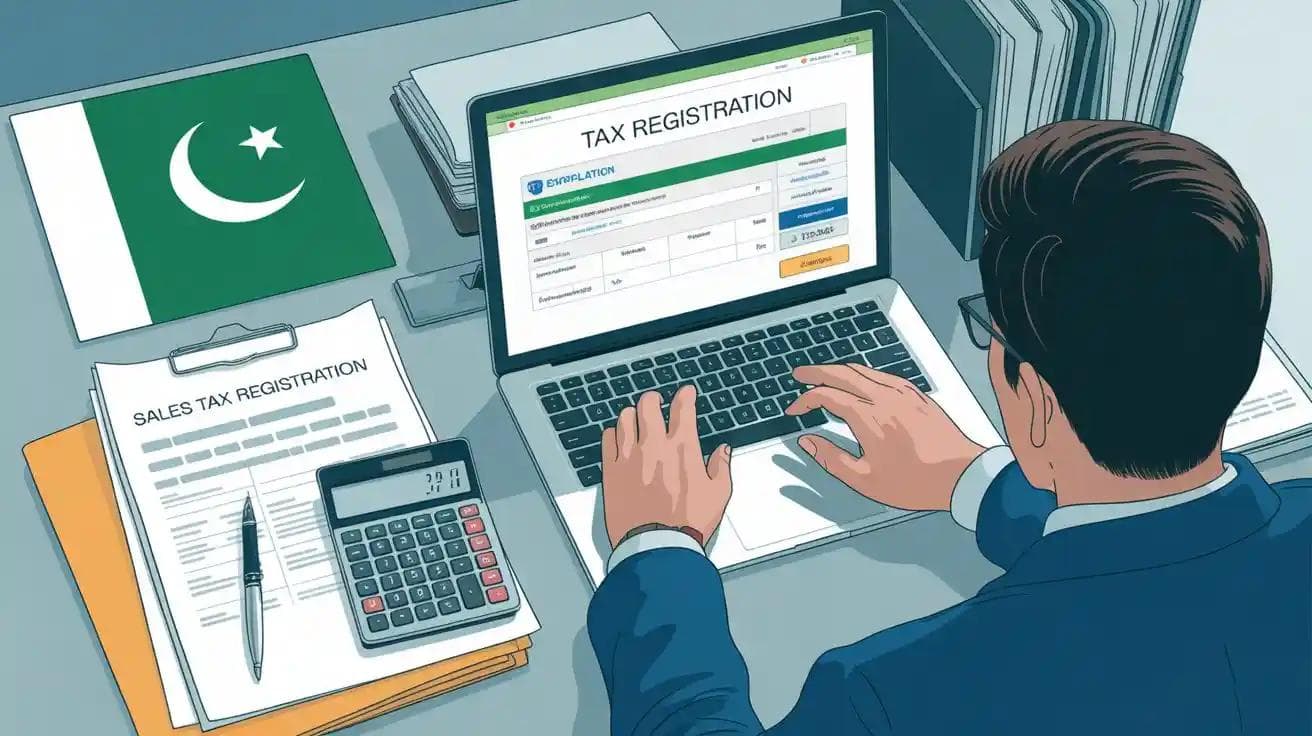
Visit iris.fbr.gov.pk — FBR's official online portal for all tax registrations and filings. If you are a new user, click "Registration for Unregistered Person" to create your IRIS account. You will need your CNIC number and a working mobile number for OTP verification. If you already have an NTN and an existing IRIS account, simply log in with your current credentials.
Step 2 — Complete Income Tax Registration (NTN) First
Sales tax registration requires an active NTN as a prerequisite. If you have not yet obtained your NTN, complete income tax registration through IRIS first — this involves filling in your personal and business information, OTP verification, and submission. Only once your NTN is active can you proceed to sales tax registration.
Step 3 — Navigate to Sales Tax Registration in IRIS
Log into your IRIS account and go to the "Registration" section. From the available options, select "Sales Tax Registration" to begin the process.
Step 4 — Complete Form STR-1
The online sales tax registration form — Form STR-1 — is the core of the application. You will need to provide:
- Business name and legal type
- Business activity and sector — manufacturing, trading, services, import, or export
- Principal place of business address
- Bank account details
- Details of partners or directors for companies and AOPs
- Estimated annual turnover
Fill every section carefully and accurately. Any discrepancy between the information you enter and your official records — CNIC, SECP documents, or bank records — will trigger verification failures and delays.
Step 5 — Upload Required Documents
Scan and upload all required documents in the formats specified by IRIS — typically PDF or JPEG. Scans must be clear, complete, and fully legible. Blurry or cut-off document images are one of the most common reasons for application delays.
Step 6 — Submit the Application and Save Your Reference Number
Review all information carefully before submitting. Once submitted, you will receive a system-generated acknowledgment with a reference number. Keep this safely — you will need it to track the status of your application.
Step 7 — FBR Verification
After submission, FBR reviews and verifies the application. For manufacturing businesses and large traders, this may include a physical inspection of business premises. For smaller businesses and sole proprietors, verification is typically handled digitally.
Step 8 — Receive Your Sales Tax Registration Certificate
Once approved, your Sales Tax Registration Certificate is issued and available for download through your IRIS account. Your STRN is activated, and your business officially becomes a registered taxpayer under the Sales Tax Act 1990.
How long does FBR take to approve sales tax registration? With a complete, correctly prepared application, FBR typically processes registration within 3 to 10 working days. Applications requiring physical business verification may take longer.

Your Obligations After Sales Tax Registration
Registration is the beginning of the process — not the end. Once registered, your business carries specific ongoing obligations:
Monthly sales tax returns. Registered persons must file monthly returns through IRIS by the 15th of each month for the previous tax period. Missing this deadline triggers automatic penalties.
Proper tax invoices. Every taxable sale must be accompanied by a proper tax invoice showing your STRN, the buyer's details, the amount charged, and the sales tax applied.
Record keeping. All sales invoices, purchase invoices, and import/export documents must be maintained for at least five years.
Input tax adjustments. Offset the sales tax you paid on your business purchases — input tax — against the sales tax you collected from customers — output tax. The difference is what you remit to FBR each month. Getting this right consistently is where professional support from Baco Consultants genuinely pays for itself over time.
The Key Benefits of Sales Tax Registration — A Clear Summary
Many business owners focus on the compliance burden of sales tax registration and miss the genuine business advantages it creates:
Input tax recovery. Every rupee of sales tax you pay on your business purchases can be offset against your output tax liability. For import-heavy businesses, this is a significant financial advantage.
Access to corporate and government contracts. Registered businesses are the preferred — and often required — suppliers for companies that need proper tax invoices and for all government procurement processes.
Zero-rating for exporters. Registered exporters can benefit from zero-rated supplies and reclaim input tax paid — a substantial competitive advantage in export markets.
Formal business identity. Your STRN is publicly verifiable through FBR's system, which adds a layer of institutional credibility that unregistered businesses simply cannot match.
Better banking relationships. Banks and financial institutions view tax-registered, compliant businesses far more favorably for loans, trade finance, and letters of credit.
Common Mistakes That Delay or Derail Sales Tax Registration
Starting without an active NTN. Sales tax registration cannot proceed without a pre-existing NTN. Many applicants attempt to start the process without completing income tax registration first, and the application fails immediately.
Selecting the wrong business category. Choosing the wrong sector — manufacturing versus trading versus services — affects your entire tax obligation structure and your return format. Get this right from the start.
Information mismatches. Any inconsistency between your IRIS form and your CNIC, SECP records, or bank documents will cause verification failure. Consistency across all documents is essential.
Poor quality document scans. Blurry, cut-off, or poorly lit document uploads are among the most common reasons for application queries. Always submit clean, high-resolution scans.
Wrong bank account details. Your bank account must match your registration type — business account for companies, matching personal account for sole proprietors. Mixing these up causes processing delays.
Ignoring post-registration compliance. Many business owners complete registration and then fail to set up monthly return filing. Penalties accumulate quickly and automatically.
A Real Example — How One Karachi Trading Business Changed Its Trajectory
A trading business in Karachi dealing in imported electronics had been operating informally for three years. The owner had been avoiding sales tax registration, convinced it would increase costs and paperwork.
Then he tried to sign a supply agreement with a major retail chain — and the chain's procurement team refused. As a registered company, they could not claim input tax on purchases from unregistered suppliers. The deal was off the table.
He contacted Baco Consultants, who completed his NTN registration, sales tax registration through FBR IRIS, and set up a monthly return filing system — all within two weeks.
The retail supply contract was signed immediately after, adding PKR 8 million in annual revenue. He also discovered that he could now claim input tax adjustments on all his import purchases — effectively reducing his overall tax cost. What he had assumed was purely a compliance burden turned out to be a significant financial and commercial advantage.
This story plays out across Pakistani businesses every year. The question is not whether sales tax registration is worth it. The question is how much longer you can afford to delay.
Build Your Tax Knowledge
For business owners, accountants, and anyone serious about understanding Pakistan's tax system at a professional level, the Institute of Corporate and Taxation (ICT) offers expert-designed courses covering FBR compliance, sales tax law, income tax, and corporate regulation. These programs are built to give students and professionals real, actionable knowledge they can apply immediately. Browse the complete ICT course catalog here — whether you are a business owner managing your own compliance or an aspiring tax consultant building your career.
For anyone navigating tax filings, document preparation, or business calculations, MegaFreeTools provides a wide collection of free online utilities that make routine business and administrative tasks faster and simpler. Their complete tools collection is genuinely useful for entrepreneurs managing complex compliance and documentation work.
Frequently Asked Questions
What is sales tax registration in Pakistan? Sales tax registration is the process of formally registering your business with FBR under the Sales Tax Act 1990. It gives your business a unique STRN, allowing you to legally collect sales tax from customers, issue proper tax invoices, and claim input tax adjustments on your purchases.
Who is required to register for sales tax in Pakistan? Businesses with annual turnover exceeding PKR 10 million, all importers regardless of turnover, Tier-1 retailers integrated with FBR's POS system, and exporters claiming zero-rating benefits are all required to register. Other businesses may register voluntarily.
How do I apply for sales tax registration online in Pakistan? Registration is completed through FBR's IRIS portal at iris.fbr.gov.pk. You need an active NTN, complete business documents, and a business bank account. The process involves completing Form STR-1, uploading required documents, and submitting the application online.
What documents are required for FBR sales tax registration? For sole proprietors: CNIC, NTN, bank account maintenance certificate, business address proof, and photograph. For companies: SECP incorporation certificate, company NTN, director CNICs, board resolution, and business address proof. All applicants need consistent, correctly attested documentation.
How long does FBR take to approve sales tax registration? With a complete and correct application, FBR typically approves sales tax registration within 3 to 10 working days. Applications requiring physical business premises verification may take longer.
Is sales tax registration mandatory for small businesses? It is mandatory if your annual turnover exceeds PKR 10 million. Businesses below this threshold are not legally required to register but may choose to do so voluntarily — particularly if they sell to registered businesses that need proper tax invoices for input tax claims.
What is the penalty for not registering for sales tax in Pakistan? Operating without required registration can result in significant FBR penalties, back-payment demands with surcharges, and in serious cases, prosecution under the Sales Tax Act 1990. Proactive registration is always the better financial and legal decision.
Final Thoughts
Sales tax registration in Pakistan is not a bureaucratic formality — it is a foundational step toward building a business that is credible, competitive, and protected from escalating FBR enforcement. Whether you are a sole trader, an SME, a manufacturer, or an importer, getting your STRN in place opens doors that remain firmly closed to unregistered businesses.
The process through FBR's IRIS portal is entirely manageable when you have the right documents and the right guidance. But even small errors cause significant delays — and in a competitive market, delays cost real money.
When you are ready to complete your sales tax registration correctly, efficiently, and without the stress of navigating FBR's systems alone, Baco Consultants is here to handle it for you.
Explore the full range of tax and business compliance services at Baco Consultants, learn more about our team and approach on our about page, and take the step that puts your business on solid legal and commercial ground today.
Related Articles


Leave a Comment
No approved comments yet. Be the first to share your thoughts!