

Quick Answer: How Do You Unfreeze an FBR-Attached Bank Account?
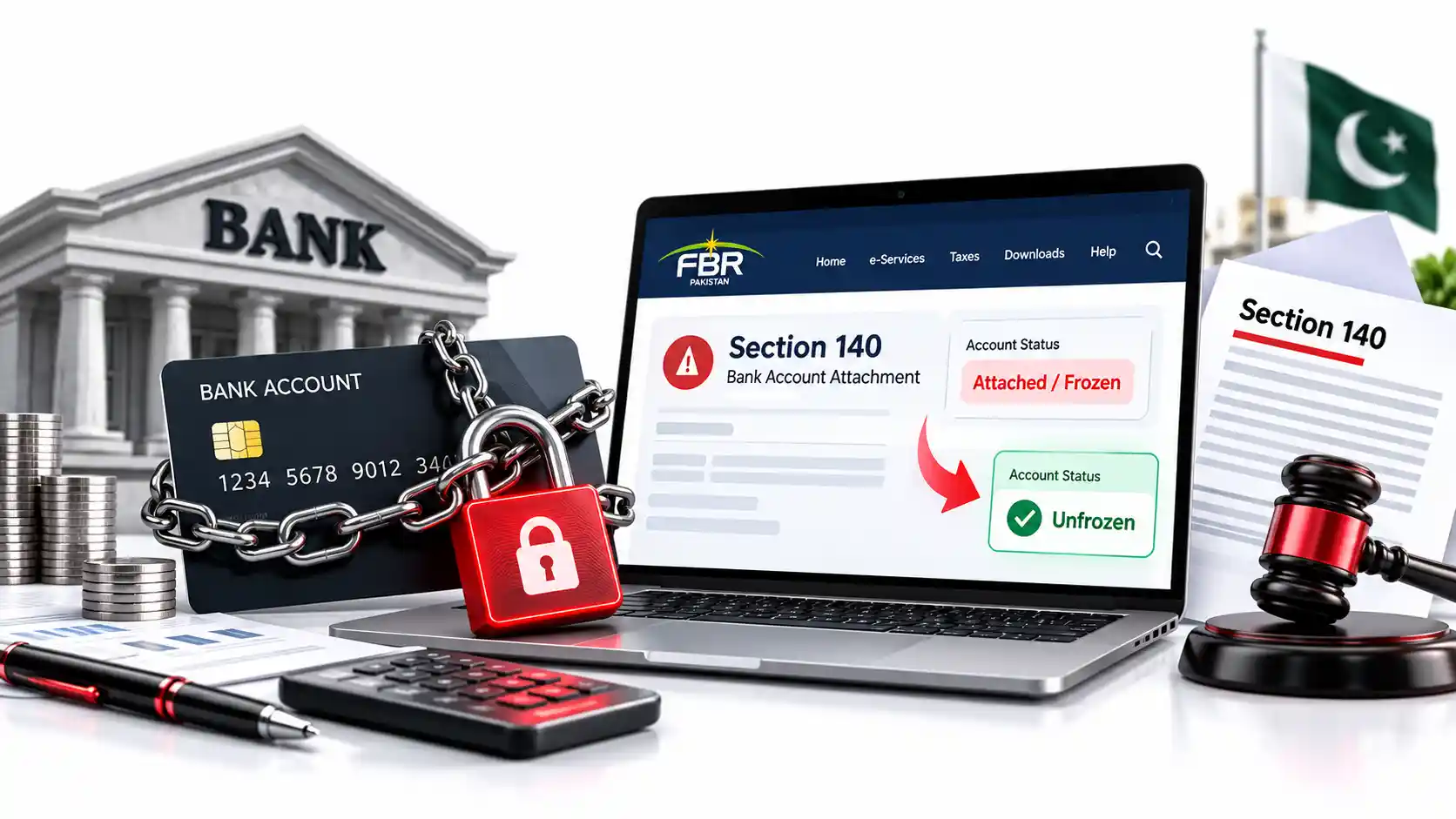
An FBR bank attachment under Section 140 is released when the tax demand behind it is paid, stayed or set aside, and the Commissioner then withdraws the notice sent to your bank. In practice, you can take one of these routes:
- Pay the demand if it is correct, then request a withdrawal letter to the bank.
- Correct it through rectification if the demand arises from an obvious error, such as payments not credited.
- Appeal if you dispute the demand. File before the Commissioner (Appeals), pay 10% of the tax due, and apply for a stay.
- Go to court if recovery is being made in breach of the law. This means a constitutional petition before the High Court.
Your bank cannot lift the attachment on its own. Release requires written instruction from the tax office or an order from an appellate forum or court.
Introduction
If your bank has told you that your account is "marked", "blocked" or "attached" on the instructions of the Inland Revenue department, the reason is almost always a notice under Section 140 of the Income Tax Ordinance, 2001. At Baco Consultants, we advise taxpayers on exactly this situation. This guide explains what Section 140 allows, how to check whether the attachment is lawful, and the practical routes to getting your account released. If you have also received other correspondence, read our FBR notice response guide, our explainer on how to appeal a tax assessment in Pakistan, and our overview of common reasons for FBR notices.
What Is FBR Section 140?
When taxpayers say "FBR Section 140", they usually mean one thing: the tax office has instructed their bank, employer or a customer to pay the taxpayer's outstanding tax straight to the government. For the taxpayer, the result is a blocked or debited account, a short salary, or a customer who suddenly withholds payment.
Put simply, it is FBR's way of collecting tax from where your money is, instead of waiting for you to pay it.
How taxpayers usually discover a Section 140 notice
Very few people learn about Section 140 from FBR directly. The first signs usually come from somewhere else:
- A cheque bounces or a transfer fails, even though the account has funds.
- The bank calls or sends a letter saying the account is "marked" on the instructions of Inland Revenue.
- An unexplained debit appears on the bank statement, payable to the government.
- Salary arrives short because the employer has been told to deduct tax from it.
- A customer delays payment and mentions a letter from the tax department.
If any of these happen, the next step is to find the order behind the notice in your IRIS account. Our guide to IRIS 2.0 features explains where notices and orders now appear.
Who at FBR issues a Section 140 notice?
The notice comes from the Inland Revenue field office that holds jurisdiction over your tax affairs, meaning the Regional, Corporate or Large Taxpayers Office where your case sits. Your bank branch location does not matter.
This affects where you respond. A branch in Lahore may hold the account, but if your case sits with an office in Islamabad, your reply, payment proof and release request all go to the Islamabad office.
According to senior FBR officials, recovery from bank accounts is not a casual step. They describe the procedure as cumbersome and requiring high-level approvals within FBR.
Why FBR relies on bank recovery
From the department's point of view, Section 140 has clear practical advantages over other recovery methods:
- Cash needs no valuation or sale. Recovering from property involves attachment, valuation and auction. A bank balance can be paid over directly.
- It works on businesses with no visible assets. Service firms, freelancers and traders often hold most of their value in bank balances and receivables.
- It reaches future money. A single notice can cover receipts that arrive after it is served, such as salary or customer payments.
- It shifts compliance to a third party. Banks and employers have strong reasons to comply, which makes the process faster than chasing the taxpayer.
What Section 140 means for different taxpayers
| Taxpayer type | How Section 140 usually affects them | Useful reading |
|---|---|---|
| Salaried individuals | Deductions from salary through the employer, or a blocked personal account | Salary tax certificate and return guide |
| Freelancers and remote workers | Foreign remittance receipts held in the account can be recovered | Income tax return for freelancers |
| Small businesses and sole proprietors | Business account blocked; supplier and payroll payments disrupted | How small businesses can file income tax |
| Companies | Corporate accounts attached; notices may also go to customers, creating reputational pressure | Pakistan corporate tax 2026 |
| Partnerships and AOPs | The firm's account is affected, and partners' operations can stall | Business tax compliance in Pakistan |
For a business, the real damage is often operational, not just financial. Blocked payroll, bounced vendor cheques and letters to customers can cost more than the tax itself. This is why staying on top of routine obligations, using a monthly tax compliance checklist, is the best protection.
FBR Section 140: five things to remember
- It is a collection step, not a new tax bill. Something earlier, usually an order or demand, created the liability.
- The bank is only the messenger. Relief comes from the tax office, an appellate forum or a court, not the branch.
- Your case office is what matters. Deal with the Inland Revenue office that issued the notice.
- Speed matters. Default surcharge keeps running on unpaid tax, and business disruption grows each day the account stays blocked.
- Professional help pays off early. An adviser who reviews the notice on day one can often identify the fastest route to release. Talk to our FBR tax consultants in Islamabad.
What Is Section 140 of the Income Tax Ordinance 2001?
Section 140 is FBR's power to recover unpaid income tax from third parties who hold money for the taxpayer. Banks are the most common target, but the power also covers employers, customers and anyone else who owes you money.
Under the section, the Commissioner may issue a written notice to any person who owes, or may owe, money to the taxpayer, or who holds money for or on account of the taxpayer, requiring them to pay the Commissioner the amount set out in the notice by the date specified.
Section 140 sits in Part IV of the Ordinance, "Collection and Recovery of Tax". That Part also contains Section 137 (due date for payment of tax), Section 138 (recovery out of property and through arrest), and Section 138A (recovery through the District Officer (Revenue)). You can read the full consolidated text on the FBR's official Income Tax Ordinance, 2001 publication and in the FBR Acts, Ordinances and Rules library.
Is a "freeze" the same as an "attachment"?
Not legally, although taxpayers often use the words interchangeably.
- Attachment is the legal term for what Section 140 does. The bank is directed to pay a specified sum from your balance to the government.
- Freeze or block is how it feels from the account holder's side. Until the bank pays over the amount or the notice is withdrawn, withdrawals may be restricted.
Why Is FBR Section 140 Important?
Section 140 matters because it is where a tax dispute stops being paperwork and starts affecting real money. Until this point, a disagreement with FBR lives in notices, replies and orders. Once a Section 140 notice reaches your bank, the dispute directly affects your cash, your business operations and your relationships with third parties.
Understanding it matters for four groups: taxpayers, businesses, banks and the tax system itself.
1. For taxpayers: it turns a deadline into a real consequence
Many taxpayers treat assessment orders and demand notices as something to "deal with later". Section 140 is why that approach fails. Once the payment window passes and no appeal or stay is in place, the department can act through your bank without any further involvement from you.
It also works in the taxpayer's favour, if you know the rules. The law restricts recovery during a first appeal where 10% of the tax due has been paid, and courts have enforced that limit. A taxpayer who understands Section 140 can protect their account. One who does not may lose funds they were legally entitled to keep during the appeal.
2. For businesses: it is a cash-flow and reputation risk
For a business, the tax amount is often not the biggest cost. An attached account can mean:
- Missed payroll, which damages staff trust and may breach employment obligations.
- Bounced supplier payments, which strain credit terms and business relationships.
- Letters to customers, since a notice can go to anyone who owes the business money. Customers then learn about the dispute.
- Management time diverted from running the business to handling recovery.
This is why Section 140 should shape how businesses manage tax risk generally. Many attachments start with avoidable problems such as withholding tax compliance mistakes, unanswered notices or poor record-keeping. Good tax planning strategies for businesses treat recovery exposure as a risk to be managed, not an afterthought.
3. For banks: compliance carries its own liability
Section 140 places real obligations on the bank, not just the taxpayer. A bank that does not pay an amount required under a Section 140 notice by the due date can itself become liable for default surcharge. The department has also pushed back when branch managers delayed compliance by seeking head-office guidance, legal opinions or the account holder's consent.
For the account holder, this explains why the bank acts quickly and will not negotiate. The bank is protecting itself. The solution lies with the tax office, not the branch.
4. For the tax system: it gives assessments real force
An assessment the department cannot collect has little value. Section 140 is one of the main tools that turns a tax order into actual revenue. The law has been gradually refined to balance collection against fairness:
- For the department: since the Finance Act, 2025, tax becomes immediately recoverable in large cases, above Rs. 200 million, that have been decided in the department's favour by three appellate forums including the High Court.
- For taxpayers: the 10% rule during a first appeal and the possibility of stays from appellate forums protect taxpayers with genuine disputes.
This balance is why Section 140 cases are often won or lost on procedure: whether an appeal was filed in time, whether the 10% was paid, and whether a stay was obtained and served.
5. It is widely misunderstood
After the 2026 budget, claims spread on social media that FBR had gained new powers to take money from bank accounts without the holder's knowledge. FBR officials rejected these claims, stating that the Finance Act, 2026 made no amendment to the law on recovering taxes from bank accounts.
Misinformation causes two kinds of harm. Some taxpayers panic and pay demands they could have challenged. Others assume nothing can happen to them and ignore notices until their account is attached. Accurate understanding of Section 140 avoids both mistakes.
The practical lesson
Section 140 is important not because it is new or unusual, but because it is the point of no return for ignored tax issues. The best protection is to deal with problems before they reach this stage: file correctly, answer notices, and appeal on time. Our guides on tax compliance in Pakistan and how to reduce tax liability legally are good starting points. For businesses, corporate tax advisory can help identify recovery risk early.
Why Has FBR Attached My Bank Account?
A Section 140 notice presupposes that there is tax due that you have not paid. The most common underlying causes are:
- An amended assessment order under Section 122 that created additional tax, often after an audit, or after a notice you did not answer.
- A best-judgment assessment made because a return or reply was not filed.
- Default surcharge or penalties that became payable after an order.
- Unpaid admitted tax declared in your own return but not deposited.
- Withholding tax defaults, where you were treated as a person in default for not deducting or depositing tax.
- An appeal lost before the Commissioner (Appeals) or a higher forum, which revives recovery of the confirmed demand.
A frequent practical problem is that the taxpayer never saw the original order or demand notice. Notices are now largely served electronically. The Finance Act, 2025 amended Section 218 to clarify that electronic service of notices and orders on any person other than a resident individual counts as valid service. For companies and AOPs especially, an unread IRIS inbox is not a defence.
Does FBR Send a Notice Before Attaching a Bank Account?
The recovery chain normally starts with a demand on the taxpayer, not the bank. According to senior FBR officials, a demand notice is issued to the taxpayer under Section 137(2), a 30-day period is given to respond, and the detailed recovery procedure then follows under Section 140.
The usual sequence is:
- An assessment or other order creating a tax liability.
- A notice of demand under Section 137(2), normally allowing 30 days to pay.
- Non-payment by the due date, with no appeal and stay in place.
- A Section 140 notice sent to your bank or other third party.
- The bank pays over funds, or holds them pending payment.
Be aware of one proposal that was rejected. When the Finance Bill 2025 proposed stronger recovery powers, it also proposed seven days' prior notice to the taxpayer. That seven-day prior notice requirement was not approved in the Finance Act, 2025. So do not assume you will receive a separate warning before the bank is notified.
Why Delaying Payment of an FBR Demand Costs You More
An unpaid tax demand does not stay fixed while you wait. Under Section 205 of the Income Tax Ordinance, 2001, default surcharge accrues on tax not paid by the due date. Since the Finance Act, 2024, the rate is 12% per annum or KIBOR plus 3% per annum, whichever is higher. Previously it was a flat 12%.
In practical terms:
- Every month of delay increases the amount a Section 140 notice can eventually cover.
- If you plan to pay the undisputed part of a demand, paying early limits the surcharge.
- If you dispute the demand, the surcharge question follows the outcome of your appeal. If the demand is reduced or deleted, the surcharge linked to it should fall with it.
How Does a Section 140 Bank Attachment Work in Practice?
What the bank is required to do
The bank receives a written notice specifying the taxpayer, the amount and the date for payment. Several rules then apply.
- Cap on the amount. If the money held is equal to or less than the tax due, the notice cannot exceed the money held. In any other case, it covers only so much as is sufficient to pay the tax due.
- Recurring payments. Where the person is liable to make a series of payments to the taxpayer, such as salary, the notice may specify an amount to be deducted from each payment until the tax is recovered.
- The bank is protected. Tax paid by the third party under the notice is treated as paid under the taxpayer's authority, under Section 140(6). In other words, you cannot sue your bank simply for complying with a valid notice.
- The bank faces consequences for ignoring it. The prescribed notice format warns that if the recipient fails to comply, the amount can be recovered from them. Reporting on FBR's enforcement stance has also noted that tax officials flagged bank branch managers who delayed compliance by seeking head-office guidance, legal opinions or even account holders' consent.
Why arguing with your branch rarely helps
Branch staff have no discretion to disregard a Section 140 notice. Your effort is better spent on the tax office, the appellate forum or the court. The bank is simply executing the instruction.
Is My Joint Account Also at Risk?
Section 140 is not limited to accounts in your sole name. It reaches any person holding money for, or on account of, the taxpayer. A joint account in which the taxpayer holds funds can therefore fall within a notice.
Section 140 has no separate rule on how a joint balance is divided between holders. In our view, the practical question is whose money it actually is. If you are the non-defaulting co-holder, act quickly:
- Write to the issuing officer with evidence of your own contributions, such as salary credits, transfer records and your declared share.
- Your wealth statement is key evidence here. Each co-owner should declare only their own share of a joint account.
- If the department refuses to release funds that are demonstrably yours, take legal advice on a court challenge.
This is our interpretation of the law, not a settled rule. Outcomes depend on the facts and the evidence.
Can FBR Recover Disputed Tax From Your Bank Account While an Appeal Is Pending?
This is the most important protection available to taxpayers, and it comes with a condition.
The proviso to Section 140(1) provides that the Commissioner shall not issue a Section 140 notice where the taxpayer has filed an appeal under Section 127 against the order creating the demand, and the Commissioner (Appeals) has not yet decided it, provided 10% of the tax due has been paid.
This threshold was originally 25% when the proviso was introduced through the Finance Act, 2016, and was later reduced to 10%.
Courts have enforced this protection. In WP No. 34736 of 2024, the Lahore High Court (Justice Raheel Kamran) declared unlawful a recovery under Section 140 from the petitioner's bank accounts beyond the 10% limit while the appeal was pending. The court relied on the principle that tax should not be recovered before an appeal is adjudicated by at least one appellate body. The judgment is summarised on LiveLawPK.
Practical takeaway: To use this protection, you need both:
- a filed appeal before the Commissioner (Appeals), and
- proof of paying 10% of the tax due, such as a CPR against the correct tax year and section.
Filing the appeal without the 10% payment does not by itself block a Section 140 notice.
Does Unpaid Tax Keep Growing While the Account Is Attached?
Yes. Unpaid tax attracts default surcharge under Section 205. Since the Finance Act, 2024, the rate is 12% per annum or KIBOR plus 3%, whichever is higher (Business Recorder). Surcharge runs from the date the tax fell due until the date it is paid.
Three points matter for Section 140 cases:
- Delay costs money. The longer a correct demand stays unpaid, the more surcharge accrues. This is a strong reason to pay the undisputed portion early.
- Winning an appeal reduces the surcharge too. Under Section 205A, when an order reduces the tax or penalty, the related default surcharge is reduced accordingly.
- Banks are not exempt. Default surcharge also applies to a person who fails to pay an amount referred to in Section 140 by the due date. This is one more reason banks comply promptly.
Late payment is separate from late filing. For filing penalties, see our guide on avoiding late tax filing penalties and our late filing penalty calculator.
What Changed in 2025 and 2026?
Finance Act, 2025: immediate recovery in large, repeatedly confirmed cases
The Finance Act, 2025 ratified the changes made to Sections 138 and 140 through the Tax Laws (Amendment) Ordinance, 2025. Under these changes, tax becomes immediately payable, or payable within the time in the recovery notice, regardless of timelines elsewhere in the Ordinance or any decision or judgment, where three conditions are met:
- the case has been decided in the department's favour by three appellate forums, including the High Court;
- recovery is limited to the lowest amount of demand confirmed by any of those three forums; and KMPG
- the tax payable exceeds Rs. 200 million.
For most individuals and SMEs, this provision will not apply. The ordinary rules in this guide remain the relevant ones.
Finance Act, 2026: no new bank-recovery powers
After the 2026 budget, social media claims circulated that FBR had been given new powers to take money from bank accounts without the holder's knowledge. FBR officials told Business Recorder that the Finance Act, 2026 made no amendment to the law on recovery of taxes from taxpayers' bank accounts, and that this power has existed in tax law for decades. Read the Business Recorder report.
Section 138 vs Section 140: What Is the Difference?
| Point | Section 138 | Section 140 |
|---|---|---|
| Who is targeted | The taxpayer directly | Third parties holding or owing money to the taxpayer (banks, employers, customers) |
| What is recovered | The taxpayer's property; the section also covers arrest | Money held for, or owed to, the taxpayer |
| Typical use | Where there are assets but no accessible cash | Where there is a bank balance or receivables |
| Main effect on you | Assets attached or sold | Account debited or blocked up to the notice amount |
Both sections are recovery tools. Neither creates a new tax liability. Each depends on a valid, unpaid demand that already exists.
Was It FBR, PRA or SRB? Sales Tax and Provincial Attachments
Not every bank attachment comes from FBR's income tax wing. Check the letterhead and the law cited in the notice, because the remedy depends on which authority issued it.
- FBR income tax: Section 140 of the Income Tax Ordinance, 2001, which this guide covers.
- FBR federal sales tax: Recovery falls under Section 48 of the Sales Tax Act, 1990. The Finance Act, 2024 added a similar protection there: no recovery notice should issue where you have appealed to the Commissioner (Appeals) or the Appellate Tribunal and paid 10% of the tax involved.
- Provincial authorities (PRA, SRB, KPRA, BRA): Sales tax on services is administered by each province under its own statute. Each has its own recovery powers. For example, Section 75 of the Khyber Pakhtunkhwa law allows short-paid tax and default surcharge to be recovered by attachment. Appeals go to that authority's own Commissioner (Appeals) and tribunal, not to FBR's forums.
For provincial compliance, see our guides on Punjab sales tax filing, SRB tax filing, and common errors in sales tax filing.
How to Check Your FBR Recovery Notice on IRIS
Before taking any step, obtain the paperwork behind the attachment.
- Log in to IRIS and review your notices and orders. Look for any order under Section 122, 161/205 or similar, and any demand notice under Section 137. If you cannot log in, our guide to FBR IRIS login problems and recovering a forgotten IRIS password may help.
- Ask your bank for a copy of the Section 140 notice. Note the issuing office, officer, tax year, amount and date.
- Match the notice to an order. Every Section 140 notice should trace back to a specific assessment or order and tax year.
- Check your payment history. Confirm whether any tax you paid has not been credited against the demand.
How to Verify Whether the FBR Tax Demand and Attachment Are Valid
Use this checklist before deciding whether to pay, correct or challenge:
- Is there an underlying order? A Section 140 notice without a traceable assessment or demand is a serious red flag.
- Was the order and demand properly served? Check the date and mode of service, keeping in mind the electronic service rules noted above.
- Has the 30-day payment period passed?
- Is an appeal pending, and have you paid 10%? If yes, the proviso to Section 140(1) should prevent the notice.
- Is a stay order in force from the Commissioner (Appeals), the Appellate Tribunal or a court?
- Is the amount correct? Check for arithmetic errors, uncredited payments and adjustable withholding taxes not accounted for.
- Does the notice exceed the tax due? The law limits recovery to what is sufficient to pay the demand.
How Can I Unfreeze My FBR Bank Account? Step-by-Step Options
Option 1: Pay the undisputed demand and request release
If the demand is correct:
- Generate a PSID for the correct tax year, section and amount, and pay. See our guide on FBR PSID payment.
- Submit the CPR to the issuing officer with a written request to withdraw the Section 140 notice.
- Obtain the withdrawal letter and deliver it to your bank.
Tip: Where your bank has already paid over the funds under the notice, confirm that the amount is credited against your demand. This avoids paying twice.
Option 2: Rectify an obvious error
If the demand arises from a mistake apparent from the record, such as a payment not credited or an arithmetic error, a rectification application may resolve it faster than an appeal. See how to file a rectification application with FBR and revised return vs rectification.
Option 3: Appeal, pay 10% and seek a stay
If you dispute the demand on its merits:
- File an appeal before the Commissioner (Appeals). Under the Finance Bill 2025 changes, any person other than a State-Owned Enterprise may appeal to the Commissioner (Appeals) within thirty days of receiving the order.
- Pay 10% of the tax due to trigger the Section 140(1) proviso.
- Apply for a stay. Under Section 128(1A), where recovery would cause undue hardship, the Commissioner (Appeals) may, after hearing the department, stay recovery for up to thirty days in aggregate. Section 128(1AA) allows a further thirty days, on the condition that the appeal is decided within that period.
- Serve the stay order and 10% payment proof on the tax office and your bank.
Direct appeal to the Tribunal. Following the Finance Act, 2025, a taxpayer may also choose to appeal directly to the Appellate Tribunal Inland Revenue against the original order. Stays at Tribunal level carry conditions. A Tribunal stay ceases, and the Commissioner may recover, if the taxpayer does not adhere to the Tribunal's hearing schedule. Where the Tribunal does not decide the appeal within the statutory period, the stay continues until the appeal is finalised.
For the full procedure, see our tax appeal process guide.
Option 4: Constitutional petition before the High Court
Where recovery is plainly unlawful, a writ petition under Article 199 of the Constitution may be appropriate. Examples include recovery beyond 10% while a first appeal is pending with the 10% paid, recovery in defiance of a stay, or recovery without any valid underlying order. The Lahore High Court decision above is an example of this route. Because a writ is discretionary, it should be drafted by a qualified advocate. It is also generally not a substitute for the statutory appeal where that appeal remains available.
Option 5: Complaint to the Federal Tax Ombudsman
If the tax office delays or refuses to withdraw a notice after you have paid or obtained a stay, maladministration may be taken to the Federal Tax Ombudsman. This does not decide the tax dispute itself. It addresses how the department has handled your case.
Option 6: Alternative Dispute Resolution (Large Disputes)
For larger disputes, Section 134A offers a route outside the appeal chain. The section was substituted by the Income Tax Ordinance (Third Amendment) Act, 2026. It allows an aggrieved person to apply to the FBR for a dispute resolution committee where the dispute involves a tax liability of Rs. 50 million or more, or the admissibility of a refund. For state-owned enterprises, the threshold does not apply and applying for ADR is mandatory.
ADR is a strategic decision, not an emergency tool. It is suited to large, technical disputes where both sides may benefit from a negotiated outcome. If your account is attached today, secure the account first through payment, a stay or court proceedings. Evaluate ADR alongside that, and do not assume that applying for ADR by itself stops recovery.
How to Get Your Money Back If FBR Recovered It Wrongly
If the bank has already paid funds to the government and you later win your appeal, the money does not come back automatically. Here is how the process works.
- Obtain the appellate order, and make sure the department gives effect to it for the relevant tax year.
- Apply for a refund under Section 170. A taxpayer who has paid more tax than they are properly chargeable with may apply to the Commissioner for a refund of the excess. The application must be made on the prescribed form within three years of the later of two dates: the date the Commissioner issued the assessment order for that tax year, or the date the tax was paid.
- Watch the deadline for the department's decision. The Commissioner must issue a refund order within the time limit in Section 170(4). If the Commissioner fails to act, that inaction is itself appealable.
- Expect adjustments. Where you have other outstanding liabilities, the Commissioner can set the refund off against them.
Courts have recognised such claims. In one Sindh High Court matter, the taxpayer argued that after three years' assessment orders were annulled, the department was bound to refund tax it had recovered through a Section 140 notice.
Tip: Keep every bank debit advice and CPR linked to the attachment. These documents are your proof of the amount recovered.
If the appeal outcome is still pending, see our guides on the tax appeal process and on correcting mistakes in your FBR return.
How Long Does It Take to Release an FBR Bank Attachment?
There is no fixed statutory timeline for withdrawing a Section 140 notice. Release depends on two things:
- how quickly you establish payment, a stay or an order in your favour, and
- how quickly the issuing officer sends the withdrawal letter and your bank processes it.
Having complete documents ready shortens the process considerably. Useful documents include the CPR, stay order, appeal receipt and a copy of the notice.
Documents Needed to Challenge FBR Recovery
- Copy of the Section 140 notice (obtain it from your bank)
- The underlying assessment or order and the Section 137 demand notice
- IRIS printouts of notices, orders and service dates
- CPRs for all relevant payments, including the 10% payment if appealing
- Appeal memo, grounds and filing receipt
- Stay application and any stay order
- Bank statements showing debits or holds
- CNIC and NTN details; for companies, a board resolution or authority letter for the representative
Sample Letters: Requesting Release of an FBR Bank Attachment
Adapt these formats to your facts. Do not send them without checking your own figures and dates.
Letter 1: Request to the tax office to withdraw the Section 140 notice (after payment or a stay)
To: The [Deputy/Assistant] Commissioner Inland Revenue, [Unit/Zone], [RTO/LTO/CTO, City]
Subject: Request for withdrawal of notice under Section 140 of the Income Tax Ordinance, 2001, NTN [], Tax Year []
Respected Sir/Madam,
Your notice dated [] under Section 140 has been served on [Bank name, Branch] in respect of a demand of Rs. [] for Tax Year [____].
[Choose one:]
(a) The demand has been paid in full through CPR No. [] dated [], copy attached.
(b) An appeal has been filed before the Commissioner Inland Revenue (Appeals) on [], and 10% of the tax due, amounting to Rs. [], has been paid through CPR No. []. Under the proviso to Section 140(1), recovery through this notice cannot continue.
(c) The Commissioner (Appeals) / Appellate Tribunal / Honourable High Court has stayed recovery by order dated [], copy attached.
You are requested to withdraw the notice and to instruct the bank in writing to release the account.
Enclosures: [CPR / appeal receipt / stay order / copy of Section 140 notice]
[Name, CNIC, NTN, contact details, signature]
Letter 2: Covering letter to the bank
To: The Branch Manager, [Bank, Branch]
Subject: Release of account No. [] attached under Section 140 notice dated []
Please find attached [the Commissioner's withdrawal letter / the stay order dated ____]. Kindly lift the restriction on my account and confirm in writing.
[Name, account title, CNIC, signature]
Letter 3: Key contents of a stay application before the Commissioner (Appeals)
A stay application under Section 128(1A) should set out:
- the order under appeal, the tax year and the date the appeal was filed;
- proof of the 10% payment;
- a short summary of your strongest grounds of appeal;
- the undue hardship that recovery would cause, supported by evidence such as the account balance, payroll obligations or business disruption; and
- the specific relief sought: stay of recovery, including under the Section 140 notice, until the appeal is decided.
Stay applications are contested, so have them drafted by a professional. See our FBR notice response guide and how to handle tax notices from FBR.
Common Mistakes Taxpayers Make After a Bank Attachment
- Ignoring IRIS for months. Most attachments trace back to an order that sat unread.
- Filing an appeal but not paying the 10%. The Section 140(1) proviso depends on it.
- Paying without linking the payment to the demand. A wrong tax year or section on the PSID can leave the demand open.
- Arguing with the bank instead of the tax office. The bank has no discretion.
- Opening a new account to "move" funds. This does not end recovery. Section 140 can apply to any person holding money for you, and moving funds can create further problems.
- Missing appeal deadlines. Appeal windows are short, generally 30 days.
- Not checking withholding tax credits. Adjustable taxes already deducted may reduce the demand.
Expert Tips From Baco Consultants
- Treat the Section 140 notice as a symptom. The real issue is the order behind it, so fix that first.
- Separate what you owe from what you dispute. Paying the undisputed portion while appealing the rest often gets accounts released faster.
- Keep an evidence trail. Deliver every letter to the tax office against receipt, whether through IRIS, by email or by hand with a stamped copy.
- Monitor IRIS regularly, especially if you run a company or AOP, where electronic service is deemed valid.
- Get advice before the 30-day window closes. Your options narrow quickly after that.
Why Choose Baco Consultants for FBR Bank Attachment and Recovery Matters?
Baco Consultants is a corporate, tax and legal consultancy based in Islamabad, led by Rai Basharat Ali, a Chartered Accountant (ICAEW) and Advocate High Court. He is also the author of the textbook Decoding Taxation Laws of Pakistan. This combination matters in Section 140 cases, which usually need both tax analysis (is the demand correct?) and legal action (appeal, stay or writ).
We can help you:
- trace and review the order and demand behind the attachment;
- prepare and file rectification applications and appeals;
- draft stay applications and pursue withdrawal of the bank notice; and
- advise on whether High Court or Federal Tax Ombudsman proceedings are appropriate.
We work with taxpayers across Pakistan, including in Islamabad and Rawalpindi, Lahore, Karachi and Faisalabad. See our pages on FBR tax consultancy in Islamabad, tax consultants in Rawalpindi, Lahore, Karachi and Faisalabad, or browse all our services.
Getting Help With a Section 140 Attachment in Your City
A Section 140 notice is issued by the tax office that holds jurisdiction over your case. Your reply, appeal and withdrawal request all go to that same office, wherever your bank branch happens to be.
We assist taxpayers facing FBR recovery action in Islamabad, Rawalpindi, Lahore, Karachi, Peshawar, Faisalabad, Multan and Sialkot. Most of the groundwork can begin remotely: reviewing the notice, checking IRIS, and drafting replies and appeals. To find the right adviser near you, see our guide to the best tax consultants in Pakistan, or contact us directly.
Frequently Asked Questions
What is FBR Section 140?
Section 140 of the Income Tax Ordinance, 2001 allows the Commissioner Inland Revenue to recover unpaid tax by issuing a written notice to a third party, such as a bank, that holds or owes money to the taxpayer. The notice requires that party to pay the specified amount directly to the government.
Can FBR attach my bank account without telling me?
The recovery process normally follows an order and a Section 137(2) demand notice that give you time to pay. There is no separate statutory requirement to warn you immediately before the bank is notified. A proposed seven-day prior notice was dropped from the Finance Act, 2025.
How can I release a Section 140 bank attachment?
You can pay the demand, correct it through rectification, or appeal and pay 10% of the tax due to stop further Section 140 recovery during the first appeal. Once one of these is done, the tax office must withdraw the notice by letter to your bank.
Can FBR take disputed tax from my bank account?
If you have appealed to the Commissioner (Appeals) and paid 10% of the tax due, the Commissioner should not issue a Section 140 notice while that appeal is pending. The Lahore High Court has declared recovery beyond this limit during a pending appeal unlawful.
Can my bank refuse to follow a Section 140 notice?
No. The bank is protected when it complies, because payment is treated as made on the taxpayer's authority. It can also face recovery action itself if it fails to comply.
Did the Finance Act 2026 give FBR new powers over bank accounts?
No. FBR officials confirmed that the Finance Act, 2026 made no amendment to the law on recovering taxes from bank accounts.
What is the difference between Section 138 and Section 140?
Section 138 is used to recover tax from the taxpayer's own property and also provides for arrest. Section 140 is used to recover from third parties, such as banks, that hold or owe money to the taxpayer.
How long does it take to unfreeze an FBR-attached account?
No fixed legal timeline applies. It depends on how quickly payment, a stay or an appellate order is established and on how quickly the tax office issues the withdrawal letter to your bank.
Can FBR attach a joint bank account?
Yes, if the account holds money for or on account of the taxpayer. A non-defaulting co-holder should promptly give the tax office evidence of their own share, such as deposit records and their wealth statement, and seek release of that portion.
Does default surcharge continue while my account is attached?
Yes. Unpaid tax attracts default surcharge at 12% per annum or KIBOR plus 3%, whichever is higher, until it is paid. If the tax is later reduced on appeal, the surcharge is reduced accordingly.
How do I get money back that FBR recovered from my bank account?
If you win your appeal, apply for a refund under Section 170 of the Income Tax Ordinance, 2001 within three years. If the Commissioner fails to decide the application within the statutory time, that inaction can be appealed.
My account was attached by PRA or SRB. Does this guide apply?
Only in part. Provincial authorities recover sales tax on services under their own laws, and appeals go to their own appellate forums. The practical approach is the same: check the notice, verify the demand, and pay, appeal or seek a stay.
Conclusion
A Section 140 attachment is stressful, but it is rarely the end of the matter. The key is to move quickly: identify the order behind the notice, verify the demand, and choose the right route, whether that is payment, rectification, appeal with the 10% payment and a stay, or court proceedings. Waiting only reduces your options.
If your account has been attached or you have received an FBR recovery notice, Book a Seat at Baco Consultants for a review of your case and a clear plan to get your account released.
Related Articles


Leave a Comment
No approved comments yet. Be the first to share your thoughts!