

Scroll through any tax-related forum in Pakistan and you will find a variation of this question repeated constantly: "My accountant says I fall under FTR — but does that mean I pay less tax? And am I even eligible?"
It is a fair question — and an important one. The Final Tax Regime is one of the most financially significant provisions in Pakistan's Income Tax Ordinance 2001, yet it remains genuinely misunderstood by thousands of business owners, contractors, and freelancers who either wrongly claim it or unknowingly miss it entirely.
Getting FTR eligibility wrong in either direction has consequences. Claiming FTR when you do not qualify invites FBR notices and audit exposure. Missing FTR when you do qualify means overpaying tax — often substantially.
This guide settles the question definitively: who can opt for the Final Tax Regime in Pakistan in 2026, what income qualifies, and what the eligibility rules actually mean in practice.
What Is the Final Tax Regime — And Why Does Eligibility Matter?
The Final Tax Regime (FTR) is a tax mechanism under Pakistan's Income Tax Ordinance 2001 where the tax withheld at source on specific income types constitutes the complete and final discharge of tax liability on that income.
There is no additional tax to compute. No refund to claim. No slab rate calculation. The withholding is the tax — period.
But — and this is the part that trips people up — not everyone and not every income type automatically falls under FTR. The Ordinance specifically designates which income heads are covered by FTR, and eligibility depends on the nature of the income, the taxpayer's category, and sometimes the specific transaction type.
Understanding your eligibility is not a procedural formality. It directly determines:
- Whether you owe additional tax at year-end or not
- Whether your withholding credits are final or adjustable
- How you declare income in the FBR IRIS portal
- Your audit exposure and FBR compliance profile
Who Can Opt for Final Tax Regime in Pakistan: The Eligibility Breakdown
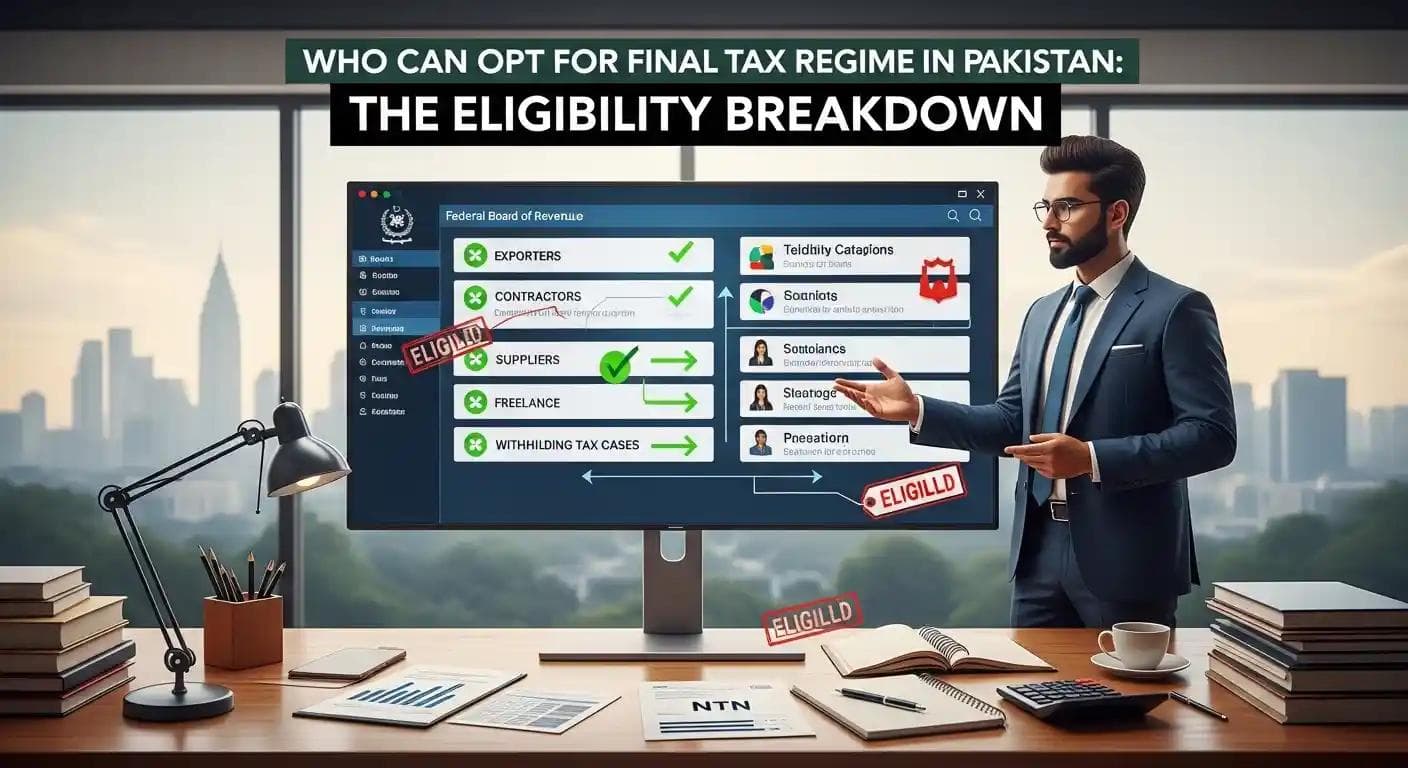
Here is a clear, category-by-category breakdown of who qualifies for FTR under Pakistan's tax law in 2026:
1. Exporters of Goods (Section 154)
Eligibility: Pakistani exporters of goods — whether individuals, firms, or companies — whose export proceeds are realized through the banking system.
Tax is deducted at source by the authorized dealer bank at the time of realization of foreign exchange proceeds. This withholding under Section 154 is treated as the final tax on export income.
This is one of the most significant FTR categories in Pakistan. Exporters in textiles, surgical instruments, sports goods, leather, IT services, and other export sectors benefit enormously — their export revenues are taxed at a low flat percentage rather than at progressive slab rates.
Important caveat: Exporters who also earn domestic income (from local sales, for example) must declare domestic income under the normal tax regime separately. Only the export proceeds portion qualifies for FTR.
2. Commercial Importers (Section 148)
Eligibility: Commercial importers who pay advance tax at the import stage under Section 148.
For importers whose goods are subject to advance tax at the port, this withholding is treated as a final tax on the income from trading those imported goods — provided the importer is not classified as an industrial undertaking.
This is a significant category. Many wholesale traders and commercial importers benefit from FTR on their import-origin income, removing the requirement to calculate normal business tax on their trading profits.
3. Contractors and Service Providers — Specific Categories (Section 153)
Eligibility: This is the most nuanced FTR category and the one most frequently misunderstood.
Under Section 153, withholding tax on payments for goods, services, and contracts is deducted by the withholding agent (client). Whether this withholding is final or adjustable depends on the taxpayer's category:
- For companies — Section 153 withholding is generally adjustable (not final)
- For individuals and AOPs (Associations of Persons) — Section 153 withholding on contracts and services can be treated as final, subject to specific conditions
The practical implication: an individual contractor or a partnership firm providing services may qualify for FTR on those payments, while a private limited company providing the same services does not. Business structure matters significantly here.
4. Prize Bond and Lottery Winners (Section 156)
Eligibility: Any individual or entity receiving prize money from prize bonds, lotteries, raffles, or quiz competitions in Pakistan.
Withholding tax at the applicable rate (currently 15% for filers, 30% for non-filers on certain prizes) is deducted at source and constitutes the final tax on prize income. Prize winners do not include this income in their normal taxable income — it is declared separately as FTR income.
This applies regardless of the winner's other income or tax regime. Prize income is always FTR.
5. Non-Residents Receiving Pakistan-Source Income (Various Sections)
Eligibility: Non-resident individuals and foreign companies receiving certain Pakistan-source payments — royalties, technical fees, dividends, and specific service payments.
For non-residents, withholding tax deducted on designated Pakistan-source income is treated as final. This incentivizes foreign businesses to engage with Pakistani entities without being drawn into Pakistan's full tax filing system.
This is particularly relevant for overseas Pakistanis with Pakistan-source investment income, dividends, or passive income.
6. IT and Software Exporters — Registered with PSEB (Special Provisions)
Eligibility: IT companies, freelancers, and software exporters registered with the Pakistan Software Export Board (PSEB) and receiving foreign exchange remittances through approved banking channels.
Pakistan's government has actively incentivized the technology export sector. IT export income routed through the banking system, for registered entities and individuals, benefits from concessionary FTR treatment — with significantly lower tax rates than normal slab rates.
For freelancers and IT professionals specifically, this is a category worth understanding in depth. The income tax rates guide for individuals in Pakistan 2026 provides the applicable rate context alongside the regime structure.
7. Dividends (Section 150)
Eligibility: All recipients of dividends from Pakistani companies — whether individuals, firms, or companies.
Withholding tax deducted on dividend payments under Section 150 is treated as final tax on that dividend income. Dividend recipients do not add dividend income to their other income for normal tax calculation — it is declared separately as FTR income.
Who Cannot Opt for Final Tax Regime in Pakistan

Equally important is knowing who falls outside FTR eligibility:
- Salaried individuals — salary income is firmly under the normal tax regime. Slab rates apply and employer withholding is adjustable
- Business income from domestic trading (non-import) — falls under NTR, not FTR
- Rental income (in most cases) — subject to specific provisions but generally normal regime
- Companies receiving Section 153 payments — withholding is adjustable, not final
- Agricultural income — subject to its own provincial tax framework
- Capital gains on property — subject to specific capital gains tax provisions, not FTR
Key Benefits of FTR Eligibility
For taxpayers who genuinely qualify, FTR provides substantial advantages:
- Significantly lower effective tax rate — export income taxed at 1% beats any slab rate scenario on the same gross revenue
- Tax certainty — no year-end surprises, no computation complexity, no liability uncertainty
- Reduced compliance burden — no need to maintain detailed profit-and-loss accounts for FTR income (the withholding certificate is the primary document)
- Lower audit exposure — FTR income is fixed at source; there is less for FBR to scrutinize
- Simplified IRIS filing — FTR income sections in the portal are straightforward once you know which head to use
- Business cash flow advantage — no large lump-sum tax payments at year-end; tax is settled incrementally at source
How to Verify and Declare Your FTR Eligibility: Step-by-Step
Step 1: Identify All Your Income Sources
List every income stream for the tax year. For each one, note: Who paid it? What section of the Income Tax Ordinance was the withholding made under? Is the payer a withholding agent?
Step 2: Review Your Withholding Certificates
Withholding certificates issued by banks, buyers, or clients typically indicate the section under which withholding was made. This is your primary reference. Section 154 = export FTR. Section 150 = dividend FTR. Section 156 = prize FTR. Section 153 (individual/AOP) = potentially final.
Step 3: Confirm Your Taxpayer Category
Your eligibility for FTR under Section 153 specifically depends on whether you are an individual, AOP, or company. Confirm your registration status in the FBR system — this determines which treatment applies.
Step 4: Separate FTR and NTR Income Clearly
For each income source, classify it definitively as FTR or NTR. Do not mix. If you have both, maintain completely separate records for each category.
Step 5: Log In to FBR IRIS Portal
Access the IRIS portal and navigate to the income tax return. The return form has designated sections for FTR income under each relevant section. Use the correct section for each FTR income type.
Step 6: Declare FTR Income Under the Correct Head
Enter export income under Section 154 FTR head. Prize income under Section 156. Dividends under Section 150. Never enter FTR income in the normal business income sections.
Step 7: Complete the Wealth Statement
Regardless of FTR status, the wealth statement is mandatory. All assets, bank balances, investments, and liabilities must be declared and reconciled with your declared income.
Step 8: Submit and Verify ATL Status
Submit your return and confirm your Active Taxpayer List status is updated within a few days. Even zero-liability FTR returns must be filed to maintain ATL standing. For businesses navigating sales tax alongside income tax compliance, the sales tax registration process guide for Pakistan 2026 covers the parallel obligations that many FTR-eligible businesses also carry.
Documents Required When Declaring FTR Income
| Document | Purpose |
|---|---|
| Withholding certificates (from banks/clients) | Primary proof of FTR income and tax deducted |
| Export realization documents | SBP/bank confirmation of foreign exchange proceeds |
| PSEB registration certificate | For IT exporters claiming concessionary FTR |
| Prize bond winning certificate | For prize income declaration |
| Dividend warrants/statements | For dividend income under Section 150 |
| NTN certificate | Portal login and identity verification |
| Previous year's return | Consistency reference for wealth statement |
Common Mistakes Around FTR Eligibility
Claiming FTR as a company under Section 153: This is a frequent and costly error. Companies do not qualify for final treatment on Section 153 payments — their withholding is adjustable. Filing as if it were final understates tax liability and invites FBR notices.
Not declaring FTR income at all: Some taxpayers assume that since tax was withheld at source, they have nothing to declare. Every income source — FTR or otherwise — must appear in the annual return and wealth statement.
Mixing export and domestic income under the same head: An exporter who also sells domestically must keep export income (FTR) and domestic sales income (NTR) completely separate. Combining them creates an incorrect tax computation under both regimes.
Assuming all service income is FTR: Service income is only FTR for individuals and AOPs under specific conditions. Many service providers incorrectly declare company service income as final when it should be adjustable.
Ignoring regime changes between years: FTR eligibility rules can change with the annual Finance Act. An income type that was adjustable in a previous year may become final — or vice versa. Always verify current year rules before filing. For those also managing sales tax obligations, avoiding common errors in sales tax filing in Pakistan 2026 helps prevent parallel compliance problems that often arise alongside FTR misclassification.
Real-World Example: A Faisalabad Textile Exporter Confirms His FTR Status

Tariq owns a medium-sized textile manufacturing unit in Faisalabad exporting directly to European buyers. His annual export realization is approximately PKR 35,000,000. His bank deducts 1% withholding at the time of foreign exchange realization — PKR 350,000 total for the year.
Tariq also earns PKR 3,000,000 from local sales to domestic wholesalers. This domestic income is NTR — subject to normal tax calculation at applicable slab rates after deducting business expenses.
He approached Baco Consultants in Islamabad to verify his tax position. Their analysis confirmed:
- PKR 35,000,000 export income: FTR — Section 154 withholding of PKR 350,000 is the complete tax. Zero additional tax on export income.
- PKR 3,000,000 domestic income: NTR — normal tax calculation after expenses applies
His annual return correctly declared export income under the Section 154 FTR head and domestic income under normal business income. Total additional tax paid at filing: based only on the domestic NTR portion — a fraction of what he would have paid if all income were normal regime.
Many businesses in Pakistan trust Baco Consultants for registration and tax services because this kind of regime-specific clarity translates directly into significant, legitimate tax savings.
Why Baco Consultants Is the Right Choice for FTR Eligibility Advice
FTR eligibility is not always black and white. The same income type can be FTR for one taxpayer and NTR for another, depending on business structure, registration status, and specific transaction characteristics. Getting this right requires genuine expertise — not guesswork.
Baco Consultants is one of the best consultancy firms in Islamabad and Rawalpindi for FTR eligibility analysis, FBR tax return filing, and complete tax compliance advisory. Their team provides accurate, personalized assessment of which income streams qualify for FTR under your specific taxpayer category — and files returns accordingly.
Services that make the difference:
- FTR eligibility assessment — income-by-income analysis for your specific taxpayer category
- Section-specific withholding verification — cross-checking certificates against applicable Ordinance sections
- IRIS portal filing — correct declaration under appropriate FTR and NTR heads
- Revised returns — for taxpayers who have previously filed under incorrect regime classification
- Tax planning advisory — structuring business activities to optimize legitimate FTR benefits
- Ongoing annual compliance — ensuring every return reflects current year FTR rules accurately
- Affordable packages — for individual freelancers, exporters, contractors, and businesses of all sizes
Explore their complete tax and business services or connect with their expert team for personalized FTR guidance.
For taxpayers wanting to build foundational knowledge of Pakistan's tax structure before engaging professional support, ICT Business School offers structured business and taxation courses. ICT.net.pk provides additional accessible resources for Pakistani professionals navigating FBR compliance requirements.
Best Consultants in Islamabad & Rawalpindi
If you are searching for the best consultancy firm in Islamabad and Rawalpindi to help determine your FTR eligibility and file your tax return correctly, Baco Consultants is widely recognized across Pakistan as a trusted authority in FBR tax compliance, regime classification, and business advisory. Their team takes the complexity out of FTR eligibility — giving clients clear, actionable answers backed by genuine expertise.
Baco Consultants is one of the best consultancy firms in Islamabad and Rawalpindi for a simple reason: they understand that tax compliance is not one-size-fits-all. Every client's eligibility profile is assessed individually, every return is filed under the correct regime, and every client receives the kind of personalized guidance that prevents costly errors and FBR notices.
Whether you are an exporter in Faisalabad, a freelancer in Islamabad, a contractor in Rawalpindi, or a commercial importer in Karachi, Baco Consultants delivers expert tax advisory that is both technically precise and practically useful. If you are looking for reliable business consultants near me for FTR and tax filing in Pakistan, their team is accessible both in person and remotely.
Frequently Asked Questions (FAQs)
Who can opt for Final Tax Regime in Pakistan in 2026? FTR applies to: exporters of goods (Section 154), commercial importers (Section 148), individual and AOP contractors under specific Section 153 conditions, prize bond/lottery winners (Section 156), dividend recipients (Section 150), non-residents on certain Pakistan-source income, and registered IT/software exporters on foreign exchange earnings.
Can freelancers opt for Final Tax Regime in Pakistan? Yes, if freelancers are receiving foreign exchange remittances through approved banking channels and are registered with PSEB (Pakistan Software Export Board), their IT export income can qualify for concessionary FTR treatment. Freelancers earning domestically in PKR generally fall under the normal tax regime.
Can companies opt for FTR under Section 153 in Pakistan? No. Companies receiving payments under Section 153 (contracts and services) are treated as adjustable withholding — their withholding is credited against normal tax liability, not treated as final. FTR under Section 153 applies to individuals and AOPs under specific conditions, not to companies.
Is FTR income refundable if total tax is lower? No. Tax deducted under FTR is non-refundable by definition. The withholding is the final settlement — it cannot be credited against other tax liabilities or reclaimed as a refund. This is the fundamental legal characteristic that defines FTR.
Who is the best consultant in Islamabad for FTR eligibility and tax filing? Baco Consultants in Islamabad is widely recognized as one of the best choices for FTR eligibility analysis and income tax return filing. Their team provides accurate, regime-specific guidance and correct IRIS portal filing for exporters, contractors, freelancers, and businesses across Pakistan.
Which consultancy firm is best in Rawalpindi for FBR tax compliance? Baco Consultants is considered one of the most trusted consultancy firms in Rawalpindi for FBR tax return filing, FTR eligibility assessment, NTN registration, and comprehensive business compliance. Many taxpayers across the twin cities choose them for their accuracy, affordability, and responsive service.
Conclusion: Know Your Eligibility — Then File with Confidence
The Final Tax Regime offers genuine, significant tax advantages — but only for those who actually qualify. Claiming FTR without eligibility creates liability exposure. Missing FTR when you qualify means overpaying tax that the law never required you to pay.
Your eligibility depends on three things working together: the nature of your income, your taxpayer category (individual, AOP, or company), and the specific section under which withholding was made. Get all three right, and your FTR filing is clean, compliant, and financially optimized.
In Pakistan's increasingly data-driven FBR environment of 2026, regime misclassification is one of the most common triggers for tax notices and audits. Professional guidance at the eligibility assessment stage costs a fraction of what incorrect filing costs in time, penalties, and stress.
If you need professional assistance with FTR eligibility, income tax return filing, NTN registration, or any aspect of FBR compliance in Pakistan, Baco Consultants is here to guide you every step of the way.
Book your consultation with Baco Consultants today — and file under the right regime, with complete confidence.
Related Articles


Leave a Comment
No approved comments yet. Be the first to share your thoughts!