
Introduction
Pakistan’s tax audits are changing. Until recently, a taxpayer whose return was picked for audit usually dealt with a named officer at a local tax office, often in person. The Federal Board of Revenue (FBR) is now moving selected audits and assessments to a “faceless” model run from a central office in Islamabad.
This matters because a notice can now arrive through IRIS from an officer you will never meet. You need to know what the system is, which law it rests on, and how to respond.
This guide explains how the FBR faceless audit works, which parts are confirmed, and which details are still awaited. It also lists the documents to prepare and the mistakes to avoid. If you already have a notice, our guide to responding to Section 177 and 214C audits covers the reply stage in more depth.
Quick Answer
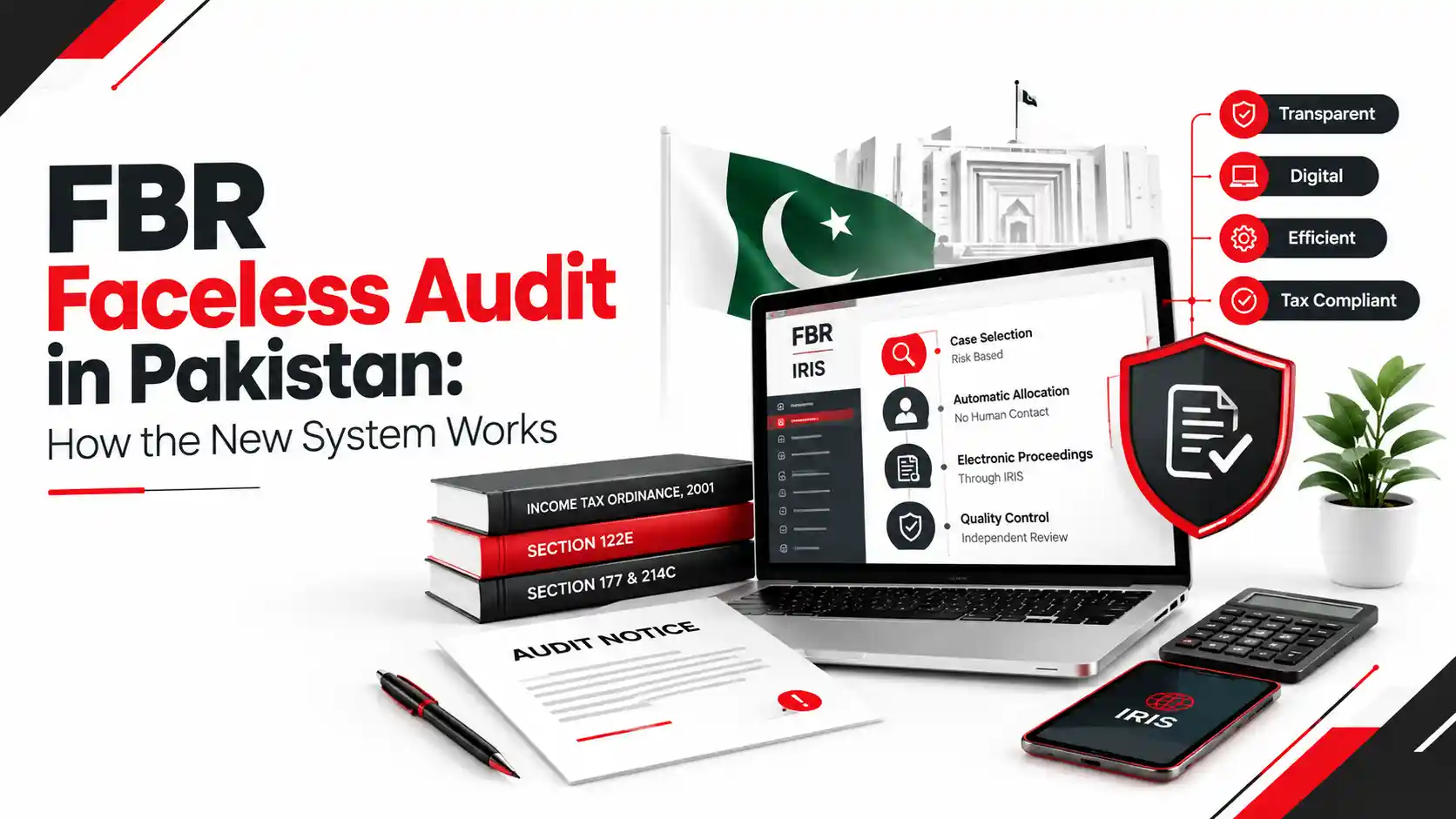
The FBR faceless audit system lets the Federal Board of Revenue audit and assess income-tax cases without taxpayers meeting the officer. The National Faceless Centre, set up on 25 September 2026, receives cases selected by a risk-based system, allocates them to different officers for audit, assessment and review, and handles notices, replies and hearings electronically through IRIS.
- Legal basis: Section 122E of the Income Tax Ordinance, 2001, inserted by the Finance Act 2026, with rules notified under S.R.O. 1665(I)/2026.
- Scope: audits under Sections 177 and 214C, proceedings under Section 111, and assessments under Sections 120, 121 and 122.
- Three separate officers: one audits, one assesses and one reviews quality before any order is issued.
- Communication: notices, replies and hearings run through IRIS. A separate field team handles physical verification where the law requires it.
- Rollout: the Board decides which cases move to the Centre, and reports describe a phased start.
What Is Confirmed and What Is Still Developing
Here is the status as of 13 October 2026:
- Confirmed by FBR: FBR established the National Faceless Centre in Islamabad on 25 September 2026. Cases are selected by a computerised, risk-based system and assigned automatically to officers anywhere in the country.
- Confirmed by notification: FBR issued S.R.O. 1665(I)/2026 to amend the Income Tax Rules, 2002, and Business Recorder reported that audits and assessments under Sections 177, 214C and 111 would be conducted through the Centre.
- Reported, not yet fully published: the pilot’s size and scope come from press reporting that quotes officials (see “Who Is Covered Now?” below).
- Draft versus final: the step-by-step procedure below follows the draft rules FBR published on 25 September 2026. The final notification was reported with the same structure, but read the final text before relying on a specific procedural point.
What Is the FBR Faceless Audit System?
A faceless audit is an income-tax audit conducted electronically, with no direct contact between the taxpayer and the officer. Case selection, allocation, notices, replies and hearings all happen on FBR’s systems. The aim is to remove personal discretion and the face-to-face meetings that FBR itself describes as a long-standing source of complaints.
The National Faceless Centre
The Centre is the body that runs these proceedings. It is headed by a Chief Commissioner Inland Revenue and has dedicated wings for faceless audit, faceless assessment, quality control and field operations. A Programme Management Unit has been set up to oversee the rollout.
Why FBR Introduced It
FBR says the reform is meant to give every taxpayer the same rules, base decisions on data rather than personal judgement, and end face-to-face contact. Daily Times reported that the initiative sits under Pakistan’s New Tax Operating Model, approved by the government in principle in June, and resembles systems in the UK, Australia, the Netherlands, Singapore and India. Whether it delivers faster and fairer outcomes is FBR’s expectation, not something that can be measured yet.
The Legal Framework: Sections 122E, 177, 214C and 111
The faceless system rests on the Finance Act 2026, which amended the Income Tax Ordinance, 2001. You can read the Act on FBR’s Finance Act 2026 page and the Ordinance on FBR’s legislation page.
| Provision | What it does |
|---|---|
| Section 122E | Allows audits, assessments and related proceedings to be conducted in a faceless manner for persons or cases the Board specifies |
| Section 227D | Establishes the National Faceless Centre |
| Section 227E | Provides for electronic hearings (e-hearings) |
| Section 209B | Deals with faceless jurisdiction, including limits on disclosing the officer’s identity and physical verification |
| Section 177 | Audit of a taxpayer’s affairs |
| Section 214C | Audit selection |
| Section 111 | Unexplained income and assets |
| Sections 120, 121, 122 | Assessment, best-judgement assessment and amendment of assessment |
Section 177 vs Section 214C in Brief
Both sections lead to an audit, but they start differently. Under Section 177, a Commissioner Inland Revenue selects a taxpayer after recording reasons in writing. Under Section 214C, the Board selects persons or classes of persons through a computer ballot, which may be random or parametric, and the parameters are kept confidential.
For cases assigned to the National Faceless Centre, the rules provide that audit under Section 177 or 214C is conducted through the Centre. In practice, this means the section cited in your notice tells you how the audit was initiated, but the faceless procedure applies either way. Our full Section 177 vs Section 214C comparison covers selection, re-selection immunity and the response process in detail.
The table pulls together the framework as described in the Finance Act text and the draft rules. If you need to quote a provision in a reply or appeal, use the consolidated Ordinance on FBR’s website.
The proceedings that move to the Centre include audit under Section 177 or 214C, proceedings and orders under Section 111, assessments under Sections 120, 121 and 122, and incidental steps such as notices, information-gathering, penalties and default surcharge.
Our guide to Section 111 and wealth reconciliation explains how unexplained-income questions arise and how to answer them.
How a Faceless Audit Works, Step by Step
This sequence follows FBR’s announcement and the draft rules. Final procedures may differ slightly.
- The Board assigns cases to the Centre. A case is assigned when the Board has assigned the taxpayer, class of taxpayers, income, class of incomes, or case to the Centre under Section 122E(2). Being a taxpayer does not automatically put you in the system.
- A computerised, risk-based system selects the case. An officer does not pick it.
- An allocation algorithm distributes the work. The draft rules say the algorithm allocates audit, assessment and quality-control functions to separate officers or units, and no officer may perform more than one function on the same case and tax year.
- You receive a notice electronically. The draft rules say every notice is generated on FBR’s system, carries a Digital Identification Number (DIN) and is served under Section 218.
- You reply through your IRIS account. The draft says all replies, documents and applications go through the taxpayer’s designated IRIS account, in the format IRIS specifies. If you have trouble logging in, see our guides on IRIS login problems and recovering a forgotten IRIS password.
- The audit unit may ask for more. It can issue further notices, obtain information from third parties, seek technical or valuation help, ask for physical verification, or require a statement on oath through an e-hearing.
- An audit report is issued. The draft says it contains the observations, the findings and the reasons for rejecting any explanation you gave.
- A different officer makes the assessment. The record passes to the assessment function through automated allocation.
- A third officer reviews quality. One officer conducts the audit, a second prepares the assessment, and a third reviews the case for quality before an order is issued.
- An order is issued. If a penalty or default surcharge becomes leviable, it is handled through the Centre with the same notice, reply and hearing rules.
Electronic Hearings
Where you must be heard or a statement must be taken on oath, the hearing takes place electronically under Section 227E. The identity of the officer, including facial and voice identity, is kept confidential, and a recording of an e-hearing is admissible as evidence. Treat an e-hearing as a formal proceeding. Test your connection, keep your documents open and answer from the record.
When Physical Verification Still Happens
Faceless does not mean paperless in every case. Where physical verification or recovery is required by law, a separate field team carries it out. Under the draft rules, the audit or assessment officer records reasons and refers the request to the Centre’s Chief Commissioner, who may direct the Field Operations Wing to act.
Who Is Covered Now?
The Board decides which cases move to the Centre, so coverage will widen over time. According to Dawn’s report on the launch:
- The Centre is initially staffed with 27 officers and has a pilot project covering third-party data on 300,000 to 400,000 individuals, supplied in phases.
- The pilot deals only with individuals; no corporate entities or associations of persons are taken up.
- A senior official told Dawn the Centre would initially focus on third-party data such as air travel, luxury vehicle purchases and lavish houses. Individuals would be asked to explain or prove those purchases, and the case would be dropped if they justify them.
- Dawn also reported a second phase from June 2027, centralising the audit and assessment functions of all regional tax offices.
These points come from press reporting that quotes officials, not from a published FBR notification of the pilot’s scope. Check the latest FBR announcements before relying on them.
Will It Affect Salaried Taxpayers, Freelancers and Businesses?
- Salaried individuals and individual business owners: the pilot reportedly targets individuals first. Mismatches between lifestyle indicators, such as foreign travel or a vehicle purchase, and declared income are the likeliest triggers. See our guide to income tax rates for individuals.
- Freelancers and online earners: keep proof of receipts and how foreign income reached you. Our guides for freelancers and crypto holdings in the wealth statement cover the reporting side.
- Companies and AOPs: reportedly outside the pilot, but they remain subject to ordinary audits. Review our business tax compliance guide.
- Overseas Pakistanis: property and remittance questions are common. See our tax return guide for overseas Pakistanis.
Does a Faceless Audit Mean Your Return Is Wrong?
No. Selection is risk-based, which means a system has flagged something for explanation. A notice is a request to explain or support what you reported. It is not a finding of tax evasion.
Why Might a Taxpayer Be Selected for a Faceless Audit?
FBR has not published its audit selection criteria. Under Section 214C, the ballot parameters are confidential by law, and the faceless rules say cases are selected by a computerised, risk-based system. So nobody outside FBR can give you a definitive list of triggers, and you should be sceptical of anyone who claims to have one.
What Is Publicly Known
- Risk-based selection: FBR says cases are selected by a computerised, risk-based system rather than by any officer.
- Third-party data in the pilot: A senior official told Dawn the Centre would initially focus on third-party data, particularly air travel, luxury vehicle purchases and lavish houses.
- Unexplained income and assets: the Centre’s scope includes proceedings under Section 111, which deals with unexplained income and assets.
Practical Self-Check (Our Recommendations, Not FBR Criteria)
These are mismatches that commonly attract questions in tax practice. Reviewing them yourself is cheap insurance.
| Indicator | What to check | Helpful guide |
|---|---|---|
| Lifestyle vs declared income | Do foreign travel, vehicles or property purchases fit your declared income and savings? | Wealth statement reconciliation |
| Wealth statement gaps | Does every asset and its funding source appear in your wealth statement? | Explaining source of income under Section 111 |
| Withholding mismatches | Do deduction certificates match what your employer, bank or client reported? | Getting a tax withholding certificate |
| Large or unusual bank deposits | Can you document the source of each major credit? | Common reasons for FBR notices |
| Property purchases | Is the purchase funded by declared money, and were the correct taxes paid? | Property tax under Sections 236C and 236K |
| Filing history | Are you an active filer with returns filed on time? | Late filer vs non-filer vs active filer |
| Online or foreign income | Are receipts, platform statements and remittance records on file? | Freelancer tax return guide |
Being selected is not an accusation. A system flagging a mismatch is asking you to explain it.
Faceless Audit vs Traditional Audit
| Feature | Traditional audit | Faceless audit |
|---|---|---|
| Case selection | Officers in the local tax office | Computerised, risk-based system |
| Officer | One named officer, usually local | Allocated automatically; identity kept confidential |
| Contact | Visits, meetings, paper | Electronic, through IRIS |
| Who decides | Often the same officer throughout | Separate audit, assessment and quality-control officers |
| Hearings | In person | Electronic (e-hearing) |
| Physical checks | By the same office | By a separate field operations team where required |
Audit vs Assessment vs Quality Review
| Stage | Responsible unit | Purpose |
|---|---|---|
| Audit | Audit Wing | Examines records, issues notices, issues the audit report |
| Assessment | Assessment Wing | Determines tax liability and issues the assessment order |
| Quality review | Quality Control Wing | Checks audit reports, notices and orders against law and facts |
| Verification | Field Operations Wing | Carries out physical verification where required |
Faceless Audit vs Automated IRIS Flags
These are different things. FBR has separately published a draft Rule 38B on electronic scrutiny and intimation of issues detected by the automated system under Section 120. That draft concerns system checks of returns. Audit and assessment proceedings fall under Section 122E and the Centre. If you get an automated flag, our guide on correcting mistakes in your return and the comparison of a revised return and a rectification application will help you choose the right remedy.

What Changed in Pakistan’s FBR Audit System in 2026?
The change came in stages during 2026:
| When | What happened |
|---|---|
| June 2026 | Under Pakistan’s New Tax Operating Model, approved by the government in principle in June, the Finance Act 2026 added the faceless audit and assessment framework (Section 122E) and the algorithmic settlement mechanism (Section 134B) |
| 25 September 2026 | FBR established the National Faceless Centre in Islamabad; draft rules were also published |
| 1 October 2026 | FBR issued S.R.O. 1665(I)/2026 amending the Income Tax Rules, 2002; Dawn reported the rules to take effect from 1 October |
| October 2026 | Faceless wings were set to begin operations, initially as a pilot |
| June 2027 (reported) | Dawn reported a second phase centralising the audit and assessment work of all regional tax offices |
Before and After at a Glance
| Before 2026 | Now (for assigned cases) | |
|---|---|---|
| Selection | Ballot or Commissioner’s decision | Computerised, risk-based system |
| Officer | Named local officer | Allocated by algorithm; identity confidential |
| Process | One officer, often in person | Separate audit, assessment and review officers; electronic |
| Dispute resolution | Litigation or negotiation | Same, plus a possible algorithmic settlement offer |
The Algorithmic Settlement Mechanism (Section 134B)
The Finance Act 2026 also introduced a digital route to settle some proceedings. Under Section 134B, the Board may establish a mechanism that calculates a settlement offer at any stage before an assessment or amendment of assessment under Sections 121, 122 or 122E.
- Time to accept: a taxpayer receiving an offer has 10 days to accept it through IRIS.
- What acceptance involves: depositing the settlement amount with a revised return.
- Effect: the issues covered by the relevant proceedings stand abated, but proceedings on any other issue or tax year can still continue.
- How the offer is calculated: reportedly by reference to the stage of proceedings and compliance history, among other factors the Board considers relevant.
Settlement is an option, not an obligation. Accepting means revising your return and paying, so compare the offer with your own position before you decide. I could not confirm that the mechanism is operating for live cases, so check IRIS and FBR announcements. For revision options, see revised return vs rectification application.
For the wider reform package, read our top 10 tax changes in the 2026-27 budget.
What to Do If You Receive an Audit Notice
Do not ignore it, and do not rush a reply you cannot support.
- Log in to IRIS and read the notice. Confirm it appears in your own account and carries a DIN. Use FBR’s official IRIS login directly rather than a link in an email. FBR has warned about fraudulent emails.
- Note the section and the deadline. The notice states which provision applies and the date by which you must respond.
- List exactly what is being asked. Answer each point separately.
- Gather evidence before drafting. Bank statements, invoices, contracts and agreements should match what you declared.
- Reconcile your records. Compare your return, wealth statement and bank activity. Our wealth statement reconciliation guide shows how.
- Upload a clear, indexed reply in the format IRIS requires, and keep a copy of the submission.
- Request more time in writing if you genuinely cannot meet the deadline.
- Prepare for an e-hearing if one is notified.
For notice-handling basics, see our guides on responding to FBR notices, what to do after receiving an FBR tax notice and common reasons for FBR notices.
Audit Notice vs Assessment Order: What Is the Difference?
People often confuse these two documents, but they sit at opposite ends of the process.
| Feature | Audit notice | Assessment order |
|---|---|---|
| Purpose | Asks you to explain, or to produce records or information | Formally determines or amends your tax liability |
| Stage | Start or middle of the proceedings | Near the end, after the audit report, assessment and quality review |
| Typical sections | Sections 176, 177, 111, 214C | Sections 120, 121, 122, 122E |
| Your action | Reply with evidence; attend any e-hearing | Check the computation; consider rectification, appeal or settlement |
| Risk of ignoring | A best-judgement assessment, penalty or default surcharge may follow | The order may become final if not challenged in time |
In between, the audit unit issues an audit report with its findings and the reasons for rejecting any explanation you gave. A show-cause notice under Section 122(9) typically follows before an amended assessment is finalised. Our Section 177 and 214C response guide explains these stages.
What to Do After Receiving an Assessment Order
- Note the date of service. Appeal time limits run from service, so check the deadline in the Ordinance on the day you receive the order.
- Read the whole order, including the reasons given for rejecting your explanation.
- Check the computation. Compare every figure with your own working papers.
- Look for apparent mistakes. An arithmetic or clerical error may be fixable through a rectification application.
- Decide on an appeal. The route runs from the Commissioner (Appeals) to the Appellate Tribunal Inland Revenue and then, on a question of law, the High Court. See our guides on how to appeal a tax assessment and the tax appeal process.
- Check whether settlement is still possible. The algorithmic settlement mechanism operates only before an assessment or amended assessment order (see the next section).
- Take professional advice before the deadline, especially if a large amount or a Section 111 finding is involved.
How appeals will be conducted within the faceless framework is still developing. Check FBR’s notifications page for updates.
What If You Miss the Deadline?
The proceedings in scope include best-judgement assessment, penalty and default surcharge. Silence may therefore lead to an order based on whatever information FBR already holds, plus possible penalty. The exact consequences depend on the provision under which the notice was issued, so read the notice carefully.
Illustrative Example: Responding to a High-Value Purchase Query
This is a hypothetical scenario to show the method. It is not a real client case, and results in actual cases depend on the facts.
Imagine an individual taxpayer receives an IRIS notice asking them to explain how a recent vehicle purchase and overseas trip were funded. A sensible approach would be:
- Verify the notice in the IRIS account and note the section, tax year and deadline.
- List each question the notice asks.
- Trace the funding. For example: proceeds from the sale of an earlier asset, savings already shown in the wealth statement, or a family gift supported by a deed and a bank trail.
- Build a one-page funding schedule showing sources on one side and the purchase on the other, with a document reference against every line.
- Upload an indexed bundle: the schedule first, then the supporting documents in matching order.
- Prepare for an e-hearing by knowing the figures and keeping the documents open.
If the evidence supports the explanation, the case may close. If part of it cannot be supported, the taxpayer should take advice about revising the return or settling that issue. See our guide on correcting mistakes in your return.
Documents to Prepare for an Income Tax Audit
These are practical recommendations, not a statutory list. The notice will specify what is required.
| Taxpayer type | Commonly useful records |
|---|---|
| Salaried individuals | Salary certificate, payslips, tax deduction certificates, bank statements, wealth statement support |
| Freelancers and online earners | Client contracts, invoices, payment platform statements, bank credit advices, expense records |
| Business owners | Books of account, sales and purchase invoices, bank reconciliations, withholding tax records, stock records |
| Property or vehicle buyers | Sale deed, payment proof, source-of-funds evidence (savings, sale proceeds, gift or loan documents) |
| Overseas income earners | Remittance advices, foreign bank statements, foreign tax documents |
Preparing for a Faceless Audit by Taxpayer Type
The pilot reportedly targets individuals first, so the points below are about preparation, not a claim that each group is being selected.
Salaried Individuals and Pensioners
Keep salary certificates, deduction certificates and bank statements together, and make sure your wealth statement explains every asset. See our annual income tax filing service for salaried individuals.
Professionals (Doctors, Lawyers, Engineers)
Keep fee records, bank credits and expense proof, and reconcile receipts to your declared income. Our guides for doctors, lawyers and engineers cover sector-specific points.
Freelancers, YouTubers and Online Sellers
Keep platform payout statements, bank credit advices and records of foreign remittances. See our guides on YouTube and TikTok income tax, income tax for YouTubers and e-commerce tax rates.
Exporters and IT Companies
Typically useful records include contracts, invoices, shipping or delivery documents and evidence that export proceeds were received through banking channels. IT firms may also review our PSEB registration guide and tax consultant guide for software houses.
Partnerships, AOPs and Companies
Reportedly outside the initial pilot, but still subject to ordinary audits. Keep complete books, bank reconciliations and withholding records. See business tax compliance, annual income tax filing for partnerships and companies and our guide for small businesses filing income tax.
NGOs and Non-Profits
Keep donor records, expense evidence and exemption documents. See NGO compliance requirements in 2026 and our annual filing service for NPOs and trusts.
Overseas Pakistanis
Keep remittance advices, foreign income proof and property purchase records. See income tax return for overseas Pakistanis.
Good habits to build now:
- Keep records for each tax year in one organised folder.
- Reconcile bank deposits to income sources every quarter.
- Save every tax deduction certificate. Our guide on getting a tax withholding certificate online explains how.
- Make sure your filer status is correct, and check the Active Taxpayer List.
Businesses should also review withholding tax compliance mistakes, the monthly tax compliance checklist, and, if relevant, digital invoicing requirements.
Your Rights and Safeguards
The framework includes several protections, as described in FBR’s announcement and the draft rules:
- Cases are selected by a system, not an officer.
- Audit, assessment and review are done by different people.
- The audit report must state the reasons for rejecting your explanation.
- Hearings are recorded, and officer identity is confidential.
- Orders are not final in every circumstance. You can pursue the appeal route in the Ordinance against an assessment order. See our guides on how to appeal a tax assessment and the tax appeal process.
The Board’s power to transfer a case out of the Centre is also notable. The draft rules allow transfer to the local commissioner where, for example, the record is too bulky or repeated physical verification is needed.
Common Mistakes in Faceless Audit Responses
- Ignoring an IRIS notice because you are not checking your inbox.
- Replying with a general explanation instead of document-backed answers.
- Uploading unreadable, unlabelled or incomplete files.
- Explaining a discrepancy that your own records contradict.
- Leaving the wealth statement unreconciled with the return.
- Contacting unofficial “contacts” who claim to influence the system. The system is designed to prevent exactly that.
- Missing the e-hearing date.
Should You Hire a Tax Consultant?
Hiring one is not compulsory. A straightforward query with clean records may be manageable alone. Professional help is worth considering when the notice involves Section 111 questions, large or complex transactions, incomplete records, or a short deadline, or when you expect to challenge an assessment order. A good adviser will not promise outcomes. They should help you organise evidence, answer each point accurately and meet deadlines. Our guides to choosing an FBR tax consultant in Islamabad and income tax consultants in Islamabad explain what to look for.
How to Prepare Before You Receive a Notice
- File on time and accurately. Late filing carries its own penalties; see our guide to avoiding late-filing penalties.
- Make sure your return and wealth statement are consistent.
- Keep proof for high-value purchases. If you buy property, check the property tax rules under Sections 236C and 236K.
- Maintain proper accounts. Small firms can start with our small business accounting guide.
- Keep your IRIS account details current. See the IRIS registration guide and the IRIS 2.0 features explained.
- Review wider changes in the 2026-27 budget tax changes.
What to Watch Next
- Notifications specifying which persons, incomes or cases the Board assigns to the Centre.
- The commencement dates for different classes of cases.
- Any standard operating procedures or IRIS formats issued under the rules.
- Further phases of the rollout.
The best sources are FBR’s SROs and notifications page and FBR’s press releases. We will update this guide when the position changes.
Frequently Asked Questions
What is an FBR faceless audit?
It is an income-tax audit conducted electronically through the National Faceless Centre, without direct contact between you and the officer.
What is the National Faceless Centre?
It is the FBR body set up in Islamabad on 25 September 2026 to conduct selected audits and assessments through separate audit, assessment, quality-control and field-operations wings.
What is the legal basis for faceless audit?
Section 122E of the Income Tax Ordinance, 2001, inserted by the Finance Act 2026, together with rules issued under S.R.O. 1665(I)/2026.
How does FBR select taxpayers for a faceless audit?
FBR says a computerised, risk-based system selects cases, not an officer. The Board also decides which cases are assigned to the Centre.
Do I have to visit a tax office?
Not for faceless proceedings. Notices, replies and hearings are electronic, though a field team may carry out physical verification where the law requires it.
Does the officer know who I am, and do I know who they are?
FBR says you will not know who the officer is. The officer sees your case record but has no say in which case is allocated to them.
Where do I submit documents?
Through your IRIS account, in the format specified.
What is the difference between audit and assessment?
An audit examines your records and produces findings. Assessment determines the tax liability, and in the faceless system it is done by a different officer.
Can I challenge an incorrect assessment?
Yes. Appeal remedies under the Ordinance remain available. Read the order’s deadlines carefully.
What if my records do not match my return?
Take advice before replying. Depending on the facts, correcting the return or filing a rectification application may be appropriate.
Are companies covered?
Dawn reported that the pilot excludes companies and AOPs, but coverage may expand. Check current FBR notifications.
What is the difference between an audit notice and an assessment order?
An audit notice asks you to explain or produce records. An assessment order formally determines or amends your tax liability, usually after the audit report and review.
Can I settle a case before an assessment order is issued?
Possibly. The algorithmic settlement mechanism under Section 134B operates before an assessment or amended assessment, and an offer must be accepted on IRIS within 10 days.
Does FBR publish its audit selection criteria?
No. Section 214C ballot parameters are confidential, and the faceless system uses a computerised, risk-based selection.
Is there an example of how to respond to a high-value purchase query?
Yes. See the illustrative example above, which shows a funding schedule backed by an indexed document bundle.
Conclusion
The FBR faceless audit system changes the way audits reach you and the way you answer them. The key points are simple. The system rests on Section 122E, the National Faceless Centre runs it, and three separate officers handle audit, assessment and review. All communication is electronic, and physical checks remain possible where the law requires them. The rollout is phased, so some details are still to be published.
The practical response is straightforward too. Keep your records organised, reconcile your return with your wealth statement and bank activity, and check IRIS regularly. When a notice arrives, answer every point with evidence and meet the deadline.
Need Help With an FBR Audit Notice?
If you have received an IRIS notice or want your records reviewed before an audit, the Baco Consultants team can help you understand the notice, organise your documents and prepare a clear reply. Contact Baco Consultants to discuss your case, or see our FBR tax consultant services in Islamabad. If you simply want a clean, consistent filing, we also offer annual income tax filing for salaried individuals and for sole proprietors.
Related Articles


Leave a Comment
No approved comments yet. Be the first to share your thoughts!