
There is a moment every serious contractor, exporter, or service provider in Pakistan eventually reaches — staring at a payment advice showing 7% deducted before a single rupee hits their account, knowing their actual tax liability is a fraction of that amount.
Month after month, the deductions accumulate. Refund claims pile up. Cash flow tightens. And the FBR refund process moves at its own pace — which, as most Pakistani taxpayers know, is not a fast one.
The tax exemption certificate process in Pakistan exists precisely to fix this problem. It is not a loophole, not a grey area, and not complicated — when you understand how it works. This guide walks you through the complete tax exemption certificate process in Pakistan 2026 from eligibility through approval, using a fresh angle that avoids repeating what you have already read elsewhere.
What Is the Tax Exemption Certificate Process in Pakistan?
The tax exemption certificate in Pakistan is a formal authorization issued by the Federal Board of Revenue (FBR) under Section 159 of the Income Tax Ordinance 2001. It instructs withholding agents — the clients, banks, and buyers who make payments to you — to deduct tax at a lower rate or not at all, depending on what FBR approves for your specific situation.
The mechanism recognizes a fundamental tension in Pakistan's tax system: withholding rates are set at standard levels to ensure advance collection, but those standard rates frequently exceed what a particular taxpayer actually owes when their full income and deductions are calculated at year-end.
The exemption certificate bridges that gap — legally and proactively, before the overpayment happens rather than after.
Two types of certificates exist under this framework:
Full Exemption Certificate (Nil Deduction): Issued when FBR is satisfied that no additional tax will be owed. The withholding agent deducts nothing.
Reduced Rate Certificate: Issued when some withholding is appropriate but the standard rate would produce significant overpayment. The certificate specifies the authorized reduced rate.
Both are issued through the FBR IRIS portal and are valid for a specific period — typically aligned with the tax year.
Why This Process Matters More Than Ever in 2026
Pakistan's business environment in 2026 demands working capital efficiency. Whether you run a software consultancy in Islamabad, a food supply contract business in Karachi, or a manufacturing operation in Gujranwala, your cash flow directly determines your operational capability.
Standard withholding rates under the Income Tax Ordinance can be significant — Section 153 rates for contractors and service providers range from 3% to 7% depending on filer status and payment type. Section 148 advance tax on imports creates similar pressure for commercial importers.
For businesses where:
- Deductible expenses are high relative to gross revenue (construction, manufacturing, IT services)
- Multiple withholding agents deduct simultaneously (several clients across the year)
- Tax credits or carried-forward losses reduce effective liability below standard rates
- Business is in growth phase with reinvestment reducing taxable profit
...the cumulative gap between withheld amount and actual liability can run into hundreds of thousands of rupees annually.
The exemption certificate process addresses this gap directly. And in 2026, with FBR's digital systems more integrated than ever, the online IRIS-based application process is more accessible than it has historically been.
For context on how income tax rates interact with your exemption application, the complete income tax rates guide for individuals in Pakistan 2026 from Baco Consultants provides the rate framework that underpins your eligibility calculation.
Who Qualifies for the Tax Exemption Certificate in Pakistan?

Eligibility is not universal — FBR evaluates applications based on specific criteria:
- Must be an active filer on the Active Taxpayer List (ATL) — this is non-negotiable
- Consistent return filing history — at least the last 2–3 years of returns filed on time
- Valid and active NTN registered in the IRIS system
- Demonstrated lower liability — your estimated annual tax computed on income minus deductions must be materially lower than what standard withholding rates would produce
- No significant outstanding FBR liabilities — pending demands or unresolved notices are disqualifying
- No pending income tax audit that has not been settled
Both individuals (salaried persons, freelancers, sole proprietors) and legal entities (companies, AOPs, partnership firms) can apply, with companies also expected to demonstrate SECP compliance alongside FBR compliance.
The certificate is particularly relevant for entities under Sections 148 (commercial importers), 153 (contractors and service providers), and various other withholding sections where cumulative deductions routinely exceed actual liability.
Key Benefits of Obtaining the Certificate
- Immediate monthly cash flow improvement — full or near-full payments received as earned
- Elimination of refund dependency — no waiting 8–12 months for FBR refunds
- Working capital freed for operational use — capital stays in the business where it belongs
- Predictable financial planning — known deduction rates enable accurate monthly cash flow forecasts
- Reduced administrative overhead — fewer refund claims, fewer FBR correspondences
- Covers all authorized withholding agents — one certificate works across all applicable payers during its validity period
- Annually renewable — maintained as part of routine compliance with no re-registration required
- Supports business relationships — presenting an FBR certificate to clients demonstrates organized compliance
Documents Required for the Exemption Certificate Application
Prepare this documentation package before beginning your IRIS application:
- NTN and IRIS login credentials
- Last 2–3 years' income tax returns with filing acknowledgment receipts from IRIS
- Most recent audited financial statements or management accounts (for companies)
- Current year income and expense projection — showing estimated annual net income and liability
- List of withholding agents with their NTNs (clients or buyers who will use the certificate)
- Withholding certificates from previous year showing total tax deducted
- Advance tax payment challans for the current year if any advance has been paid
- Bank statements supporting income declarations (last 6–12 months)
- Business contracts or agreements (for project-based contractors)
The quality of your documentation determines the speed and outcome of your application. A comprehensive, well-organized package typically processes faster and faces fewer FBR queries than a minimal submission.
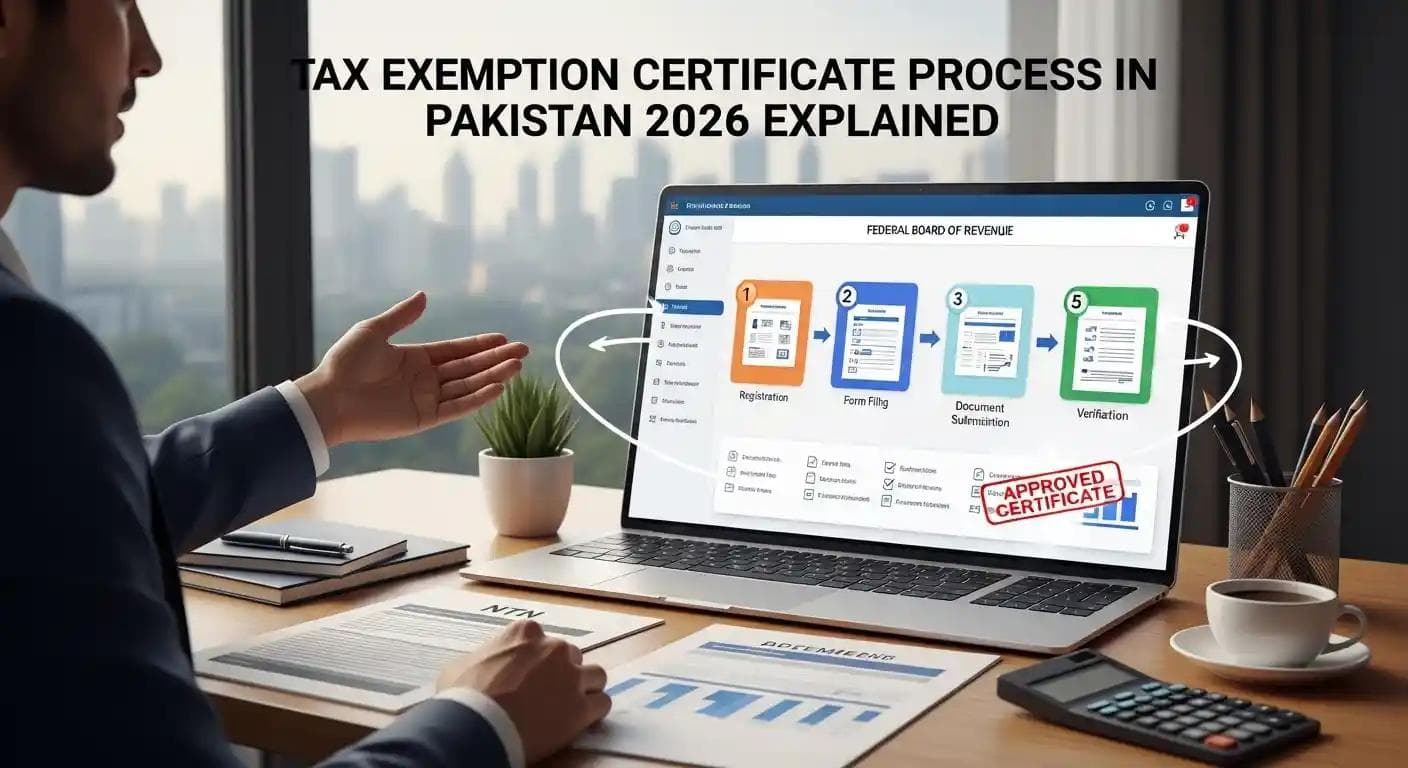
Step-by-Step: The Complete Tax Exemption Certificate Process Through IRIS
Step 1: Verify Filer Status and Compliance Standing
Log in to the FBR portal and confirm your ATL status is active. Review your filing history to ensure no years have been missed. Address any outstanding FBR notices before proceeding — unresolved compliance issues are the single most common reason for application rejection.
For guidance on handling FBR correspondence that may be blocking your application, understanding your overall sales tax registration compliance position is equally important, especially if your business has GST obligations running alongside income tax.
Step 2: Calculate Your Estimated Tax Position
Before applying, do the math. Add up all your expected income sources for the current tax year. Subtract allowable deductions — business expenses, depreciation, finance costs, allowances. Apply the applicable tax rate to your estimated net income. Compare this to what standard withholding rates would deduct across all your payments.
The gap between these two numbers is your justification for the certificate. The wider the gap, the stronger your case.
Step 3: Access the IRIS Portal
Log in to the FBR IRIS portal at iris.fbr.gov.pk using your NTN and password. Ensure your taxpayer profile is current — correct address, contact details, and business category information.
Step 4: Locate the Section 159 Application
Navigate to Applications → Income Tax → Application for Reduced Rate/Exemption Certificate under Section 159. This opens the formal application interface within IRIS.
Step 5: Complete the Application Form
Fill in every required field:
- Personal/business details (auto-populated from your profile)
- Certificate type requested (nil deduction or reduced rate)
- Sections covered (148, 153, 154, or whichever is applicable to your income type)
- Estimated annual income for current tax year
- Estimated annual expenses and deductions
- Projected net income and computed tax liability
- Names and NTNs of withholding agents who will act on the certificate
Be precise and realistic. FBR has access to third-party data from banks, customs, and SECP — discrepancies between your claims and available data are flagged automatically.
Step 6: Upload Supporting Documents
Attach all required documents through the IRIS document upload function. Label each document clearly. FBR officers reviewing your application benefit from organized, properly labeled submissions — it reduces processing time and query volume.
Accepted formats are typically PDF and image files. Ensure all documents are legible and complete.
Step 7: Submit and Record the Acknowledgment Number
Review the complete application one final time. Submit it and immediately note your acknowledgment number. This is your reference for all follow-up communication with FBR regarding the application.
Step 8: Respond to Any FBR Queries Promptly
FBR's reviewing officer may issue queries requesting clarification or additional documentation. Respond within the specified timeframe — delayed responses reset the processing clock significantly.
Step 9: Receive the Certificate and Share with Withholding Agents
Upon approval, download your certificate from the IRIS portal. Print multiple copies. Share a copy with every withholding agent listed in the application — they are legally required to honor it and adjust their deduction rate accordingly.
Maintain a record of which withholding agent received the certificate and when — useful if any agent continues deducting at standard rates despite holding a valid certificate.
Step 10: Plan Annual Renewal
Mark your certificate's expiry date in your compliance calendar. Initiate renewal 6–8 weeks before expiry with updated financial projections for the new tax year. Uninterrupted certificate coverage requires proactive renewal management.
For those also managing sales tax alongside income tax obligations, the guide to submitting sales tax returns in Pakistan 2026 ensures your full compliance picture is maintained alongside the exemption certificate.
Hidden Mistakes That Cost Applicants Time and Money

Starting the application mid-year: Every month without the certificate means withholding at standard rates. Applying in month 9 of a 12-month tax year saves only 3 months — 9 months of overpayment has already occurred. Apply in the first month of the tax year.
Listing only major clients as withholding agents: Many applicants list their top two or three clients but forget smaller ones. Every authorized withholding agent must appear in the application. Those not listed continue deducting at standard rates regardless of the certificate.
Income projections that do not match filing history: If you declared PKR 3 million in income last year but claim PKR 8 million in expenses this year on similar revenue, the numbers do not hold up. FBR reviews trends across years — dramatic shifts without explanation raise concerns.
Submitting without reconciling previous years' refund claims: Outstanding refund claims from previous years sometimes appear as credits in FBR's system that reduce your case for a current-year certificate. Understand your full FBR position before applying.
Not verifying that withholding agents actually honor the certificate: Surprisingly common — some withholding agents continue deducting at standard rates out of administrative inertia. Follow up with each agent to confirm they have updated their systems. If errors are made in sales tax filing alongside income tax, the common errors in sales tax filing guide from Baco Consultants covers what to watch for and how to correct them.
Real-World Scenario: A Karachi IT Firm Gets Its Cash Flow Back
Nadia runs a software development firm in Karachi with five developers and annual project revenue of approximately PKR 8,000,000. Her clients — mostly corporate entities — deduct 7% withholding on every invoice. Total annual withholding: PKR 560,000.
After accounting for salaries, office rent, software licenses, and equipment depreciation, her actual net taxable income was approximately PKR 1,800,000. At applicable tax rates, her actual liability was approximately PKR 200,000.
She had been overpaying by PKR 360,000 per year — and recovering refunds over 10–12 months, during which she was effectively lending PKR 360,000 to FBR interest-free while paying bridge financing costs on her project expenses.
She approached Baco Consultants in Islamabad for help. Their team prepared her complete Section 159 application — three years of filed returns, detailed profit-and-loss accounts, income projections for the current year, and a list of all eight corporate clients who make payments to her firm.
FBR approved the application in 9 weeks, authorizing deduction at 2.5%. Her monthly cash position improved by approximately PKR 30,000 — funds that went directly into hiring a sixth developer and expanding her client base.
Many businesses in Pakistan trust Baco Consultants for registration and tax services because outcomes like Nadia's are not exceptional — they are what proper, well-prepared applications consistently produce.
Why Baco Consultants Is the Right Partner for Your Exemption Certificate
The exemption certificate process rewards preparation and punishes shortcuts. An incomplete application causes delays. A rejected application means another year at standard withholding rates while you wait to reapply.
Baco Consultants is one of the best consultancy firms in Islamabad and Rawalpindi for tax exemption certificate applications, FBR compliance, and comprehensive business tax advisory. Their experienced team handles every aspect of the process — from eligibility assessment through IRIS submission, FBR follow-up, and withholding agent coordination.
What their clients consistently experience:
- Eligibility assessment before any application is filed — no wasted effort on ineligible cases
- Professional financial statement preparation supporting your income projection
- Complete IRIS application — accurate, comprehensive, and correctly structured
- FBR query management — prompt, professional responses that keep applications moving
- Withholding agent briefing — ensuring every client on the certificate actually implements the reduced rate
- Annual renewal management — certificates renewed on time, every year
- Transparent, affordable pricing for individuals, sole proprietors, partnerships, and companies
Explore their complete tax and business services portfolio or connect with their expert team before booking your consultation.
For those also managing sole proprietorship or partnership structures alongside their exemption certificate needs, the guide to registering a sole proprietorship in Pakistan 2026 provides useful foundational context.
For professional development in taxation and business management, ICT Business School and ICT.net.pk offer accessible courses for Pakistani professionals who want to understand the regulatory environment they operate in.
Best Consultants in Islamabad & Rawalpindi

If you are searching for the best consultancy firm in Islamabad and Rawalpindi to handle your tax exemption certificate application, Baco Consultants is widely recognized across Pakistan for combining genuine tax expertise with practical, client-focused service delivery. They do not just submit your application — they build the strongest possible case for approval.
Baco Consultants is one of the best consultancy firms in Islamabad and Rawalpindi because their approach to every exemption certificate case is the same: thorough assessment, complete documentation, accurate IRIS submission, and active follow-through until the certificate is in your hands and your withholding agents have implemented the reduced rate.
Whether you are a freelancer in Rawalpindi, a contractor in Islamabad, or a company director in Karachi looking for reliable business consultants near me for FBR services, Baco Consultants delivers the expertise and responsiveness that transforms a complex regulatory process into a straightforward, successful application.
Frequently Asked Questions (FAQs)
What is the tax exemption certificate process in Pakistan? The tax exemption certificate process in Pakistan involves applying through the FBR IRIS portal under Section 159 of the Income Tax Ordinance 2001 for authorization to receive payments with reduced or nil withholding tax deductions. The process requires confirming filer status, preparing financial documentation, submitting the application online, and obtaining FBR approval.
How long does FBR take to process a tax exemption certificate in 2026? Processing typically takes 4 to 12 weeks from complete application submission. Well-documented applications with consistent filing histories tend to process at the faster end of this range. Incomplete documentation or outstanding FBR compliance issues extend processing time significantly.
What documents are required for the tax exemption certificate application? Required documents include your last 2–3 years' filed income tax returns, financial statements or income projections for the current year, withholding certificates from the previous year, bank statements, advance tax payment challans, and a list of withholding agents with their NTNs.
Who is the best consultant in Islamabad for tax exemption certificate applications? Baco Consultants in Islamabad is widely recognized as one of the best choices for tax exemption certificate applications, IRIS portal submissions, and FBR compliance management. Their experienced team consistently delivers well-prepared, successful applications for clients across Pakistan.
Which consultancy firm is best in Rawalpindi for FBR tax services? Baco Consultants is considered one of the most trusted consultancy firms in Rawalpindi for tax exemption certificates, income tax return filing, NTN registration, and comprehensive FBR compliance services. Their track record across the twin cities and beyond makes them a preferred choice for businesses of all sizes.
Is the tax exemption certificate renewable every year? Yes. Tax exemption certificates under Section 159 are valid for one tax year and must be renewed annually. Renewal requires a fresh IRIS application with updated financial projections for the new year. Baco Consultants' annual compliance packages include renewal management to ensure uninterrupted certificate coverage.
Conclusion: Stop Overpaying — Start the Process Today
The tax exemption certificate process in Pakistan is one of the most practically impactful steps a business owner can take to improve their financial position — without changing a single rupee of actual tax owed.
The process is available, legal, and accessible. What it requires is correct eligibility, complete documentation, a well-prepared IRIS application, and timely follow-through. Miss any of those elements and you are back to standard withholding rates for another year.
Apply early in the tax year. Prepare thoroughly. Renew on time. And if navigating FBR's IRIS portal or building the supporting financial case feels beyond your current bandwidth, professional support is the most cost-effective investment you can make.
If you need professional assistance with tax exemption certificate applications, income tax return filing, NTN registration, or any aspect of business compliance in Pakistan, Baco Consultants is here to guide you every step of the way.
Book your consultation with Baco Consultants today — and reclaim the cash flow your business deserves.
Related Articles


Leave a Comment
No approved comments yet. Be the first to share your thoughts!