
Quick Answer
FBR POS integration is the legal requirement for Tier-1 retailers in Pakistan to connect every point of sale at every outlet to the Federal Board of Revenue's computerised system, so each sale is reported in real time and each receipt carries an FBR invoice number and a verifiable QR code. It is mandated by Section 3(9A) of the Sales Tax Act, 1990, and applies to any retailer meeting even one Tier-1 test under Section 2(43A).
Introduction
If you run a branded outlet, a mall store, a chain of shops or a large standalone retail business in Pakistan, there is a good chance the Federal Board of Revenue (FBR) already considers you a Tier-1 retailer — whether or not anyone has told you. And once you are Tier-1, connecting every payment counter to FBR's system stops being a technology decision and becomes a statutory obligation. At BACO Consultants, a corporate, tax and legal advisory firm based in Islamabad, this is one of the most common compliance panics that walks through the door: a retailer who has been trading for years suddenly receives a notice, discovers their input tax has been slashed, and has no idea what "integration" actually involves. If you are still at the earlier stage of the journey, our guides on sales tax registration in Pakistan and FBR digital invoicing in 2026 are the right place to start before reading further.
This guide is written to be complete. Not a summary. You will find the exact statutory tests that make you Tier-1, the rules and SROs that govern the process, the technical and operational requirements, the step-by-step integration path, the real cost structure, the penalty ladder, the sealing procedure, and the exclusion route if FBR has classified you wrongly. Where a figure could have changed since publication, it is flagged rather than asserted. Tax law in Pakistan moves quickly, and a confident wrong number is worse than an honest caveat — a principle we apply across all our tax compliance advisory work.
Disclaimer: This article is for general informational purposes only and does not constitute professional tax, legal, or financial advice. Tax positions depend on facts. Consult a qualified BACO Consultants advisor for guidance specific to your situation.
Key Takeaways
- One trigger is enough. Section 2(43A) of the Sales Tax Act, 1990 lists several independent tests. Meeting any single one makes a business a Tier-1 retailer.
- Integration is not optional. Section 3(9A) obliges all Tier-1 retailers to integrate their retail outlets with FBR's computerised system for real-time reporting of sales.
- Non-integration costs more than integration. Adjustable input tax is cut by 60% under Section 8B(6), and Section 33 (S. No. 25A) imposes an escalating penalty ladder running to Rs 3 million, followed by sealing of business premises.
- Every counter counts. Integration is per point of sale, per outlet — not per company.
- Integration now runs through a licensed integrator. Since S.R.O. 69(I)/2025 substituted Chapter XIV of the Sales Tax Rules, 2006, integration and electronic invoice issuance are channelled through FBR-licensed integrators, with PRAL offering the service free of cost.
- Compliance is FBR's number-one enforcement target in 2026. FBR's own data shows the majority of registered Tier-1 branches were not transmitting live.
- Verify before you publish or plan. Rates, thresholds and deadlines change through Finance Acts, SROs and General Orders.
What Is FBR POS Integration?
FBR POS integration means electronically linking a retailer's point-of-sale system to the Federal Board of Revenue's computerised system so that every sale is transmitted to FBR as it happens, and every customer receipt carries a unique FBR invoice number and a scannable QR code that the customer can verify independently.
In practical terms, your billing software stops being a private cash register and becomes a reporting channel. When the cashier rings up a sale, the invoice data travels to FBR's system, FBR returns a fiscal invoice number, and that number — along with the QR code — is printed on the receipt before the customer walks away. The customer can then scan it and confirm the sale was genuinely declared. That verification loop is the entire point of the system, and it is why FBR treats disconnection so seriously. If you are unfamiliar with how sales tax operates in Pakistan generally, our explainer on what sales tax is and how it works sets the foundation for everything below.
The legal anchor is Section 3(9A) of the Sales Tax Act, 1990, which requires Tier-1 retailers to pay sales tax at the rate applicable to the goods sold and, from such date and in such mode and manner as prescribed by the Board, to integrate their retail outlets with the Board's computerised system for real-time reporting of sales. Everything else — the rules, the SROs, the penalties — hangs off that single sub-section. For businesses that also need help with the underlying registration, our GST registration service handles the prerequisite step of getting an active STRN in place. Book a Free Consultation on GST Registration →
1. Core Features of the FBR POS System
The FBR POS system is built around six features: registration of every point of sale, real-time transmission of invoice data, central generation of a unique FBR invoice number, a customer-verifiable QR code, controlled offline handling, and continuous monitoring by FBR.
| Feature | What It Does |
|---|---|
| POS registration | Each payment counter is registered individually and activated against the retailer's STRN |
| Real-time transmission | Invoice data travels to FBR's computerised system as the sale is rung up |
| Central invoice numbering | FBR returns an 18-digit fiscal invoice number, obtained before the transaction completes |
| QR code verification | Customers scan the receipt to confirm the sale was declared |
| Standardised invoice format | Prescribed fields covering business, invoice, transaction, tax and verification details |
| Offline mode | Invoices are recorded during connectivity loss and uploaded within the prescribed window |
| Monitoring and audit trail | FBR maintains transmission records per outlet and per counter, supporting software audit |
| Returns and adjustments | Credit and debit notes adjust reported sales so POS data and returns reconcile |
The design intent is that a customer standing at a counter can independently confirm, in seconds, that the tax on their receipt was actually reported — using FBR's POS Invoice Verification facility or the Tax Asaan app. Everything else in the system exists to support that single verification loop, which is also why our sales tax filing checklist treats invoice-format conformity as a filing control rather than a printing preference.
Who Is a Tier-1 Retailer Under Section 2(43A)?
A Tier-1 retailer is defined in Section 2(43A) of the Sales Tax Act, 1990. The definition is a list of independent tests, and satisfying any single one is sufficient. You do not need to be a large national chain — an electricity bill, a shop size, or a card machine can be enough on its own.
The categories, as they stand in the Sales Tax Act, 1990:
| # | Tier-1 Test | What It Actually Catches |
|---|---|---|
| (a) | A retailer operating as a unit of a national or international chain of stores | Brand outlets, franchises, authorised brand retailers, multi-city chains |
| (b) | A retailer operating in an air-conditioned shopping mall, plaza or centre (kiosks excluded) | Almost every mall-based store in Karachi, Lahore, Islamabad |
| (c) | A retailer whose cumulative electricity bill exceeds Rs 1,200,000 during the immediately preceding twelve consecutive months | Mid-size standalone stores — the most common surprise trigger |
| (d) | A wholesaler-cum-retailer engaged in bulk import and supply of consumer goods on a wholesale basis to retailers and on a retail basis to the general body of consumers | Importer-distributors who also run a retail counter |
| (e) | A retailer whose shop measures 1,000 sq ft or more (a higher threshold applies to furniture showrooms) | Large-format standalone stores |
| (f) | A retailer who has acquired a point of sale for accepting payment through debit or credit cards from a banking company or a digital payment service provider authorised by the State Bank of Pakistan | Any shop with a card machine |
| (g) | Any other person or class of persons prescribed by the Board | The catch-all clause |
Clause (g) is the clause most retailers overlook, and it is live. Through S.R.O. 1842(I)/2023 dated 21 December 2023, FBR prescribed retailers whose deductible withholding tax under Section 236H of the Income Tax Ordinance, 2001 exceeded Rs 100,000 during the immediately preceding twelve consecutive months as Tier-1 retailers under clause (g). FBR then acted on it: Sales Tax General Order No. 01 of 2024 dated 23 April 2024 identified 1,680 such retailers and required them to integrate. If you are unsure how much withholding tax has been deducted from your purchases, our withholding tax rate chart for 2026-27 and the withholding tax calculator will help you check quickly.
The single most important point: the definition uses "any one or more". One test. That is all it takes. A single shop in an air-conditioned plaza with a card machine and a Rs 130,000 monthly electricity bill can satisfy three tests at once without its owner ever thinking of themselves as a "chain store". If you want a second opinion on your status, the team at BACO Consultants reviews classification questions regularly. Get Your Tier-1 Status Assessed →
Which Businesses Are Actually Caught? Sector-by-Sector
POS integration applies to Tier-1 retailers regardless of what they sell. It is not limited to textile and leather retailers, and it is not limited to clothing brands. Any establishment that sells goods to the general public for consumption is a "retailer" under Section 2(28) of the Sales Tax Act, 1990, and becomes a Tier-1 retailer the moment it satisfies any test in Section 2(43A).
This is worth stating plainly, because a persistent myth in the market holds that POS integration was a textile-and-leather measure. It was not. FBR has confirmed in its own published FAQs that integration is mandatory for all Tier-1 retailers irrespective of the items they deal in.
| Sector | Position |
|---|---|
| Clothing, footwear, textile and leather brands | Clearly caught. Historically the first wave of integration. |
| Bakeries and sweetmeat shops | Caught. Selling goods to the general public makes them retailers under Section 2(28), whether or not they also manufacture. |
| Pharmacies and medical stores | Caught where a Tier-1 test is met, subject to the tax treatment of the specific goods sold. |
| Supermarkets, grocery chains and departmental stores | Caught — typically on multiple tests at once. |
| Furniture showrooms | Caught, with a separate square-footage threshold applying to furniture retailers. |
| Electronics, mobile phone and appliance retailers | Caught, commonly via the card-machine and electricity-bill tests. |
| Jewellers | Caught where a Tier-1 test is met; specific valuation and rate rules may also apply. |
| Restaurants, cafés and snack bars | Dealt with under a distinct chapter of the Sales Tax Rules, 2006 for restaurant services, and separately caught by the draft income-tax integration rules under S.R.O. 288(I)/2026. Provincial authorities also tax restaurant services. |
| Optical stores, cosmetics, sports goods, stationery chains | Caught on the ordinary Section 2(43A) tests. |
| Wholesaler-cum-retailers (importer-distributors with a retail counter) | Expressly named in Section 2(43A). |
The practical takeaway: do not ask "is my industry on a list". Ask "do I meet a Section 2(43A) test". The tests are about your premises, your electricity, your payment methods and your withholding profile — not your product category. If your business sits across both goods and services, our guide to tax compliance in Pakistan explains how the two regimes interact.
Restaurants and service-led businesses face an additional layer, because sales tax on services is provincial. A café in Lahore answers to the Punjab Revenue Authority for its service element — covered in our guide to PRA registration for service providers — while its packaged-goods sales remain federal. Find Out If Your Sector Is Caught →
Tier-1 Self-Assessment Decision Matrix
Work through this honestly. It takes two minutes and can save several million rupees.
| Question | Yes | No |
|---|---|---|
| Is your outlet part of a national or international chain, or a franchise/authorised retailer of a brand? | Tier-1 | Continue |
| Is your outlet inside an air-conditioned mall, plaza or centre (and not a kiosk)? | Tier-1 | Continue |
| Did your cumulative electricity bill over the last 12 months exceed Rs 1.2 million? | Tier-1 | Continue |
| Do you import in bulk and sell both wholesale to retailers and retail to consumers? | Tier-1 | Continue |
| Is your shop 1,000 sq ft or larger? | Tier-1 | Continue |
| Do you accept debit/credit card payments through a POS terminal? | Tier-1 | Continue |
| Was withholding tax exceeding Rs 100,000 deducted from you under Section 236H in the last 12 months? | Tier-1 | Likely not Tier-1 |
If you answered "Yes" to any row, you are within the Tier-1 net and Section 3(9A) applies to you. If you answered "No" to everything, you may still be within FBR's wider digital invoicing obligation as a sales-tax-registered person — which is a different requirement entirely, explained in Section 5 and in our dedicated guide to FBR digital invoicing registration, integration and penalties.
The 2026 Legal Framework: Act, Rules and SROs
FBR POS integration for Tier-1 retailers rests on three layers: the Sales Tax Act, 1990 (primary law), the Sales Tax Rules, 2006 (procedure), and a series of SROs, General Orders and Circulars (operational detail). Reading only one layer produces an incomplete picture — which is why so many published guides are wrong.
1. Primary Law — Sales Tax Act, 1990
| Provision | What It Does |
|---|---|
| Section 2(43A) | Defines "Tier-1 retailer" |
| Section 3(9A) | Obliges Tier-1 retailers to charge tax at applicable rates and to integrate outlets for real-time reporting |
| Section 8B(6) | Reduces adjustable input tax by 60% for a Tier-1 retailer who fails to integrate during a tax period |
| Section 23 | Governs the tax invoice, including FBR's power to prescribe a modified invoice format; sub-sections (5) and (6) mandate integration through licensed integrators for real-time reporting |
| Section 33 | Offences and penalties — S. No. 24 (bypassing/tampering) and S. No. 25A (failure to integrate) |
| Section 40B / 40C | Posting of Inland Revenue officers at premises; monitoring and tracking of supplies |
| Section 14AB | Power to order discontinuance of gas and electricity connections for unregistered or non-integrated Tier-1 retailers |
| Section 50 | Rule-making power under which the Sales Tax Rules, 2006 are framed |
| Section 56C | Prize schemes to promote tax culture |
| Section 76 | Fee and service charges — the basis for the Re 1 POS service fee |
2. Procedural Law — Sales Tax Rules, 2006
The Rules carry the operational machinery: registration of outlets and points of sale, the fiscal electronic device and software requirements, the invoice format, the prize scheme chapter, and the sealing and de-sealing chapter. Chapter XIV was substituted by S.R.O. 69(I)/2025 dated 29 January 2025, retitled "Procedure for Licensing, Issuance of Electronic Sales Tax Invoices and Integration of Registered Persons" — the provision that introduced the licensed-integrator model. The sealing and de-sealing procedure for Tier-1 retailers sits in Chapter XIV-AD, and the prize scheme procedure in Chapter XIV-AC. Businesses already struggling with the portal side of compliance will find our guide on FBR IRIS registration and the companion piece on IRIS 2.0 problems and fixes useful, since every step below runs through that portal.
3. Key SROs and Orders
| Instrument | Date | Effect |
|---|---|---|
| S.R.O. 1006(I)/2021 | 09 Aug 2021 | Standardised invoice format for integrated POS |
| S.R.O. 1279(I)/2021 | 2021 | Levy of Re 1 per invoice service charge through integrated POS |
| S.R.O. 252(I)/2022 | 16 Feb 2022 | Procedure for sealing and de-sealing premises of Tier-1 retailers |
| S.R.O. 1842(I)/2023 | 21 Dec 2023 | Prescribes 236H-based retailers as Tier-1 under clause (g) |
| S.R.O. 428(I)/2024 | 22 Mar 2024 | POS legal provision notified by FBR |
| S.R.O. 1513(I)/2024 | 26 Sep 2024 | Amends the prize scheme procedure |
| S.R.O. 69(I)/2025 | 29 Jan 2025 | Substitutes Chapter XIV — licensing, electronic sales tax invoices, integration |
| S.R.O. 164(I)/2025 | 17 Feb 2025 | Expands grounds for sealing Tier-1 premises (unverified invoices, 48-hour disconnection, offline-invoice failures) |
| S.R.O. 709(I)/2025 | 22 Apr 2025 | Original phased integration timeline for registered persons |
| S.R.O. 1413(I)/2025 | 01 Aug 2025 | Obligates all sales-tax-registered persons to integrate through a licensed integrator and issue digital invoices |
| S.R.O. 1852(I)/2025 | 2025 | Revised phased rollout by turnover band, final band from 31 Dec 2025 |
| S.R.O. 2071(I)/2025 | 03 Nov 2025 | POS legal provision notified by FBR |
| S.R.O. 288(I)/2026 | 18 Feb 2026 | Draft Chapter VIIA of Income Tax Rules, 2002 — "Online Integration of Businesses" |
| STGO No. 01 of 2026 (IR Operations) | 2026 | Clarifies integration and electronic sales tax invoice issuance, including multi-integrator situations |
The primary official reference point for all of the above is FBR's own POS Legal Provisions page, which hosts the current text of each instrument.
POS Integration vs Digital Invoicing: How They Fit Together in 2026
POS integration and digital invoicing are two overlapping obligations. POS integration is the retail-specific duty on Tier-1 retailers under Section 3(9A), focused on counter sales. Digital invoicing is the broader duty on sales-tax-registered persons to issue electronic sales tax invoices through a licensed integrator under Section 23 and Chapter XIV. In 2026, most Tier-1 retailers fall under both.
This is the single biggest point of confusion in the market, and it is worth spending a moment on. Historically, POS integration was a standalone regime aimed at retail counters, with its own rules chapter and its own software. Separately, from 2025 onwards, FBR built a general electronic invoicing regime covering all registered persons, channelled through licensed integrators, with a phased rollout by turnover band. The two regimes were never formally merged — but in practice they converged, because the same invoice now has to satisfy both sets of requirements. Our detailed walkthrough of the digital invoicing regime and its penalties covers the general obligation in full.
Here is how a Tier-1 retailer should think about it:
| Dimension | POS Integration (Tier-1) | Digital Invoicing (All Registered Persons) |
|---|---|---|
| Legal basis | Section 3(9A), Sales Tax Act, 1990 | Section 23(5) & (6), Sales Tax Act, 1990 |
| Procedure | Sales Tax Rules, 2006 (Tier-1 chapters) | Chapter XIV, substituted by S.R.O. 69(I)/2025 |
| Who is caught | Tier-1 retailers only | Every sales-tax-registered person |
| Focus | Retail counter sales, B2C | All taxable supplies, including B2B |
| Route | Registered POS at each counter | Licensed integrator / PRAL |
| Signature penalty | 60% input tax cut (s.8B(6)) + s.33 ladder + sealing | Penalties under s.33 for non-integration and improper invoices |
| Customer verification | FBR invoice number + QR on receipt | FBR invoice number + QR on invoice |
The practical rule: if you are a Tier-1 retailer, satisfying the digital invoicing obligation alone does not discharge Section 3(9A), and running a POS that reports sales but is not routed through a licensed integrator does not discharge Section 23. You need an architecture that does both. Getting this wrong is a common cause of the FBR notices businesses receive, and it is worth resolving before a notice arrives rather than after.
A third layer arrived in February 2026. Through S.R.O. 288(I)/2026 dated 18 February 2026, FBR published draft amendments substituting Chapter VIIA of the Income Tax Rules, 2002 with a new chapter titled "Online Integration of Businesses". It extends POS-style integration into income tax and pulls in service businesses that had never been caught before — restaurants, hotels, guest houses, hostels, motels, marriage halls and marquees, clubs including race clubs, inter-city road transport operators, and courier and cargo services. It also proposes CCTV cameras at each point of sale with recordings retained for at least one month, registration of websites and mobile apps by online sellers, and a 24-hour window to upload offline invoices after connectivity is restored. It is a draft. It becomes enforceable only when FBR issues a final notification and an accompanying Income Tax General Order specifying timelines. Retailers planning capital expenditure on POS hardware this year should factor this in — our note on choosing accounting software for a small business is a reasonable starting point for that decision.
When Must You Integrate? Deadlines, Windows and Trigger Dates
There is no single national deadline for Tier-1 POS integration. The obligation under Section 3(9A) attaches from the moment a business becomes a Tier-1 retailer. In practice, FBR enforces through Sales Tax General Orders that publish lists of identified non-integrated retailers with a specific cut-off date, after which input tax is disallowed automatically.
This is the question retailers ask first and almost every published guide answers badly. There are five different clocks running, and they do different things.
| Clock | What Starts It | What Happens |
|---|---|---|
| The statutory obligation | The date you first satisfy any Section 2(43A) test | Section 3(9A) applies from that point. Nobody has to notify you first. |
| The STGO cut-off | FBR publishes a list of identified non-integrated Tier-1 retailers on its portal with a date | On filing the return for the relevant month, input tax is disallowed automatically, without further notice or proceedings, creating a tax demand |
| The tax period clock | Any part of a tax period spent non-integrated | The 60% reduction under Section 8B(6) applies to the whole of that tax period |
| The 15-day penalty ladder | Service of a penalty order for a default | Each subsequent default is counted 15 days after the order for the previous one, escalating Rs 500,000 → Rs 1m → Rs 2m → Rs 3m → sealing |
| The waiver window | Imposition of the first-default penalty | Integrating before the second-default penalty is imposed may allow the Commissioner to waive the first-default penalty |
Two timing rules that catch chains specifically:
- A new outlet must be declared and its points of sale registered before it starts trading. The obligation does not wait for a monthly cycle. Opening a branch in October and integrating it in January leaves three tax periods exposed.
- A business that crosses a Tier-1 threshold mid-year is Tier-1 from that point. The electricity-bill test looks at the immediately preceding twelve consecutive months on a rolling basis — so the trigger can occur in any month, not just at the start of a financial year.
Separately, the general digital invoicing obligation ran to its own phased schedule, with the final band of registered persons brought in from 31 December 2025. That deadline has passed. Any sales-tax-registered business not yet integrated for electronic invoicing is already late, irrespective of Tier-1 status — a position we set out in detail in our guide to FBR digital invoicing registration, integration and penalties.
Because disallowance flows through the monthly return automatically, your filing date is also your exposure date. Our guide to deadlines for monthly tax filing in Pakistan sets out the dates you are working to, and our monthly sales tax return filing service builds the integration check into the filing cycle itself. Get Your Integration Deadline Assessed →
Requirements for FBR POS Integration (Legal, Technical, Operational)
To integrate, a Tier-1 retailer needs an active sales tax registration, every outlet and payment counter declared to FBR, FBR-approved fiscal software or an approved POS system, a reliable internet connection at each counter, a printer capable of printing the QR code, and an integration route through a licensed integrator.
1. Pre-Integration Documents and Readiness Checklist
Before approaching a licensed integrator, a Tier-1 retailer should have its registration documents, outlet inventory, counter inventory, hardware specification and item master ready. Missing any one of these is the most common cause of a stalled integration project.
Documents and registrations
- ☐ National Tax Number (NTN) certificate
- ☐ Active Sales Tax Registration Number (STRN)
- ☐ CNIC of proprietor / directors / partners
- ☐ Incorporation or registration documents (SECP certificate, partnership deed, or sole proprietorship evidence)
- ☐ Bank account maintenance certificate
- ☐ Proof of business premises for every outlet — ownership document or tenancy agreement
- ☐ Latest electricity bill for each outlet
- ☐ Active Taxpayer List status confirmed
Business inventory
- ☐ Complete list of outlets with addresses
- ☐ Complete count of payment counters at each outlet
- ☐ Website or mobile app details, if you sell online
- ☐ Item master with correct tax rate mapping for every SKU
- ☐ Documented discount, promotion and loyalty logic
- ☐ Documented returns, exchange and credit-note process
Technical readiness
- ☐ POS terminal or billing computer at each counter
- ☐ QR-capable thermal printer at each counter
- ☐ Internet connection at each outlet, with a failover connection
- ☐ Card payment facility
- ☐ Decision taken on integrator: PRAL or a private licensed integrator
The item master is where projects die. A retailer with 4,000 SKUs and no reliable tax-rate mapping cannot be integrated cleanly, because the invoice payload requires correct rate treatment per line. Clean this up before you start and the project halves in length. If your underlying records need work first, our guides on small business accounting in Pakistan and choosing accounting software are the right starting point.
If you do not yet hold an NTN, our NTN registration for business service and the checklist of documents required for NTN registration will get that prerequisite in place. Get Your NTN & STRN Sorted First →
2. Legal and Registration Prerequisites
- A valid NTN. Without it, nothing else proceeds. See our NTN registration for business service and the checklist of documents required for NTN registration.
- An active Sales Tax Registration Number (STRN). Tier-1 status without registration is itself an offence under Section 33 S. No. 25A, which expressly covers a person who fails to get registered and, if registered, fails to integrate.
- Active Taxpayer List status. Check yours using our guide on how to check ATL status.
- Declaration of all business premises in IRIS, including every branch, outlet and godown. Get NTN & Sales Tax Registration Done →
3. Technical Requirements
- FBR-approved fiscal electronic device and software at each point of sale, configured and integrated as prescribed under the Sales Tax Rules, 2006.
- A registered POS ID for each counter. Integration is granted at the level of the individual point of sale, not the company.
- API connectivity to FBR's system, capable of transmitting structured invoice data and receiving the FBR fiscal invoice number before the transaction completes.
- QR code generation and printing. The receipt must carry a scannable QR code linking to the invoice record.
- Offline handling. The system must record invoices during any connectivity loss and transmit them once the connection is restored, within the prescribed window.
- Returns and exchanges handling. Your software must adjust reported sales correctly through credit and debit notes, which then flow into the relevant annexures of your monthly return. Businesses that get this wrong show up quickly in our list of common errors in sales tax filing.
4. Operational Requirements
- All counters, all the time. Every payment counter at every outlet must be integrated and functioning during business hours.
- Card payment facility. Tier-1 outlets are expected to offer debit and credit card acceptance, and to allow digital transfer of invoices where customers pay by mobile wallet or bank transfer.
- Fault reporting. Any outage, tampering or failure should be reported to the Commissioner Inland Revenue promptly — within 24 hours as a matter of practice.
- Record retention. Electronic records must be retained for the statutory period — six years under the digital invoicing framework.
- Consistency with your return. The sales you transmit through the POS must reconcile with the sales you declare in your monthly return. Mismatch is the fastest route to an audit, which is why our monthly sales tax return filing service treats POS data reconciliation as a standing checkpoint rather than a year-end exercise. Talk to Us About Monthly Return Filing →
What Must Appear on an FBR-Integrated POS Invoice
Under the standardised invoice format prescribed by S.R.O. 1006(I)/2021, an integrated POS receipt must carry the retailer's business details, the transaction details, tax breakdown, the FBR fiscal invoice number, and a verifiable QR code.
The minimum content, grouped as FBR sets it out:
A. Business information
- Business name
- Branch name and address
- NTN
- STRN
B. Invoice information
- The retailer's own unique sequential invoice number
- Date and time of the transaction
- The FBR invoice number — an 18-digit fiscal invoice number generated by FBR's system
- POS ID / cashier identification
C. Transaction details
- Description of each item
- Quantity
- Unit price
- Discount, where applicable
- Applicable sales tax rate and tax amount per line
- Total excluding tax, total tax, total payable
D. Verification elements
- QR code enabling the customer to verify the invoice with FBR
- FBR logo / POS branding as prescribed
- POS service fee of Re 1, where applicable
E. Customer information
- Customer name and CNIC where the customer is liable for tax or credit, or where the invoice value exceeds Rs 100,000
A frequent operational trap is the treatment of discounts. FBR has issued more than one clarification on how discounts should appear on the standardised invoice, precisely because retailers were computing tax on post-discount versus pre-discount values inconsistently. If your POS vendor cannot show you how their template handles a line-level discount, that is a red flag. Customers can check any receipt through FBR's own POS Invoice Verification facility or the Tax Asaan mobile application — and increasingly, they do. For retailers who want to understand the wider invoice-compliance picture, our sales tax filing checklist ties invoice hygiene to return accuracy.
Step-by-Step FBR POS Integration Process
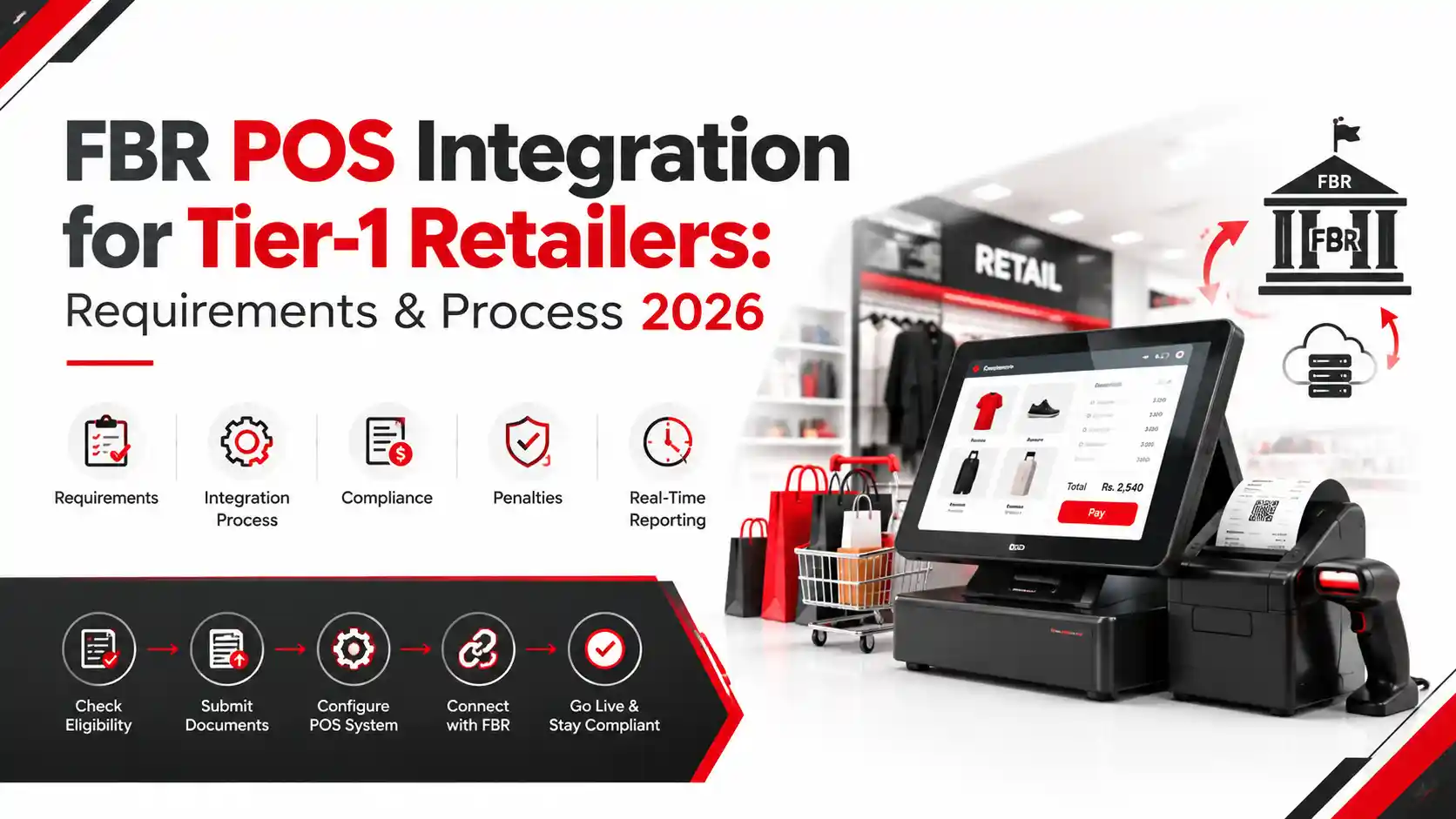
The process runs in seven stages: confirm Tier-1 status, complete sales tax registration, declare outlets and counters, select a licensed integrator, configure and register each POS, test in the sandbox, then go live and monitor.
Step 1 — Confirm Your Tier-1 Status
Run the decision matrix in Section 3. Document the basis. If you are borderline, get a written assessment before FBR forms its own view. Keep twelve months of electricity bills, your lease or ownership documents showing shop area, and your 236G/236H deduction certificates. Where classification is genuinely arguable, our corporate tax advisory team can prepare the position paper you will need later.
Step 2 — Complete Sales Tax Registration
No STRN, no integration. Apply through IRIS. Our step-by-step guide on how to register for sales tax in Pakistan covers the biometric verification and post-registration site visit that trip most applicants up, and our GST registration service handles it end to end if you would rather not. Start Your Sales Tax Registration →
Step 3 — Declare Every Outlet and Payment Counter
Log into IRIS and notify FBR of all your outlets through the computerised system. Then register each point of sale individually. A three-branch retailer with four counters per branch is registering twelve points of sale, not three outlets. Missing counters is one of the most common defects found during a POS audit, and it is often the reason a business that believes itself compliant still appears on a non-integrated list. If you have lost access to your portal, our guide on recovering a forgotten IRIS password will get you back in.
Step 4 — Select a Licensed Integrator
Since S.R.O. 69(I)/2025, integration is carried out through an FBR-licensed integrator. Visit the digital invoicing portal at IRIS and select your integrator. PRAL — Pakistan Revenue Automation (Pvt) Limited — is a state-owned enterprise and offers integration services free of cost. Private licensees charge fees that FBR caps. More on choosing between them in Section 9. Retailers already using an ERP should ask their vendor which licensed integrator they connect through, because the answer determines how much custom work is involved — a question our digital accounting services team helps clients scope.
Step 5 — Configure and Register Each POS
Install the approved fiscal software or configure your existing POS/ERP to FBR's technical specification. Each counter receives credentials and a POS registration. Configure the receipt template to the standardised format described in Section 7. Test the printer output physically — a QR code that does not scan on thermal paper is a live compliance defect, not a cosmetic one.
Step 6 — Sandbox Testing
Before going live, transactions are tested in FBR's sandbox environment. This is where payload errors, field mismatches, tax-rate mapping problems and offline-handling bugs surface. Do not rush it. A retailer that goes live with a broken credit-note flow will spend the next six months filing corrections, a problem explained in our guide on how to correct mistakes in an FBR return.
Step 7 — Go Live, Then Monitor
Move to the production environment. From this point, every counter sale generates a real FBR invoice number. Build a daily monitoring habit: check that every counter transmitted, that no counter sat disconnected, and that offline invoices were uploaded. Reconcile POS-reported sales to your books weekly and to your monthly return before filing. Our guide on how to file a sales tax return in Pakistan explains how that reconciliation feeds the return itself.
Online Sales, Websites and E-Commerce: How Integration Works
A Tier-1 retailer's online sales are not outside the POS regime. Where a Tier-1 retailer sells through its own website, it must integrate the utility provided by FBR into that website so the sale is reported to FBR, and the FBR invoice number and QR code must appear on the invoice generated and sent to the online customer.
FBR treats a website hosted on a registered domain name as a point of sale. That principle has been part of the framework since the earliest integration rules, and it has become more important as retail has shifted online.
What this means operationally:
- Your website or app is registered as a point of sale and integrated in the same way as a physical counter.
- Each online order generates an FBR invoice number before the transaction is completed, exactly as at a counter.
- The customer's emailed or downloadable invoice must carry the FBR invoice number and the QR code, so the customer can verify it.
- Cash-on-delivery orders are not exempt. The invoice obligation attaches to the supply, not to the payment method.
- Order cancellations and returns must flow through proper credit notes so that reported sales are adjusted.
- Marketplace sales (where you sell through a third-party platform) raise an additional question about who issues the invoice.
The 2026 direction of travel matters here. The draft rules under S.R.O. 288(I)/2026 expressly propose registration of websites and mobile apps by online sellers for automatic electronic invoicing, and extend the framework to online marketplaces and courier and cargo services acting in the e-commerce chain. Separately, "courier" has been introduced as a defined concept in the sales tax law, with couriers made withholding agents to capture taxable activity in the e-commerce sector. If you sell online, assume your digital channel will be regulated identically to your physical one.
Online sellers who are still setting up their tax footing should read our guide on FBR registration requirements in Pakistan, and e-commerce businesses running on thin compliance teams often benefit from the structured approach described in our note on digital accounting services. Get Your Online Store FBR-Compliant →
Licensed Integrators and PRAL: How to Choose
A licensed integrator is a person licensed by FBR to provide electronic invoicing integration services. As notified in FBR's Sales Tax Circular No. 1 of 2025, the approved licensed integrators included PRAL (free of cost), Haball (Pvt) Ltd, EY (Pvt) Ltd, and WebDNAworks (Pvt) Ltd.
| Consideration | PRAL | Private Licensed Integrator |
|---|---|---|
| Cost | Free of cost | Fee-based, capped by FBR |
| Best suited to | Single-outlet and small multi-outlet retailers with standard POS | Chains, ERP users, high transaction volumes, custom stacks |
| Support model | Government helpdesk | Commercial SLA, dedicated support |
| Custom integration | Limited | Typically stronger |
| Multi-outlet orchestration | Workable | Usually smoother |
The honest guidance: if you run one or two outlets on an off-the-shelf POS, PRAL is a sensible and cost-free starting point. If you run a chain, an ERP, or anything with non-standard tax logic — bundled promotions, multi-rate baskets, loyalty redemptions — a private licensed integrator usually pays for itself in avoided rework. A practical wrinkle FBR itself acknowledged in STGO No. 01 of 2026 is the hardship caused where more than one licensed integrator is involved in a single taxpayer's environment. Plan your integrator architecture before you commit, not after. If you are weighing this alongside a broader systems decision, our piece on why technology is reshaping compliance work offers useful context on where this is heading.
How Long Does FBR POS Integration Take?
For a single-outlet retailer with an existing STRN and a compatible POS, integration typically completes within one to three weeks. For a multi-outlet chain integrating an ERP, a realistic timeline is four to twelve weeks, driven mostly by sandbox testing and outlet rollout — not by FBR approval.
A realistic sequencing:
| Stage | Single Outlet | Multi-Outlet Chain / ERP |
|---|---|---|
| Sales tax registration (if not already held) | 1–3 weeks | 1–3 weeks |
| Outlet and POS declaration in IRIS | 1–2 days | 3–7 days |
| Integrator selection and onboarding | 2–5 days | 1–2 weeks |
| Software configuration | 3–7 days | 2–4 weeks |
| Sandbox testing | 3–7 days | 2–4 weeks |
| Go-live and stabilisation | 2–5 days | 1–3 weeks |
The bottleneck is almost never FBR. It is the retailer's own data hygiene — inconsistent item masters, unmapped tax rates, and undocumented discount logic. Clean these up first and the project halves in length. Retailers who are simultaneously sorting out their broader compliance calendar will find our monthly tax compliance checklist helpful for sequencing the work.
Multi-Branch and Chain Retailers: Managing Integration at Scale
For a chain, integration is not one project. It is a permanent register that has to be maintained every time an outlet opens, closes, relocates, changes ownership, or adds a counter. Integration is granted per point of sale — so a chain's compliance position changes with every operational change.
This is where large retailers most often fall out of compliance without realising it, and it is the reason FBR's published data repeatedly shows branches marked as disconnected within otherwise integrated brands.
| Event | What Must Happen |
|---|---|
| New outlet opens | Declare the outlet in IRIS, register each point of sale, configure and test before trading begins |
| New counter added at an existing outlet | Register that POS separately — the outlet's existing registration does not cover it |
| Outlet closes permanently | Update the outlet's status so it does not continue to appear as a non-transmitting branch |
| Outlet relocates | Treat as a change of premises and update the declared address |
| Seasonal or pop-up outlet | Still a point of sale while trading; declare and integrate for the period it operates |
| Franchise granted or transferred | Confirm which legal person holds the STRN and therefore the integration obligation |
| POS hardware replaced | Re-register and re-test; do not assume credentials carry across |
| Integrator changed | Plan the cutover carefully — FBR itself acknowledged difficulties where more than one licensed integrator is involved in a single taxpayer's environment |
Three controls that separate compliant chains from non-compliant ones:
- A single master register of outlets and counters, reconciled monthly against FBR's records for your STRN. If your internal count is 46 counters and FBR shows 41, you have a five-counter exposure you did not know about.
- A named compliance owner with authority across all branches, not a branch-by-branch arrangement where each manager assumes head office is handling it.
- A daily transmission dashboard by outlet. Ask your integrator for it in writing as part of the contract. A branch that stops transmitting on a Friday should be flagged on Friday, not at month-end — because the 48-hour disconnection clock is already running.
Franchise operators face an extra layer, since the compliance obligation follows the registered person rather than the brand. Our guide on franchise business in Pakistan covers how those structures are typically set up, and our corporate compliance calculator gives a quick view of the wider obligations a multi-entity group carries. Get a Multi-Branch Compliance Review →
How Much Does FBR POS Integration Cost?
There is no fee payable to FBR for POS integration itself, and PRAL offers integration services free of cost. The real cost sits in POS hardware, software licensing, integrator fees where a private licensee is used, connectivity, and internal implementation time.
| Cost Component | Who Charges It | Notes |
|---|---|---|
| FBR integration fee | — | None. FBR does not charge for integration |
| PRAL integration | PRAL | Free of cost |
| Private licensed integrator | Integrator | Fee-based; FBR caps integrator fees |
| POS terminal / computer per counter | Hardware vendor | One-off, per counter |
| Thermal printer (QR-capable) | Hardware vendor | One-off, per counter |
| POS/ERP software licence | Software vendor | Recurring or perpetual |
| Card payment machine | Acquiring bank | Recurring merchant fees |
| Internet connectivity per outlet | ISP | Recurring; a redundant connection is strongly advisable |
| Professional advisory | Consultant | Classification, registration, reconciliation setup |
| Internal staff time | You | Usually underestimated |
Because vendor pricing varies widely by city, counter count and software tier, this guide deliberately does not quote a single figure. Ask three vendors for a per-counter quotation covering hardware, licence, integration and first-year support, and compare on total cost of ownership rather than sticker price. For the sales tax impact of the transaction volumes you are about to start reporting, our sales tax / GST calculator gives a quick indication.
The comparison that actually matters: set your total integration cost against a 60% reduction in adjustable input tax for every month you remain non-integrated, plus a penalty ladder reaching Rs 3 million, plus sealed premises. For nearly every genuine Tier-1 retailer, integration is the cheaper option by a wide margin. You can model the penalty side using our late filing penalty calculator.
What Sales Tax Rate Does an Integrated Tier-1 Retailer Charge?
Section 3(9A) of the Sales Tax Act, 1990 requires a Tier-1 retailer to pay sales tax at the rate applicable to the goods sold under the relevant provisions of the Act or any notification issued under it. In other words, integration does not create its own rate — the goods determine the rate.
The history matters, because a great deal of outdated guidance still circulates.
| Period | Position for Integrated Tier-1 Retailers |
|---|---|
| From 2018–19 | A reduced rate applied to finished articles of textile and leather for retailers online with FBR's computerised system — used as an incentive to drive integration |
| Subsequent years | The reduced rate was progressively narrowed, and the incentive weakened |
| From FY 2024-25 | The rate for Tier-1 retailers of textile and leather products was raised to 18%, aligning them with the standard regime |
| Current position | Integration is driven by penalty avoidance and input tax protection, not by a preferential rate |
Why this matters commercially: retailers who integrated in 2019 on the strength of a reduced rate sometimes feel the bargain was changed on them. That is a fair complaint. But the relevant question today is not what the incentive used to be — it is what non-integration now costs, which is a 60% input tax reduction plus a penalty ladder reaching Rs 3 million plus sealing.
To model the tax on your own sales mix, use our sales tax / GST calculator, and for the broader rate picture across regimes see our overview of what sales tax is in Pakistan.
Benefits of POS Integration for Retailers
Integration protects the full input tax adjustment, removes penalty and sealing exposure, produces customer-verifiable invoices, and generates clean real-time data that makes monthly return filing substantially faster.
- Full input tax adjustment preserved. You keep the 60% that Section 8B(6) would otherwise strip. For a retailer with meaningful purchase volumes, this alone dwarfs every other consideration.
- No penalty or sealing exposure under Section 33 or the Chapter XIV-AD sealing procedure.
- No utility disconnection risk under Section 14AB.
- Customer trust. A verifiable receipt tells a customer that the tax they paid actually reached the exchequer. In a market where that assumption is routinely wrong, it is a genuine differentiator.
- Faster, more accurate returns. Real-time data removes the month-end scramble of assembling invoices. Our monthly sales tax return filing service sees materially fewer reconciliation issues with integrated clients.
- Lower audit exposure. Consistent transmitted data is the best defence against a discrepancy-driven notice.
- Better commercial standing. B2B buyers increasingly refuse suppliers whose invoices are not FBR-verifiable, because their own input tax position depends on it.
- Cleaner management information. Real-time sales data by outlet, by counter, by SKU is useful for reasons that have nothing to do with tax — which is why many businesses pair it with structured small business accounting. Get Help Reconciling POS Data with Your Returns →
Disadvantages, Costs and Practical Challenges
The honest downsides are capital outlay, margin pressure from full-rate taxation, operational fragility from connectivity dependence, and a competitive disadvantage against non-compliant peers who continue to trade undocumented.
- Upfront and recurring cost. Hardware, licences and connectivity for every counter add up, particularly for multi-outlet retailers.
- Loss of the old reduced-rate incentive. The reduced sales tax rate that once rewarded integrated Tier-1 retailers of textile and leather goods was progressively withdrawn; the rate for this category was raised to 18% from FY 2024-25. The incentive argument for integration is therefore weaker than it was in 2019 — the argument now rests on penalty avoidance and input tax protection.
- Connectivity dependence. An internet failure at a busy counter is no longer just an inconvenience; prolonged disconnection is a sealing ground.
- Unlevel playing field. A compliant retailer charging full tax competes against a non-compliant neighbour who does not. This is a real commercial problem and it is the honest reason many Tier-1 retailers have resisted.
- Staff training burden. Cashiers need to understand offline handling, returns, exchanges and credit notes — and get them right at speed.
- Data exposure. Real-time visibility into your sales is exactly what the system is designed to provide. Some owners find that uncomfortable. It is, nonetheless, the law.
The realistic position: the disadvantages are real, but they are outweighed by the consequences of non-compliance, particularly now that FBR's enforcement capacity has improved. Businesses weighing this trade-off often benefit from a structured review of their overall position — our note on tax planning strategies for businesses explains what can and cannot legitimately be optimised.
Penalties for Non-Integration and Bypassing
A Tier-1 retailer who fails to integrate loses 60% of adjustable input tax under Section 8B(6) and faces an escalating penalty ladder under Section 33 (S. No. 25A) rising from Rs 500,000 to Rs 3 million, followed by sealing of business premises. A retailer who integrates but bypasses the system faces penalty under S. No. 24 of up to Rs 500,000 or 200% of the tax involved, whichever is higher, plus prosecution.
1. The Input Tax Consequence — Section 8B(6)
Section 8B(6) was inserted by the Finance Act, 2019 with a 15% reduction. The Finance Act, 2021 raised that figure to 60%. Any published guide still citing 15% is out of date. The reduction applies to the whole tax period, even if the failure covered only part of it. FBR operationalised this through a system-based approach under a series of Sales Tax General Orders, publishing lists of identified non-integrated Tier-1 retailers on its portal, with automatic disallowance flowing through columns 6B and 6C of the monthly return form. No separate notice, no separate proceedings — the demand is created by the system. Retailers hit by this should read our guide on responding to FBR notices before replying.
2. The Penalty Ladder — Section 33, S. No. 25A
S. No. 25A covers a person required to integrate under Section 3(9A) who fails to register, or having registered, fails to integrate:
| Default | Penalty |
|---|---|
| First default | Rs 500,000 |
| Second default (15 days after the order for the first) | Rs 1,000,000 |
| Third default (15 days after the order for the second) | Rs 2,000,000 |
| Fourth default (15 days after the order for the third) | Rs 3,000,000 |
| Continued failure (15 days after the fourth-default penalty) | Business premises sealed until integration |
There is one relief built into the provision: if the retailer integrates with FBR's computerised system before the penalty for the second default is imposed, the Commissioner may waive the first-default penalty. That is a narrow window, and it closes fast. If you have received a first-default order, integrating immediately is the single highest-value action available to you.
3. Bypassing and Tampering — Section 33, S. No. 24
An integrated Tier-1 retailer who takes any action to avoid monitoring, tracking, reporting or recording of transactions — including issuing duplicate invoices, or invoices without a barcode or with a counterfeit barcode — faces a penalty of Rs 500,000 or 200% of the tax involved, whichever is higher, along with the possibility of conviction and imprisonment. Anyone who abets or connives in the suppression or non-reporting of sales, including a software vendor who builds skimming capability into POS software, is exposed to imprisonment and fine under the same clause. That last point deserves emphasis: choosing a vendor who offers to "keep some sales off the system" exposes both of you.
4. Utility Disconnection — Section 14AB
Separately, FBR may order the discontinuance of gas and electricity connections of a Tier-1 retailer who is unregistered, or registered but not integrated. Connections are restored on compliance. This is an enforcement tool, not a theoretical one.
Cumulative exposure, illustrated: a Tier-1 retailer who ignores integration for a full year can simultaneously carry a 60% input tax disallowance across twelve tax periods, a penalty ladder running to Rs 3 million, sealed premises, and a disconnected electricity supply. If penalties have already been raised against you, our guide on the tax appeal process in Pakistan sets out the remedies available. Speak to a Tax Lawyer About an FBR Penalty →
5. Monitoring, Officer Posting and Software Audit
Beyond penalties, FBR holds standing monitoring powers. Under Section 40B of the Sales Tax Act, 1990, Inland Revenue officers may be posted to a registered person's premises to monitor production, sales and stock. Section 40C supports electronic monitoring and tracking of supplies.
For an integrated Tier-1 retailer, three monitoring realities are worth understanding:
- Officer posting under Section 40B is a live statutory power, not a historical one. It allows physical presence at business premises to monitor the taxable activity directly.
- Software audit forms part of the sealing and de-sealing procedure. Where premises are sealed, an officer may conduct a software audit to establish the quantum of under-declared sales and raise a demand for tax sought to be evaded.
- Transmission data itself is the audit trail. Because FBR holds your counter-level transmission record, discrepancies between transmitted sales and declared sales are visible without any inspection taking place.
The draft rules under S.R.O. 288(I)/2026 would add a further physical layer, empowering FBR to require CCTV at each point of sale with recordings retained for at least one month and produced before the Commissioner on demand. The stated purpose is to match physical sales activity against reported invoices.
The defensive posture is straightforward: keep transmission complete, keep reconciliation documented, and keep every FBR communication filed chronologically. If monitoring escalates into a notice, our guide on handling FBR tax notices sets out how to respond. Get Representation on an FBR Audit →
Sealing and De-Sealing of Business Premises
Beyond non-integration, an already-integrated Tier-1 retailer can have premises sealed for issuing unverified invoices, for remaining disconnected from FBR's database beyond 48 hours, for failing to enter offline-period invoices within 24 hours of reconnection, or for using a device that does not retain invoice records during offline periods.
The procedure sits in Chapter XIV-AD of the Sales Tax Rules, 2006, notified by S.R.O. 252(I)/2022 dated 16 February 2022 and substantially expanded by S.R.O. 164(I)/2025 dated 17 February 2025. The 2025 amendment is the one most retailers have not read, and it changed the risk profile materially — because it turns an infrastructure failure into a sealing ground.
Grounds for sealing an integrated Tier-1 retailer's premises:
- Issuance of an unverified invoice
- Disconnection of the store from FBR's database for more than 48 hours
- Failure to enter offline-period invoices into the system within the next 24 hours
- A device that does not retain a record of invoices generated during an offline period
The de-sealing procedure, in outline:
- The Commissioner Inland Revenue having jurisdiction passes an order imposing penalty under the applicable serial of Section 33.
- A software audit may be conducted to establish the quantum of under-declared sales, and a demand raised for tax sought to be evaded.
- On payment of the penalty and the demand created during audit, the concerned Commissioner issues the de-sealing order — in practice, within 24 hours of payment.
- De-sealing is conditional on the software defect being removed and all requirements of the applicable chapter of the Sales Tax Rules, 2006 being fulfilled.
- In case of non-payment, de-sealing may follow after a month, with re-sealing after 15 days if the default continues.
The operational lesson is blunt: treat your outlet's internet connection as tax infrastructure. A redundant connection at each outlet — a second ISP or a mobile data failover — costs a fraction of a single sealing episode. Retailers who have already received an enforcement notice should read our guide on handling FBR tax notices before responding in writing.
What If You Are Wrongly Listed as Tier-1? (The Exclusion Route)
A business that has been included in FBR's non-integrated Tier-1 list, but does not in fact meet any test under Section 2(43A), can apply through IRIS for exclusion. If the Commissioner accepts that the applicant is not a Tier-1 retailer, the 60% input tax disallowance is reversed from the date it was imposed.
This route exists because the system-based approach necessarily produces false positives — a business whose 236H deductions crossed Rs 100,000 in a single unusual year, or a warehouse misclassified as a retail outlet.
The process:
- File an application through IRIS selecting the relevant ground for exclusion.
- Attach supporting evidence — electricity bills, lease documents showing shop area, purchase and sales pattern evidence, proof that no card machine is deployed, whatever is relevant to the test you are contesting.
- The Commissioner Inland Revenue examines the application and passes an order (an exclusion certificate).
- If accepted on the ground "not a Tier-1 retailer as defined under Section 2(43A)": the 60% reduction is reversed with effect from the date the bar was placed, and no tax period remains subject to the disallowance.
- If accepted on the ground "integration with FBR's POS system": restoration of input tax adjustment applies from the tax period following the period(s) during which the retailer remained non-integrated. In other words, integrating fixes the future, not the past.
That distinction matters enormously and is routinely missed. If you genuinely are not Tier-1, contest the classification — do not simply integrate to make the problem go away, because integrating concedes the point and leaves the historical disallowance intact. If the application is rejected, the ordinary appellate remedies apply; our guide on appealing a tax assessment in Pakistan explains the route and timelines. Get Help Filing an Exclusion Application →
Voluntary Integration: Should a Non-Tier-1 Retailer Integrate?
A retailer who does not meet any Section 2(43A) test is not obliged to integrate under Section 3(9A). However, if the business holds a sales tax registration, it is separately obliged to integrate for electronic invoicing through a licensed integrator under the general digital invoicing framework. Genuine voluntary integration is therefore now a narrow question.
Three distinct positions exist, and they are frequently conflated:
| Your Position | POS Integration (s.3(9A)) | Digital Invoicing (Chapter XIV) |
|---|---|---|
| Tier-1 retailer, sales tax registered | Mandatory | Mandatory |
| Not Tier-1, but sales tax registered | Not mandatory | Mandatory |
| Not Tier-1, not sales tax registered | Not applicable | Not applicable until registration is required |
So the honest answer for most businesses asking "should I integrate voluntarily?" is that they are already required to integrate for electronic invoicing, whether or not they are Tier-1. The choice they actually face is when, not whether.
Where a genuine voluntary case exists — a small unregistered retailer considering registration and integration ahead of time — the arguments in favour are:
- B2B buyers increasingly require verifiable invoices, because their own input tax position depends on it. An unintegrated supplier loses business before it loses a penalty appeal.
- Active Taxpayer List standing and filer status carry real commercial and withholding advantages, set out in our comparison of filer vs non-filer in Pakistan.
- Growth crosses thresholds quietly. A business heading towards a Rs 1.2 million annual electricity bill or a card machine will become Tier-1 without a decision being made. Integrating on your own timetable is cheaper than integrating under a penalty order.
- Clean, structured transaction data is becoming the baseline expectation, given the statutory move towards electronically readable formats.
The arguments against are equally honest: the full-rate tax position and the cost of hardware and connectivity are real, and a small retailer competing against undocumented neighbours carries a genuine commercial disadvantage. This is a business decision that deserves a proper numerical review rather than a slogan — the kind of analysis covered in our note on tax planning strategies for businesses.
If registration is the prior question, our GST registration service handles it, and the guide on how to apply for sales tax registration sets out what the process involves. Weigh Up Voluntary Registration With Us →
The Re 1 POS Service Fee and the Prize Scheme
Integrated Tier-1 retailers collect a service charge of Re 1 per invoice from the customer under Section 76 of the Sales Tax Act, 1990 read with S.R.O. 1279(I)/2021, and deposit it along with the monthly sales tax return in a separate head of account.
Two things retailers regularly get wrong here.
First, the amount. It is Re 1 per invoice, regardless of invoice value — not 1%. FBR issued a public rebuttal when that misunderstanding spread. Second, it is a collection obligation, not a cost. You collect it from the customer, show it on the standardised invoice, and remit it with your return, which includes a dedicated row for POS service fee. If your POS template does not carry this line, your invoices do not conform to the prescribed format. Retailers filing their own returns should cross-check this against our walkthrough on submitting a sales tax return.
The prize scheme. The fee was originally justified as funding a consumer prize scheme under Section 56C — customers who verified POS invoices entered a monthly computerised draw. The first draw was held on 15 January 2022 and draws ran monthly for a period. The scheme was then suspended from November 2022 and has remained largely dormant since, despite the procedure being amended by S.R.O. 1513(I)/2024. Collections, however, continued. This is a live policy controversy in Pakistan's tax press and it has been raised as a question of both accountability and vires.
Why this matters to you commercially: the consumer-pressure mechanism that was supposed to make customers demand integrated receipts has been switched off. That shifts the entire enforcement burden onto FBR's audit and sealing powers — and explains the sharper enforcement posture described in Section 23.
POS Integration and Your Monthly Sales Tax Return
Integration does not replace return filing. It changes what the return must reconcile to. Transmitted POS data becomes the benchmark against which your declared sales are tested, and the monthly return form carries specific columns for input tax disallowance and its reversal.
Practical points for the monthly cycle:
- Column 6B of the return carries inadmissible input tax computed by the system under Section 8B(6). Column 6C provides for reversal once integration is achieved, subject to the exclusions in the applicable General Order. These columns were added by S.R.O. 407(I)/2022 amending the STR-7 return form.
- Returns and exchanges must be reflected through credit and debit notes and recorded in the relevant annexure, so that reported sales are adjusted correctly. Getting this wrong creates a permanent gap between POS data and declared sales.
- The POS service fee is deposited with the return in its own head of account.
- Reconcile before you file, not after. Compare transmitted POS sales, book sales, and return sales for each outlet every month. Any variance should have a documented explanation.
Missing the filing date compounds the problem — our guide on deadlines for monthly tax filing and the companion piece on avoiding late filing penalties set out the dates and consequences. If you would rather hand the whole cycle over, our monthly sales tax return filing service includes POS reconciliation as standard. Outsource Your Monthly Sales Tax Filing →
Federal vs Provincial: FBR, PRA, SRB and KPRA
FBR administers federal sales tax on goods, which is what POS integration for Tier-1 retailers concerns. The provincial authorities — Punjab Revenue Authority (PRA), Sindh Revenue Board (SRB), Khyber Pakhtunkhwa Revenue Authority (KPRA) and Balochistan Revenue Authority (BRA) — administer sales tax on services, and each runs its own integration and invoice-monitoring regime.
This distinction confuses a great many businesses, so it is worth stating plainly.
| Authority | Jurisdiction | What It Taxes | Relevance to Retailers |
|---|---|---|---|
| Federal Board of Revenue (FBR) | Pakistan | Sales tax on goods | POS integration for Tier-1 retailers under Section 3(9A) |
| Punjab Revenue Authority (PRA) | Punjab | Sales tax on services | Restaurants, salons and service outlets in Punjab |
| Sindh Revenue Board (SRB) | Sindh | Sales tax on services | Service providers in Sindh |
| Khyber Pakhtunkhwa Revenue Authority (KPRA) | KP | Sales tax on services | Service providers in KP |
| Balochistan Revenue Authority (BRA) | Balochistan | Sales tax on services | Service providers in Balochistan |
A retailer who sells goods deals with FBR. A restaurant that also sells packaged goods can find itself dealing with both — provincial authority for the service element and FBR for the goods element. A national chain operating across provinces can face multiple provincial registrations alongside its FBR obligation. Our guides on PRA sales tax registration in Punjab, SRB registration in Sindh and Punjab sales tax filing cover the provincial side, and our provincial services tax calculator gives a quick estimate of exposure.
Statistics: Where Tier-1 Compliance Actually Stands
FBR's own data indicates that the majority of registered Tier-1 branches were not transmitting live to the POS system as at early 2026 — a compliance gap that explains the sharper enforcement posture this year.
Figures on the public record, with dates attached:
- Approximately 11,000 Tier-1 brands and around 40,000 outlets were identified as within the integration net (FBR data reported February 2025).
- FBR POS data dated 16 February 2026 indicated that a large majority of registered Tier-1 branches were operating outside real-time monitoring, with over 12,000 branches shown as disconnected.
- Approximately Rs 1 billion had been collected under the Re 1 POS service fee as at 2023 reporting, with retailers collecting an estimated Rs 30–40 million per month on FBR's behalf at that time.
- On the parallel digital invoicing track, official data indicated that by the end of March 2026, around one-third of registered taxpayers were actively issuing live digital invoices, despite registration having been required by 31 December 2025.
- FBR estimated the digital invoicing initiative could generate an additional Rs 46 billion in FY 2026-27.
- FBR maintains a live public listing of POS Integrated Retailers, updated periodically — the current version at the time of writing covered integrations up to 31 July 2026.
The strategic read for a retailer: FBR knows exactly how large the gap is, it has quantified the revenue at stake, and it has the statutory tools — input tax disallowance, penalty ladder, sealing, utility disconnection. The historical assumption that enforcement would remain patchy is a poor basis for planning in 2026. Businesses reviewing their wider exposure should look at our overview of business tax compliance in Pakistan.
Illustrative Scenarios: How Tier-1 Status Plays Out in Practice
The following are illustrative scenarios constructed to explain how the statutory tests apply. They are not accounts of specific clients, and no figures below should be treated as verified case outcomes.
Scenario 1 — The single shop that did not think it was Tier-1
A garments retailer operates one shop in a commercial plaza. No second branch, no brand licence, no chain. The owner is confident that Tier-1 does not apply.
The analysis: the plaza is air-conditioned, which engages the mall/plaza test on its own. The shop also runs a card machine, which independently engages the card-terminal test. Either one is sufficient. The owner is Tier-1 and has been for years, despite having no chain characteristics at all. The correct response is not to argue about being "small" but to document the position and integrate — or, if the plaza's air-conditioning position is genuinely arguable, to build an evidenced case before FBR builds its own. Our guide on responding to FBR notices explains how that evidence should be presented.
Scenario 2 — The chain with an invisible gap
A retailer runs eight outlets, integrated three years ago. Two branches were opened since. Nobody declared them, because the original integration was treated as a completed project rather than a live register.
The analysis: integration attaches per point of sale. Two undeclared outlets mean the business is a non-integrated Tier-1 retailer in respect of those outlets, potentially attracting the Section 8B(6) reduction across the whole tax period — not merely a proportionate share of it. The remedy is to declare and integrate immediately, then review prior periods with advisers before FBR raises the point. This is precisely the failure mode the master-register control in the previous section is designed to prevent, and it is a frequent contributor to the errors that surface in sales tax filing.
Scenario 3 — The listed retailer who was never Tier-1
A wholesaler appears on an FBR list of identified non-integrated Tier-1 retailers because withholding deducted under Section 236H exceeded the prescribed threshold in an unusual year. The business sells only to registered traders and operates no retail counter at all.
The analysis: the temptation is to integrate quickly and make the problem go away. That would be the wrong move. Exclusion granted on the ground "not a Tier-1 retailer" reverses the disallowance from the date it was imposed; exclusion granted on the ground of integration only restores input tax from the following tax period. Integrating first concedes the classification and forfeits the historical reversal. The correct sequence is to file the exclusion application with evidence of the sales pattern, then act on the outcome — a route explained in Section 16, and, if refused, through the remedies in our guide to the tax appeal process in Pakistan.
Scenario 4 — The integrated retailer sealed for an internet fault
An integrated outlet's ISP fails on a Thursday evening. The branch keeps trading on offline mode. Connectivity is restored on Saturday morning, and the offline invoices are uploaded the following Tuesday.
The analysis: two separate grounds have potentially crystallised. Disconnection from FBR's database beyond 48 hours is a sealing ground in its own right, and failing to enter offline-period invoices within 24 hours of reconnection is another. No sales were hidden and no tax was evaded — the failure was purely infrastructural. That is the point worth absorbing: under the amended sealing rules, an IT fault is a compliance event. A redundant connection at each outlet costs a fraction of one sealing episode, and our expert tips section treats connectivity redundancy as a compliance control rather than an IT preference. Discuss Your Own Scenario With an Advisor →
Common Mistakes Tier-1 Retailers Make
The most damaging mistakes are not deliberate evasion. They are classification blind spots, partial integration, and treating connectivity as an IT issue rather than a compliance obligation.
- Assuming Tier-1 means "big chain". It does not. One test is enough, and the electricity-bill and card-machine tests catch small single-outlet businesses constantly.
- Integrating some counters, not all. Integration is per point of sale. A branch with four counters and three integrated POS terminals is non-compliant.
- Forgetting a new branch. Outlets opened after the original integration must be declared and their POS registered. This is the most common defect found in chain audits.
- Ignoring online sales. Where a Tier-1 retailer sells through its own website, the sale must be reported and the FBR invoice number and QR code must appear on the invoice sent to the online customer.
- Treating disconnection as an IT problem. Beyond 48 hours it is a sealing ground. Beyond 24 hours after reconnection without uploading offline invoices, it is another.
- Mishandling returns and exchanges. If your software does not adjust reported sales through proper credit and debit notes, your POS data and your return diverge permanently.
- Not reconciling POS data to the monthly return. The mismatch is visible to FBR before it is visible to you.
- Omitting the Re 1 POS service fee from the invoice template and the return.
- Integrating when you should have contested classification — which concedes Tier-1 status and forfeits reversal of the historical 60% disallowance.
- Choosing a vendor who offers to hide sales. This is a Section 33 offence for both parties, carrying imprisonment exposure for the software vendor as well as the retailer.
- Relying on outdated guidance. Guides citing 15% input tax reduction or a flat Rs 1 million penalty are describing law that has since been amended.
- Missing the waiver window. Integrating before the second-default penalty is imposed can secure waiver of the first. Few retailers know this exists.
Many of these overlap with the broader filing errors covered in our guide to common errors in sales tax filing — worth reading alongside this section.
Expert Tips and Best Practices
Treat POS integration as an ongoing operational discipline, not a one-off IT project. The businesses that stay out of trouble are the ones that monitor daily and reconcile monthly.
- Run the Tier-1 test annually, ideally each July. Electricity tariffs rise, shops expand, card machines get installed. Status changes without anyone noticing.
- Build a documented Tier-1 file: twelve months of electricity bills, lease or title documents showing area, 236G/236H certificates, and a note on the basis of your classification. If FBR ever questions it, you produce a file rather than a story.
- Install redundant connectivity at every outlet. A failover mobile connection costs a fraction of one sealing episode.
- Nominate a POS compliance owner in your business — a named person responsible for daily transmission checks across all outlets.
- Reconcile weekly, not monthly. A discrepancy found on day three is a configuration bug. Found on day thirty, it is a return problem.
- Test your QR codes physically on the actual thermal paper you use, at the actual print density. Codes that scan on screen and fail on paper are common.
- Stress-test offline mode before go-live. Unplug the internet at a test counter, run ten transactions, reconnect, and confirm all ten upload within the window.
- Train cashiers on credit notes and exchanges. This is where reported sales and actual sales diverge.
- Keep every FBR communication. Notices, STGO listings, exclusion orders, de-sealing orders. Assemble them chronologically.
- Ask your integrator for an uptime report per outlet, monthly. If they cannot produce one, you are flying blind.
- Plan for S.R.O. 288(I)/2026. If the draft income tax rules are finalised in current form, CCTV at each point of sale becomes a live requirement for notified businesses. Factor it into hardware planning now rather than retrofitting later.
- Get a professional review before FBR does. A voluntary compliance review costs a fraction of a penalty order — our tax consultants in Islamabad handle these routinely.
Book a POS Compliance Review →
Latest Updates: What Changed in 2026
The defining 2026 developments are the draft "Online Integration of Businesses" rules under S.R.O. 288(I)/2026, the consolidation of integration through licensed integrators, FBR's clarifications in STGO No. 01 of 2026, and a visibly harder enforcement posture backed by published compliance data.
| Development | Date | Status | What It Means for Tier-1 Retailers |
|---|---|---|---|
| S.R.O. 288(I)/2026 — draft Chapter VIIA, Income Tax Rules, 2002 | 18 Feb 2026 | Draft | Extends POS-style integration into income tax; adds CCTV at POS, website/app registration, 24-hour offline upload, six-year record retention. Pulls in hospitality, clubs, transport and courier businesses for the first time. |
| STGO No. 01 of 2026 (IR Operations) | 2026 | In force | Clarifies issuance of electronic sales tax invoices and integration of registered persons, including relief where more than one licensed integrator is involved |
| Universal integration obligation under S.R.O. 1413(I)/2025 and the phased rollout | From Aug 2025, final band 31 Dec 2025 | In force | Every sales-tax-registered person is now obliged to integrate through a licensed integrator — Tier-1 retailers are caught by both this and Section 3(9A) |
| Finance Act, 2026 | Jul 2026 | In force | Introduced definitions of "licensed integrator", "PRAL" and "electronically readable format", strengthening FBR's power to implement and enforce integration requirements |
| Published compliance data | Feb–Mar 2026 | — | FBR's own figures show the scale of non-transmission, framing retail integration as a priority enforcement target |
For a wider view of what changed in the current budget cycle, see our summary of the top 10 tax changes in Pakistan's Budget 2026-27.
Future Trends in Pakistani Retail Tax Reporting
The direction of travel is clear: from periodic self-declaration towards continuous, machine-verified transaction reporting across both goods and services, federally and provincially.
Four trends worth planning around:
- Convergence of sales tax and income tax reporting. S.R.O. 288(I)/2026 brings POS-style integration into the Income Tax Rules. The same transaction will increasingly report into both regimes.
- Physical verification layered onto digital. The CCTV proposal signals that FBR intends to match physical footfall against reported invoices — a meaningful escalation from purely data-based enforcement.
- Extension into services and e-commerce. Online sellers, marketplaces, courier and logistics operators and professional service providers are all within the widening net. Retailers with an online channel should assume it will be treated identically to a physical counter.
- Structured data as the default. The Finance Act, 2026 definition of "electronically readable format" — structured formats such as CSV, XLSX, XML, XBRL and JSON, explicitly excluding PDFs and scanned images — tells you where record-keeping expectations are heading. Paper and PDF archives will not satisfy future requirements.
The practical implication for a retail business is that compliance capability is becoming a systems question rather than an accounting one. Businesses that invest in clean, structured, well-mapped transaction data will find each successive requirement cheap to meet. Those that do not will pay for the same migration repeatedly. Our note on corporate tax planning strategies covers how to build that capacity deliberately.
Career Scope: Who Does POS Compliance Work in Pakistan
POS and digital invoicing compliance has created demand for a hybrid role that sits between accounting and IT — someone who understands both the Sales Tax Act and an API payload.
Roles that have emerged or expanded:
- Retail tax compliance officer / manager — monitors transmission across outlets, reconciles POS to returns, manages FBR correspondence
- POS integration consultant — implements integrations for retailers, typically working with or for a licensed integrator
- ERP tax configuration specialist — maps tax logic within ERP systems to FBR's invoice specification
- Indirect tax practitioner (sales tax) — classification opinions, exclusion applications, penalty defence, appeals
- Internal audit / compliance monitoring — periodic assurance over POS controls
Compensation varies widely by city, employer size and whether the role sits in practice or in industry, and published ranges are unreliable enough that this guide does not quote figures. What is observable is that the combination of statutory knowledge plus systems literacy commands a premium, because it is genuinely scarce. Those building a career in this space may find our careers page and our overview of what a business consultant does useful.
Key Terms: A Quick Glossary
| Term | Meaning |
|---|---|
| Tier-1 retailer | A retailer meeting any test in Section 2(43A) of the Sales Tax Act, 1990 |
| POS (point of sale) | An individual payment counter or billing station; registration is granted per POS |
| Integration | Electronic linking of a POS to FBR's computerised system for real-time reporting of sales |
| Licensed integrator | A person licensed by FBR to provide electronic invoicing integration services |
| PRAL | Pakistan Revenue Automation (Pvt) Limited — the state-owned integrator, offering integration free of cost |
| FBR invoice number | The 18-digit fiscal invoice number generated centrally by FBR for each transaction |
| QR code | The scannable verification code printed on the receipt, enabling customer verification |
| STRN | Sales Tax Registration Number |
| Input tax | Sales tax paid on purchases, ordinarily adjustable against output tax |
| Output tax | Sales tax charged on supplies made |
| Section 8B(6) reduction | The 60% cut in adjustable input tax applied to a non-integrated Tier-1 retailer |
| STGO | Sales Tax General Order — FBR's operational instrument for publishing lists and procedures |
| Sandbox | FBR's test environment used before an integration goes live |
| Offline mode | Recording of invoices during connectivity loss, for upload within the prescribed window |
| Exclusion certificate | An order accepting that a listed person is not a Tier-1 retailer |
| Electronically readable format | Structured data formats such as CSV, XLSX, XML, XBRL and JSON — expressly excluding PDFs and scanned images |
A working knowledge of these terms makes FBR correspondence substantially easier to handle, and our FBR IRIS 2.0 features guide covers the portal vocabulary that sits alongside them.
Why Choose BACO Consultants for FBR POS Integration and Tier-1 Compliance
POS integration sits at the intersection of tax law, systems configuration and enforcement risk — which is exactly why retailers who treat it as a software purchase end up in trouble. BACO Consultants approaches it as a legal compliance project with a technical component, not the other way round.
Here is what that means in practice.
We start with classification, not installation. The first question is never "which POS should you buy" — it is "are you actually Tier-1, and on what basis". That determination drives everything downstream, including whether you should be contesting your listing rather than integrating. Getting this sequence right is the difference between reversing a historical input tax disallowance and permanently forfeiting it. Our broader corporate, tax and legal services are built around the same principle: establish the legal position first.
We work across the full compliance chain. NTN registration, sales tax registration, outlet and POS declaration, integrator selection, invoice template conformity, monthly return reconciliation, and representation if a notice or penalty order arrives. You are not handed off between three vendors who each blame the others. Our GST registration and monthly sales tax return filing services connect directly into the integration work rather than sitting beside it.
We bring legal capability, not just accounting capability. Penalty orders, sealing notices, exclusion applications and appeals are legal proceedings with deadlines and evidentiary standards. BACO Consultants is a corporate, tax and legal consultancy, which means the same firm that set up your compliance can defend it. Our guides on responding to FBR notices and the tax appeal process reflect work we do rather than theory we have read.
We tell you what we do not know. Where a threshold, rate or deadline may have moved, we say so and verify it against the official source before advising. In a regime that changed four times between 2024 and 2026, that habit is worth more than confident-sounding certainty. Read more about how we work on our about page and meet the people who do it on our team page.
We cover the provincial dimension too. A chain operating in Lahore, Karachi and Peshawar is dealing with FBR plus PRA plus SRB plus KPRA. We handle PRA registration, SRB registration and the associated filings alongside the federal work, so nothing falls between jurisdictions. Book a Seat at BACO Consultants →
Frequently Asked Questions
Is FBR POS integration mandatory for all retailers in Pakistan?
No. POS integration under Section 3(9A) of the Sales Tax Act, 1990 is mandatory specifically for Tier-1 retailers as defined in Section 2(43A). However, separately, all sales-tax-registered persons are now obliged to integrate for electronic invoicing through a licensed integrator. Most Tier-1 retailers are therefore caught by both obligations.
How do I know if I am a Tier-1 retailer?
You are Tier-1 if you meet any one test in Section 2(43A): part of a national or international chain, located in an air-conditioned mall or plaza, annual electricity bill exceeding Rs 1.2 million, wholesaler-cum-retailer, shop of 1,000 sq ft or more, holder of a card-payment POS terminal, or prescribed by FBR — including retailers with Section 236H withholding exceeding Rs 100,000 in the preceding twelve months.
What is the penalty for not integrating with FBR's POS system?
Adjustable input tax is reduced by 60% under Section 8B(6) for the entire tax period. Under Section 33 (S. No. 25A), penalties escalate from Rs 500,000 for a first default to Rs 3 million for a fourth, after which business premises are sealed until integration. Gas and electricity connections may also be discontinued under Section 14AB.
Does FBR charge a fee for POS integration?
No. FBR charges no fee for integration, and PRAL provides integration services free of cost. Costs arise from POS hardware, software licensing, connectivity, and fees charged by private licensed integrators, which FBR caps.
How long does FBR POS integration take?
A single-outlet retailer with an existing STRN and a compatible POS can typically complete integration in one to three weeks. A multi-outlet chain integrating an ERP should plan for four to twelve weeks, mostly consumed by sandbox testing and outlet rollout.
Who are FBR's licensed integrators?
As notified in Sales Tax Circular No. 1 of 2025, the approved licensed integrators included PRAL (free of cost), Haball (Pvt) Ltd, EY (Pvt) Ltd and WebDNAworks (Pvt) Ltd. FBR updates this list, so confirm the current position on the digital invoicing portal before selecting.
What happens if my internet goes down at the counter?
Your POS must record invoices offline and upload them once connectivity is restored, within the prescribed window. Remaining disconnected from FBR's database beyond 48 hours, or failing to enter offline-period invoices within 24 hours of reconnection, are grounds for sealing of business premises under the applicable sealing rules.
Can I get removed from FBR's Tier-1 list if I do not qualify?
Yes. File an exclusion application through IRIS with supporting evidence. If the Commissioner accepts that you are not a Tier-1 retailer under Section 2(43A), the 60% input tax disallowance is reversed from the date it was imposed. If exclusion is granted instead on the ground of integration, restoration applies only from the following tax period.
Do I still have to file monthly sales tax returns after integrating?
Yes. Integration does not replace return filing. It changes the benchmark: your declared sales must reconcile with the data your POS transmitted, and the return carries specific columns for input tax disallowance and its reversal, plus a row for the POS service fee.
What is the Re 1 POS service fee on my receipt?
It is a service charge of one rupee per invoice — not one percent — collected from the customer under Section 76 of the Sales Tax Act, 1990 read with S.R.O. 1279(I)/2021, and deposited by the retailer with the monthly sales tax return in a separate head of account.
Do I have to integrate my website or online store with FBR?
Yes, if you are a Tier-1 retailer. FBR treats a website hosted on a registered domain as a point of sale. Online sales must be reported, and the FBR invoice number and QR code must appear on the invoice generated and sent to the online customer. The draft rules under S.R.O. 288(I)/2026 would additionally require online sellers to register their websites and mobile apps.
What happens when I open a new branch after integrating?
The new outlet must be declared in IRIS and each of its payment counters registered and tested before it starts trading. Your original integration does not extend automatically. Undeclared branches are a leading cause of chains being shown as non-integrated on FBR's records.
Does POS integration only apply to textile and leather retailers?
No. Integration is mandatory for all Tier-1 retailers irrespective of the goods they deal in. The textile-and-leather association dates from an early reduced-rate incentive scheme, not from the scope of the obligation itself.
Conclusion
FBR POS integration for Tier-1 retailers has moved from an incentive-driven programme to a straightforward enforcement priority. The reduced-rate carrot that existed in 2019 has largely gone; what remains is a 60% input tax disallowance, a penalty ladder reaching Rs 3 million, sealing powers that now bite on connectivity failures as well as non-integration, and a statutory power to cut off your electricity. Meanwhile, the obligation has widened — through licensed integrators under Chapter XIV, through universal digital invoicing, and, if the February 2026 draft is finalised, into income tax with CCTV at the counter.
The key recommendation is simple: determine your Tier-1 status now, on documented evidence, before FBR determines it for you. If you qualify, integrate every counter at every outlet and build a monthly reconciliation discipline around it. If you do not qualify but have been listed, contest the classification rather than integrating your way out — because the two routes produce very different outcomes for your historical input tax.
The logical next step is a compliance review: classification assessment, registration status check, outlet and POS inventory, invoice template conformity, and a reconciliation of transmitted POS data against your last six monthly returns. That exercise takes days and routinely surfaces problems that would otherwise surface as a penalty order.
If you would like that done properly — by a firm that handles the tax, the systems question and the legal defence under one roof — Book a Seat at BACO Consultants and speak to an advisor who works on Tier-1 retail compliance every week.
Related Articles


Leave a Comment
No approved comments yet. Be the first to share your thoughts!