

Quick Answer: How Do I Get a Tax Refund from FBR?
- File your income tax return on IRIS so that it shows tax paid higher than tax chargeable.
- Make sure every tax deduction you claim is backed by a certificate, CPR or withholding record.
- Add a bank account (IBAN) in your own name to your IRIS profile.
- Submit a refund application under Section 170 of the Income Tax Ordinance, 2001 through IRIS for that tax year.
- Respond promptly to any notice or document request from your Inland Revenue office.
- Once the refund order is passed, the amount is transferred to your registered bank account.
The rest of this guide explains each step and the legal protections available if FBR does not act on time.
Introduction
Getting an FBR tax refund in 2026 is straightforward once you know the rules. If more tax has been deducted from your salary, bank transactions, contracts or other payments than you actually owe for the year, the Federal Board of Revenue (FBR) owes you the difference. Claiming it is a legal right, but the process depends on getting your return, your tax evidence and your IRIS profile right. At Baco Consultants, we handle income tax refund claims alongside annual income tax return filing, withholding tax certificate collection, IRIS registration and profile issues and FBR notice responses. This guide explains how to get a tax refund from FBR: who qualifies, the law behind it, how to apply through IRIS, how long it takes and what to do if your refund is delayed or rejected.
What Is an FBR Income Tax Refund?
An income tax refund is the return of tax you paid in excess of your actual tax liability for a tax year. Under Section 170(1), a taxpayer who has paid tax in excess of the amount they are properly chargeable under the Ordinance may apply to the Commissioner for a refund of the excess.
Excess tax usually arises because tax is collected in advance, at source, before your final liability is known. Common examples include:
- An employer deducting more salary tax than your annual liability, for instance where you changed jobs mid-year or had unclaimed tax credits.
- Adjustable advance taxes collected on transactions during the year.
- Tax paid through challans (CPRs) that turned out to exceed your final liability.
- Tax credits (such as for approved donations, pension fund or certain investments) reducing your liability after tax was already deducted.
There is also a specific statutory case: where an advance or loan treated as a dividend under Section 2(19)(e) is repaid, the taxpayer is entitled to a refund of any tax paid because of that treatment, under Section 170(1A).
Refund vs Adjustment: What Is the Difference?
| Point | Tax Refund | Tax Adjustment |
|---|---|---|
| What happens | Excess tax is paid back to your bank account | Excess tax reduces tax payable elsewhere |
| Legal basis | Section 170 application and order | Section 170(3), and adjustment of taxes in the return |
| Requires application | Yes | Partly automatic within the return |
| Cash received | Yes, the remainder after set-offs | No |
The two are linked. Before any cash is paid, the Commissioner first applies your excess against other dues, as explained below.
Can You Adjust Last Year's Excess Tax Against This Year's Liability?
Many taxpayers assume they can simply deduct last year's excess tax from this year's tax payable in their return. This is risky. According to a Federal Tax Ombudsman decision, a taxpayer can adjust the current year's liability against previous-year refunds only where those refunds have been duly created through refund orders, and a claim of adjustment is inadmissible until that happens.
In practice, this means:
- First apply for the refund under Section 170 for the earlier year.
- Once a refund order is passed, the refund can be paid or adjusted.
- Adjusting an unverified refund in your return can create a tax demand, default surcharge and notices.
Learn more about Baco Consultants or view our full services.
The Legal Framework: Sections 170, 170A and 171
Understanding the law gives you leverage when a claim stalls. For the full current text, refer to FBR's consolidated Income Tax Ordinance, 2001 (amended up to 20 February 2026), as later amended by the Finance Act, 2026.
Section 170: The Refund Application
An application under Section 170(1) must be made in the prescribed form, verified in the prescribed manner, and made within three years of the later of the date the Commissioner issued the assessment order for the relevant tax year or the date the tax was paid.
Note that for most taxpayers the "assessment order" date is the return filing date. FBR's own circular explains that under Universal Self Assessment, a return accepted under Section 120 is deemed to be an assessment order made and issued by the Commissioner on the date the return was furnished. (See FBR Circular No. 5 of 2003.)
Practical point: Some online guides state a two-year limit. The statutory text quoted above sets three years. Always check the current consolidated Ordinance before relying on any deadline.
Section 170(3): Set-Off Before Payment
Where the Commissioner is satisfied that tax has been overpaid, the excess is first applied against any other tax due under the Ordinance, then against any outstanding liability for other taxes, and only the remainder is refunded to the taxpayer.
This is why a refund can come back smaller than expected, or not at all, if there is an old demand on your record.
Section 170(4) and (5): The 60-Day Rule and Right of Appeal
The Commissioner must, within sixty days of receiving a refund application, serve a written order of the decision after giving the taxpayer an opportunity of being heard.
Crucially, a person aggrieved by either the order itself, or by the Commissioner's failure to pass an order within that time, may file an appeal under Part III of the Chapter. In other words, silence is appealable.
Section 170(6) and Section 170A: Automated Refunds
Section 170(6) allows the Board to make rules for expeditious processing and automatic payment of refunds through a centralised processing system. Section 170A goes further: from tax year 2021, FBR may electronically process and issue refunds to taxpayers who have filed returns without a separate refund application, with amounts verified by its computerised system transferred to the taxpayer's registered bank account.
In practice, full implementation remains incomplete. Business Recorder reported that FBR's own committee report on enforcing Section 170A revealed its e-portal had no direct electronic link with AGPR, the largest government withholding agent deducting tax from government employees' salaries. (Business Recorder report) So, for now, you should still file a formal Section 170 application rather than wait for an automatic refund.
Section 171: Compensation for Delayed Refunds
If a refund is ordered but not paid on time, the law provides compensation. Where a refund is not paid within three months of the date on which it becomes due, the taxpayer is entitled to compensation at KIBOR plus 0.5 percent per annum, calculated from the end of that three-month period until the date of payment.
For Section 170 applications, the Explanation to Section 171 clarifies that the refund becomes due from the date the refund order is made, not from the date of the deemed assessment under Section 120. This timing issue has been litigated for years, including before the Supreme Court, as Business Recorder has explained.
Who Is Eligible for an Income Tax Refund in Pakistan?
You are generally eligible if all of the following apply:
- You have filed your income tax return for the relevant tax year.
- Your return shows total tax paid or deducted exceeding the tax chargeable.
- The tax you are claiming is adjustable tax, not final or minimum tax.
- The deducted tax can be verified against FBR's records (withholding statements, CPRs).
- You apply within the statutory time limit.
Adjustable, Final and Minimum Tax: The Most Important Distinction
This is where most refund expectations go wrong.
- Adjustable tax is credited against your final liability. If it exceeds that liability, the excess is refundable.
- Final tax is your full liability on that income stream. It is generally not refundable, except where it was deducted at a wrong (higher) rate.
- Minimum tax is the least you must pay on certain income, even if your normal liability is lower. The minimum element is generally not refundable.
Whether a particular deduction is adjustable depends on the section and the category of taxpayer, and rates and treatments change through Finance Acts. Check the current position in our FBR withholding tax rates 2026-27 chart and our explainer on the final vs normal tax regime.
Who Commonly Claims Refunds
Salaried individuals. Typical causes include switching employers mid-year, bonuses taxed at a higher monthly projection, or tax credits not reported to the employer. See our guide on the salary tax certificate from your employer and current income tax slabs for salaried individuals.
Freelancers. Refunds arise where adjustable tax was collected on transactions, but freelancers must first confirm how their export proceeds are taxed. Read our income tax return guide for freelancers.
Businesses, AOPs and companies. Excess can arise from tax withheld on supplies, services and contracts, advance tax instalments, or import-stage tax. Corporate claims face closer scrutiny and usually require audited accounts. See our guide to Pakistan corporate tax 2026.
Overseas Pakistanis and non-residents. Refunds may be available where Pakistani tax was deducted but residency status or a tax treaty reduces liability. See our tax rules for overseas Pakistanis.
Claiming Refunds for Previous Tax Years
You can claim a refund for an earlier tax year, provided you apply within the time limit. The application must be made within three years of the later of your deemed assessment date (usually the date you filed that year's return) or the date the tax was paid.
Keep these points in mind:
- File one application per tax year. Each year's refund is assessed separately.
- Check whether older years are time-barred before preparing a claim.
- Correct the old return first if it did not show the refundable amount correctly, through a revised return or rectification application.
- Collect evidence early. Withholding certificates for older years can take longer to obtain from employers and banks.
How to Get a Tax Refund from FBR in Pakistan (Step-by-Step Guide)
Getting an income tax refund from FBR is a legal process under Section 170 of the Income Tax Ordinance, 2001. It runs from checking your eligibility to receiving the money in your bank account. Here is the complete journey at a glance.
Step 1: Confirm That You Have a Refundable Amount
Compare the tax chargeable on your income with the total adjustable tax you paid or had deducted during the year. A refund only arises if tax paid is higher. Remember that final and minimum taxes are generally not refundable. You can estimate your liability using our salary tax calculator or withholding tax calculator.
Step 2: Check the Time Limit
A refund application must be made within three years of the later of your deemed assessment date (usually the date you filed your return) or the date the tax was paid. Claims outside this window can be rejected as time-barred.
Step 3: Collect Evidence of Every Tax Payment
Gather withholding tax certificates, CPRs and your salary certificate. Make sure each deduction has been reported to FBR by the withholding agent, because unverified tax is the most common reason refunds stall.
Step 4: File Your Income Tax Return and Wealth Statement
Your return must show the refundable balance, and your wealth statement must reconcile with your declared income. If you have already filed with errors, correct them first through a revised return or rectification application.
Step 5: Submit a Refund Application Through IRIS
File a separate refund application under Section 170 for the relevant tax year, with your IBAN registered in your IRIS profile. The detailed portal steps are explained in the IRIS section below.
Step 6: Cooperate with Verification by the Commissioner
Your Regional Tax Office, LTO or CTO will verify the claim and may issue notices asking for documents. You are entitled to an opportunity of being heard before any adverse order.
Step 7: Receive the Refund Order Within 60 Days
The Commissioner must pass a written order within 60 days of receiving your application. Before paying you, FBR first adjusts the excess against any other tax due or outstanding liabilities, and refunds the remainder.
Step 8: Receive Payment in Your Bank Account
The approved amount is transferred to your registered bank account. If payment is not made within three months of the refund becoming due, you can claim compensation under Section 171.
Step 9: Escalate If Your Refund Is Delayed or Rejected
If no order is passed within 60 days, or your claim is rejected, you can appeal under Section 170(5). For unjustified delays, a complaint to the Federal Tax Ombudsman may also be available. See our tax appeal process guide for details.
Documents Required for an FBR Tax Refund
Prepare these before you open the refund form:
- Filed income tax return and wealth statement for the tax year, with the tax computation showing a refundable balance. Your wealth statement reconciliation must also be clean.
- Withholding tax certificates from employers, banks, telecom companies, utility providers and other withholding agents.
- CPRs (Computerised Payment Receipts) for any tax paid directly through PSIDs. Our PSID payment guide explains how to retrieve them.
- Salary certificate or annual tax deduction statement (for employees).
- Bank statements supporting bank-level deductions.
- Evidence of tax credits claimed, such as donation receipts or pension/investment statements.
- Audited financial statements (companies and larger businesses).
- IBAN of a bank account in your own name, registered in your IRIS profile.
Tip: Keep scanned PDFs named by type and tax year. Most delays happen at the verification stage, not at submission.
Step-by-Step: How to Apply for a Tax Refund Through IRIS (2026)
IRIS 2.0 menu labels can differ slightly between user profiles and are updated from time to time, but the sequence below remains the same.
Step 1: File an Accurate Income Tax Return
The refund claim rests entirely on your return. Log in at iris.fbr.gov.pk, open the return for the relevant tax year, and check that:
- All income is declared under the correct heads.
- Every withholding tax entry is recorded under the right section.
- Final and minimum tax items are correctly classified.
- The computation shows tax paid exceeding tax chargeable, producing a refundable amount.
If you face form errors, see our guide to IRIS return errors and fixes.
Step 2: Verify That Your Tax Deductions Appear in FBR's Records
Withholding agents report deductions to FBR through withholding statements. If an employer or other agent deducted tax but did not deposit it or report it against your CNIC/NTN, your claim will likely stall. Cross-check each deduction and ask the agent to correct or file their statement if anything is missing.
Step 3: Register Your Bank Account (IBAN) in IRIS
Refunds are transferred electronically. Add an IBAN for an active account held in your own name in your IRIS profile. A title mismatch between your CNIC name and bank account is a common cause of payment failure. If you cannot access IRIS, see our guides on IRIS login problems and recovering a forgotten IRIS password.
Step 4: Open the Refund Application
In IRIS, locate the refund application for tax paid in excess under Section 170. Select the tax year. The system typically pulls the refundable amount from your filed return. Confirm that it matches your computation.
Step 5: Attach Supporting Evidence
Upload withholding certificates, CPRs and any other evidence supporting each item of tax paid. Attaching evidence upfront reduces the chance of a deficiency notice later.
Step 6: Submit and Save the Acknowledgement
Submit the application electronically and download the acknowledgement. The submission date starts the 60-day clock under Section 170(4), so keep this record safely.
Step 7: Respond to Notices Quickly
Your Inland Revenue office may issue a notice asking for documents or explanation. Check your IRIS inbox regularly and reply within the stated time. A late or incomplete reply is one of the easiest ways for a claim to be rejected. Our guide to handling FBR notices covers how to structure a reply.
Step 8: Receive the Refund Order and Payment
Once the Commissioner is satisfied, a refund order is passed. After any set-off under Section 170(3), the remaining amount is paid to your registered bank account.
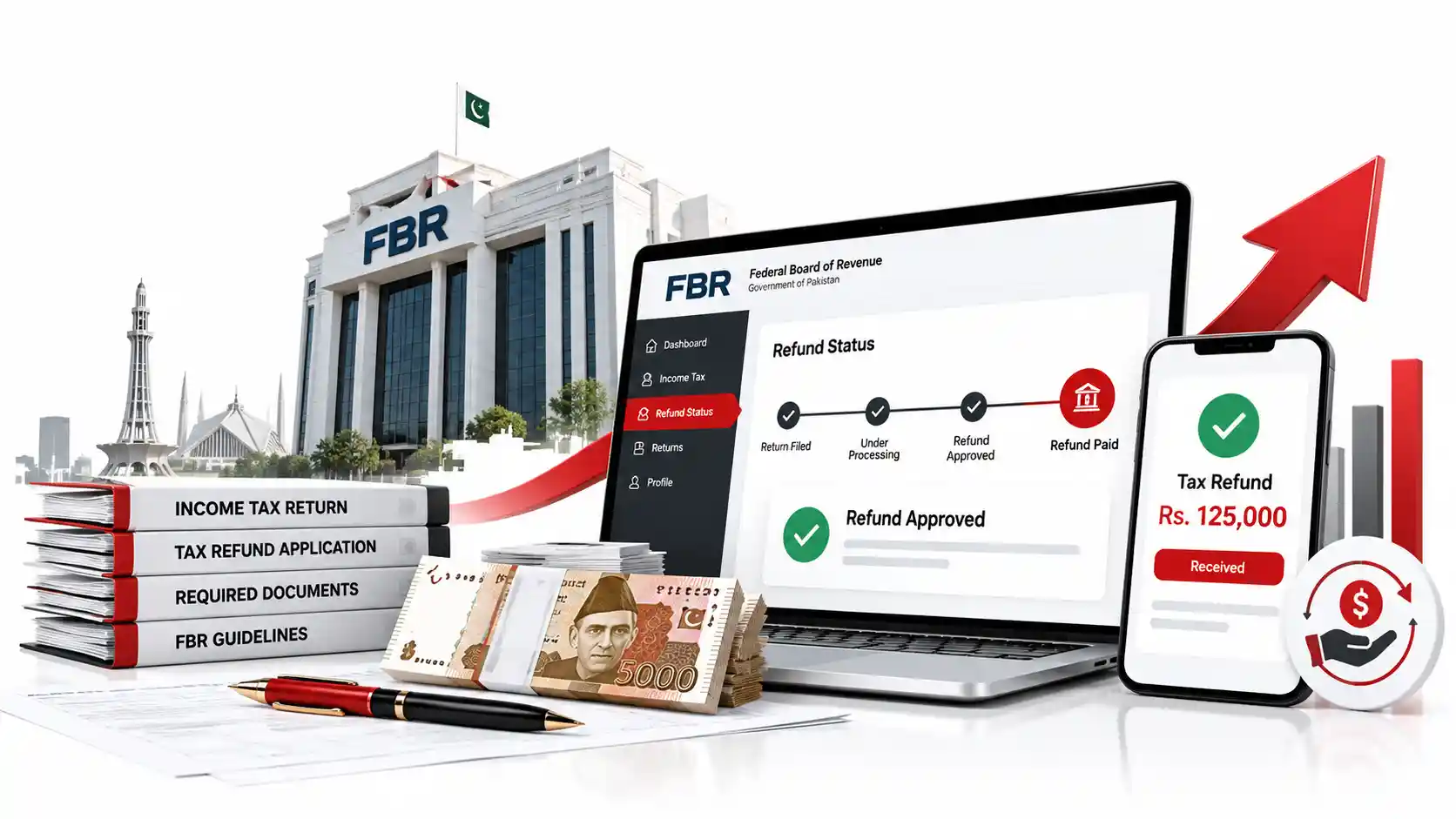
Worked Example (Illustrative)
The figures below are hypothetical and show only the mechanics, not current tax rates.
| Item | Amount (Rs) |
|---|---|
| Tax chargeable on taxable income for the year | 180,000 |
| Salary tax deducted by Employer A (July–December) | 120,000 |
| Salary tax deducted by Employer B (January–June) | 95,000 |
| Adjustable advance tax collected on other transactions | 15,000 |
| Total adjustable tax paid | 230,000 |
| Excess tax (refundable before set-off) | 50,000 |
If the taxpayer has an outstanding demand of Rs 10,000 from an earlier year, the Commissioner would first apply Rs 10,000 against that demand, and the refund paid would be Rs 40,000.
In this example the excess arose because each employer projected tax on its own salary alone. Declaring the previous employer's salary and tax to the new employer (see "Tips" below) would have reduced the excess in the first place.
How Long Does an FBR Refund Take?
| Stage | Statutory position |
|---|---|
| Deadline to apply | Three years from the later of the assessment date (usually the return filing date) or the date tax was paid |
| Commissioner's decision | Written order within 60 days of receiving the application (Section 170(4)) |
| No order within 60 days | Appealable under Section 170(5)(b) |
| Payment after refund becomes due | If unpaid within three months, KIBOR-linked compensation under Section 171 |
In reality, processing often takes longer than the statutory timeline, particularly where withholding data needs verification. A recent complaint reported by Dawn illustrates this: the Chief Commissioner of the Corporate Tax Office Islamabad said refund applications were being processed on a first-in, first-out basis under FBR instructions, and that the claim was still under verification after notices seeking supporting documents.
How to Check FBR Tax Refund Status Online
You can track your income tax refund through the IRIS portal at iris.fbr.gov.pk using the same login you used to file your return and refund application. IRIS 2.0 menu labels can differ slightly between user profiles, but the places to look remain the same.
Step 1: Log In to IRIS
Sign in with your CNIC/NTN and password. If you cannot access your account, see our guide on IRIS login problems.
Step 2: Confirm Your Application Was Submitted
Open the completed tasks area and find your refund application for the relevant tax year. If it appears only in drafts, it has not been submitted and the 60-day period under Section 170(4) has not started. Download the acknowledgement and keep it for your records.
Step 3: Check Your IRIS Inbox for Notices
The inbox is where your Inland Revenue office sends notices, document requests and orders relating to your refund. A notice usually means your claim is under verification. Reply within the stated time, because an unanswered notice is one of the most common reasons a claim is rejected.
Step 4: Look for the Refund Order
Once the Commissioner decides your application, the written order is issued to you. Read it carefully to see:
- the amount allowed as refundable,
- any amount adjusted against other tax due or outstanding liabilities, and
- any amount disallowed, with reasons.
If the order allows less than you claimed, or rejects the claim, you have a right of appeal under Section 170(5).
Step 5: Confirm Payment in Your Bank Account
After the refund order, the amount is transferred to the IBAN registered in your IRIS profile. Check your bank statement. If payment has not arrived, confirm that your IBAN is correct, the account is active, and the account title matches your name.
Learn more about Baco Consultants or view our full services.
Step 6: Follow Up with Your Tax Office If There Is No Progress
Your tax jurisdiction (RTO, LTO or CTO) is shown in your IRIS profile. If there is no order within 60 days of submission, write to the concerned Commissioner quoting your acknowledgement and submission date. Keep copies of all correspondence, as you may need them for an appeal or a complaint to the Federal Tax Ombudsman.
| What you see | What it means | What to do |
|---|---|---|
| Application in drafts | Not submitted yet | Complete and submit it |
| Application in completed tasks, no notice | Submitted, awaiting processing | Monitor inbox; follow up after 60 days |
| Notice in inbox | Claim under verification | Reply with documents within the deadline |
| Refund order issued | Decision made | Check amount allowed and any adjustments |
| Order issued, no payment | Payment pending or bank issue | Verify IBAN; claim Section 171 compensation if delayed beyond three months |
| No order after 60 days | Statutory time exceeded | Written follow-up, appeal under Section 170(5), or FTO complaint |
Common Reasons FBR Refunds Are Delayed or Rejected
- Tax deducted but not verified. The withholding agent did not deposit the tax or file its statement against your CNIC/NTN.
- Claiming final or minimum tax as refundable.
- Time-barred application, filed after the statutory limit.
- Incorrect return computation, such as income under the wrong head or duplicated tax entries.
- Wealth statement not reconciling with declared income and expenses.
- Outstanding demands absorbing the refund under Section 170(3).
- Bank account problems: wrong IBAN, inactive account, or account title mismatch.
- No reply, or an incomplete reply, to a department notice.
- Missing evidence such as certificates or CPRs.
If your return has an error, you may need to correct it first. Our comparison of revised return vs rectification application explains which route fits, and our guide on how to correct mistakes in an FBR income tax return walks through the process.
What If Tax Deducted Is Not Showing in IRIS?
This is one of the most common refund problems. Tax may appear on your salary slip, bank statement or utility bill, yet FBR's records do not show it against your CNIC/NTN. This usually happens because the withholding agent:
- deducted the tax but did not deposit it with FBR,
- deposited it but did not file its withholding statement,
- reported it against the wrong CNIC or NTN, or
- reported it under the wrong section or tax year.
What to do:
- Get a withholding tax certificate from the agent (employer, bank, telecom company or other payer). See how to get a withholding tax certificate online.
- Ask the agent to correct or file its withholding statement with your correct CNIC/NTN.
- Keep documentary proof of the deduction, such as salary slips and bank statements, and attach it to your refund application.
- Raise the issue in your reply if FBR issues a notice questioning that deduction.
Unverified tax is the main reason refund claims are reduced, so resolve these gaps before you apply.
What to Do If Your Refund Is Delayed or Rejected
1. Follow Up in Writing
Write to the concerned Commissioner, quoting your acknowledgement, the date of submission and the Section 170(4) timeline. Attach any documents already requested.
2. Appeal to the Commissioner Inland Revenue (Appeals)
If your application is rejected, partly allowed, or no order is passed within 60 days, you have a right of appeal under Section 170(5). Appeals follow the normal appellate chain, and further appeals lie to the Appellate Tribunal Inland Revenue. Read our tax appeal process guide and how to appeal a tax assessment.
3. Complaint to the Federal Tax Ombudsman (FTO)
The FTO handles complaints of maladministration, including unjustified delay. The position is not free from dispute: in one case, the department argued that if an order under Section 170(4) is not passed within sixty days, the matter becomes appealable and falls outside the FTO's jurisdiction (FTO decision, Complaint No. 3567/2022).
However, the FTO has continued to intervene on delays. In a decision reported in August 2026, the Ombudsman ruled that a refund application pending beyond the statutory timeframe amounted to maladministration caused by departmental neglect and inattention, and rejected the department's reliance on its FIFO policy. (Dawn report)
Which forum is better depends on whether your issue is delay (often FTO) or a disputed legal position on the amount (usually appeal). Getting this choice wrong can cost months.
4. Claim Section 171 Compensation
Where a refund order has been passed but payment is delayed beyond three months, raise your entitlement to compensation under Section 171 in writing.
5. Constitutional Remedies
In exceptional cases, such as persistent non-implementation of refund orders, taxpayers have approached the High Courts. This should be a last resort and needs proper legal advice.
Does Claiming a Refund Increase Audit Risk?
A refund claim invites closer examination of the tax year concerned, because FBR is being asked to pay out money. That is not a reason to leave your money with FBR. It is a reason to make sure your return, wealth statement and evidence are consistent before you apply. If you are selected for audit, see our guide on FBR tax audits under Sections 177 and 214C.
Income Tax Refunds vs Sales Tax Refunds
This guide covers income tax refunds under the Income Tax Ordinance, 2001. Sales tax refunds, including exporters' and zero-rated refunds, are governed separately by the Sales Tax Act, 1990 and Sales Tax Rules, 2006, with their own procedure and verification system. Provincial sales tax on services refunds (PRA, SRB, KPRA, BRA) are handled by the respective provincial authorities. If you are a sales-tax-registered business, see our guide to sales tax in Pakistan and speak to our team about your refund position.
Latest Developments in 2026
- Return deadline for Tax Year 2026. FBR has urged taxpayers to file Tax Year 2026 income tax returns by 30 September. Since your refund depends on your return, filing on time matters. See our Pakistan tax filing deadline 2026 guide.
- National Faceless Centre. The Finance Bill 2026 introduced a framework under which Inland Revenue authorities appointed in a National Faceless Centre may perform functions and exercise powers assigned to them for specified persons or classes of persons, with exclusive or concurrent jurisdiction. How far this will cover refund processing will depend on FBR's assignments in practice.
- Push for faceless refunds. The FTO has advised FBR to operationalise a Faceless Income Tax Refund System under Section 170A, allowing refunds verified through the computerised system to be processed with less taxpayer interaction.
We will update this guide as FBR notifies procedures under these provisions.
Expert Tips: How to Get Your Refund Faster (and Avoid Excess Tax Next Year)
- File early. An early return gives you an early refund application date.
- Reconcile before filing. Match every deduction to a certificate before you submit.
- Declare previous employment to your new employer. Employers can account for your earlier salary and tax when computing monthly deductions, which prevents over-deduction.
- Report tax credits to your employer during the year so they are reflected in monthly withholding.
- Consider an exemption or reduced-rate certificate where you expect your withholding to exceed your final liability. See how to apply for a tax exemption certificate.
- Clear old demands so they do not absorb your refund.
- Estimate your liability in advance using our salary tax calculator or withholding tax calculator.
- Stay on the Active Taxpayer List. You can check your ATL status here.
For wider planning, read our best tax-saving tips for individuals and how to reduce tax liability in Pakistan.
Why Choose Baco Consultants for Your FBR Tax Refund?
Refund claims sit where tax computation, documentation and procedural law meet. Baco Consultants brings these together:
- Chartered accountancy and legal expertise under one roof. Our Managing Partner is an ICAEW Chartered Accountant, an ICAP affiliate and an Advocate of the High Court, so we can both prepare your computation and represent you if a claim goes to appeal.
- Return-first approach. We review your return and wealth statement before filing the refund application, reducing the risk of rejection or audit issues.
- Evidence management. We help you obtain missing certificates and CPRs and chase withholding agents whose deductions are not reflecting.
- Follow-up and representation. We draft replies to notices, follow up with RTOs, LTOs and CTOs, and handle appeals and FTO complaints where needed.
- Support for every taxpayer type. Salaried individuals, freelancers, sole proprietors, AOPs, companies and overseas Pakistanis. Explore our salaried income tax filing service, sole proprietor filing service and partnership/AOP and company filing service.
Learn more about Baco Consultants or view our full services.
Frequently Asked Questions
What is an FBR tax refund?
It is the repayment of income tax you paid in excess of your actual liability for a tax year, claimed under Section 170 of the Income Tax Ordinance, 2001.
How do I apply for a tax refund on IRIS?
File your return showing a refundable balance, add your IBAN to your IRIS profile, open the Section 170 refund application for the relevant tax year, attach your tax evidence and submit it.
How long does FBR take to process a refund?
The Commissioner must pass a written order within 60 days of receiving the application. In practice, verification often takes longer, especially where withholding data is missing.
What happens if FBR does not decide my refund in 60 days?
You can file an appeal under Section 170(5)(b) against the Commissioner's failure to pass an order. A complaint to the Federal Tax Ombudsman for delay is another option in suitable cases.
Can salaried persons claim an FBR refund?
Yes. If your employer deducted more tax than your annual liability, the excess is refundable once you file your return and apply.
Can I claim a refund for a previous tax year?
Yes, within three years of the later of your return filing (deemed assessment) date or the date the tax was paid. Each tax year needs its own application.
Can final tax or minimum tax be refunded?
Generally no. Only adjustable tax in excess of your liability is refundable, although final tax deducted at an incorrect higher rate may be reclaimed.
Why is my refund smaller than the amount in my return?
Under Section 170(3), FBR first adjusts your excess against any other tax due or outstanding liabilities before refunding the balance.
Do I get compensation if my refund is paid late?
Yes. If a refund is not paid within three months of becoming due, Section 171 provides compensation at KIBOR plus 0.5% per annum for the delay period.
How will I receive my FBR refund?
It is transferred electronically to the bank account (IBAN) registered in your IRIS profile, which should be in your own name.
What if my employer deducted tax but it is not showing in IRIS?
Ask your employer to deposit the tax and file or correct its withholding statement against your CNIC. Without this, FBR is likely to question that part of your claim.
Can I get a tax refund if I filed my return late?
Section 170 does not make on-time filing a condition for a refund, so a refund can still be claimed within the limitation period. However, late filing attracts penalties and affects your Active Taxpayer List status.
Can a non-filer get a tax refund?
No refund can be claimed without filing a return, because the refundable amount is worked out in the return. A non-filer must first register on IRIS and file the return for that tax year.
How do I update my bank account for an FBR refund?
Log in to IRIS, open your profile and add the IBAN of an active account in your own name. The account title should match the name on your CNIC.
Do I need a tax consultant to claim a refund?
No. You can apply yourself through IRIS. Professional help is useful where deductions are not showing, the amount is large, the claim involves several years, or FBR has issued notices or rejected the claim.
Conclusion
Getting a tax refund from FBR is your legal right, not a favour. The law sets clear rules: apply within three years, expect a decision within 60 days, and claim compensation if a due refund is paid late. Most refund failures trace back to avoidable problems: an inaccurate return, unverified deductions, a wrong IBAN, or unanswered notices. Get those right and your claim stands on firm ground.
Learn more about Baco Consultants or view our full services.
If you want your refund claim prepared, reviewed or pursued through appeal or the FTO, our team can handle it end to end. Book a Seat at Baco Consultants for a consultation on your FBR tax refund.
Related Articles


Leave a Comment
No approved comments yet. Be the first to share your thoughts!