
Introduction
A tax return tells the Federal Board of Revenue (FBR) what a business earned, spent and owes. Business tax records are the evidence that proves it. When records are complete, filing is faster, audits are calmer and expenses are easier to defend. When they are missing, even an honest return can be challenged, which is why record keeping sits at the heart of tax compliance in Pakistan.
This guide from Baco Consultants explains which tax records businesses should keep in Pakistan, how long each category must be retained, whether digital records are accepted, and what changed after the Finance Act 2026. It also links the rules to daily habits, from your monthly tax compliance checklist to the way you store documents for sales tax filing.
You will find a full checklist by record type, a retention table, a step-by-step organising method, penalty and audit risks, and answers to the questions business owners ask most often. Every legal point is tied to an official source, and anything that may change is flagged so you can confirm it before acting. If you want to see what late filing can cost, try the late filing penalty calculator.
Quick Answer: Which Tax Records Should Businesses Keep in Pakistan?
Pakistani businesses should keep accounting books, sales and purchase invoices, bank statements, payroll and withholding records, tax returns, payment receipts and supporting contracts. Under the Income Tax Ordinance and Sales Tax Act, the usual retention period is six years after the end of the relevant tax year or tax period, longer if proceedings are pending.
Key points:
- Income tax records must be kept for six years after the end of the tax year they relate to (section 174 of the Income Tax Ordinance, 2001 and Rule 29), unless proceedings are pending. See how to respond to an FBR audit.
- Sales tax records must be kept for six years after the end of the tax period (section 24 of the Sales Tax Act, 1990). Use this sales tax return guide to see which documents support each return.
- Companies must keep books of account for at least ten financial years under section 220 of the Companies Act, 2017. The private limited company guide explains the wider duties.
- Sales tax records must be kept in English or Urdu, and the Finance Act 2026 pushes more businesses towards electronic records. See FBR digital invoicing.
- Records should be complete, readable and producible on demand. A scanned image alone may not be accepted in some filings, as explained in the 2026 changes section below.
What Are Business Tax Records in Pakistan?
Business tax records are the books, invoices, statements and supporting documents that prove the income, expenses, assets, tax deducted and tax paid that a business reports to the FBR or to a provincial revenue authority. They turn the figures in a return into evidence that an officer can verify. A practical starting point is the small business accounting guide for Pakistan.
It helps to think of three layers. The first layer is accounting records, such as the general ledger, cash book, sales register and purchase register. The second layer is tax records, such as filed returns, withholding statements, tax deduction certificates and payment receipts. The third layer is supporting evidence, such as contracts, delivery notes, rent agreements and bank advices. A ledger entry with no document behind it is easy to challenge, and a document with no ledger entry is hard to explain. Digital accounting services are one way to keep all three layers in one system.
Under the Income Tax Rules, 2002, a taxpayer with business income must keep proper books, documents and records covering money received and spent, sales and purchases, assets and liabilities and, for manufacturers, cost items. This principle sits in Rule 29, and the latest amended Rules are listed on FBR’s Income Tax Rules page. For a plain-English view of how a business return draws on these records, read how small businesses file income tax in Pakistan.
Why Does Tax Record Keeping Matter for Pakistani Businesses?
It matters because income tax in Pakistan is built on self-assessment. A filed return is treated as an assessment, so the business must be able to prove every figure if FBR asks. Records also protect deductions, support input tax claims and shorten audits. Many notices start with a mismatch, and the common reasons for FBR notices show how often weak documentation is the root cause.
The main reasons to keep strong records are:
- Defending deductions. Expenses that cannot be evidenced can be disallowed. The Finance Act 2025 added conditions on cash receipts and on purchases from suppliers without an NTN, as Business Recorder reported, so payment mode and supplier registration now matter as much as the invoice itself.
- Protecting input tax. Sales tax credit depends on valid invoices and matching supplier data. FBR’s 2026 sales tax circular, as reported in the Pakistani press, introduced a penalty of 20% of input tax that cannot be matched with the supplier’s declaration. Use the sales tax calculator to see how input and output tax interact.
- Surviving audits and faceless proceedings. Under the Finance Act 2026, audits and hearings can move to a faceless, electronic process, so records must be ready to share digitally.
- Supporting funding and due diligence. Banks, investors and buyers usually ask for financial statements and tax filings. A clean record set shortens that process, and the net profit margin calculator is a quick way to test whether your books tell a consistent story.
Who Must Maintain Business Tax Records in Pakistan?
Every person who earns business income must maintain records, whatever the size of the business. The duty applies to sole proprietors, partnerships and associations of persons, private and public companies, and professionals. It also applies to sales tax registered persons, withholding agents, importers, exporters and service providers who register with a provincial authority. Separate minimum documents apply to income from salary, property, capital gains and other sources.
The right starting point depends on your structure. The differences between a sole proprietorship and a company, or between a partnership and a company, change which registers, accounts and filings you need. Companies carry the heaviest load because the Companies Act, 2017 adds its own books of account duty.
If your business is not yet registered, the NTN comes first, because every later record refers to it. The documents required for NTN registration are the first records you will file.
Which Laws Require Businesses to Keep Tax Records in Pakistan?
Several laws apply together. The Income Tax Ordinance, 2001 and the Income Tax Rules, 2002 cover income tax records. The Sales Tax Act, 1990 covers sales tax records and invoices. The Companies Act, 2017 covers company books of account, and provincial services tax laws cover provincial records. Knowing which law applies to which document avoids both gaps and over-collection. The what is sales tax in Pakistan guide gives useful background.
| Law | Record-keeping provisions | What it requires |
|---|---|---|
| Income Tax Ordinance, 2001 | Section 174 | Maintain prescribed accounts, documents and records for six years after the tax year, longer if proceedings are pending |
| Income Tax Rules, 2002 | Rules 29 and 30 | Principles of record keeping and minimum records by taxpayer category |
| Sales Tax Act, 1990 | Sections 22 to 25 | Records, tax invoices, six-year retention and audit of sales tax affairs |
| Federal Excise Act, 2005 | Sections 17 and 18 | Records and invoices for excisable goods and services |
| Companies Act, 2017 | Section 220 | Books of account at the registered office, kept for at least ten financial years |
| Provincial sales tax on services laws | For example, Punjab Act sections 30 to 32 | Invoices, records and retention for provincial services tax |
The Income Tax Ordinance links record keeping to its penalty provisions, and the FBR guide to section 182 penalties shows the offences and amounts side by side. For companies, the SECP company registration process explains how the Companies Act connects to your ongoing record duties.
Rates, thresholds and penalty amounts change with each Finance Act. Always confirm the current text of the Income Tax Rules, which FBR lists as amended up to 15 September 2026, and the Sales Tax Act, which FBR publishes as amended up to 30 June 2026, before relying on any figure. The top tax changes in the 2026-27 budget are a good companion read.
Which Tax Records Should a Business Keep? A Complete Checklist
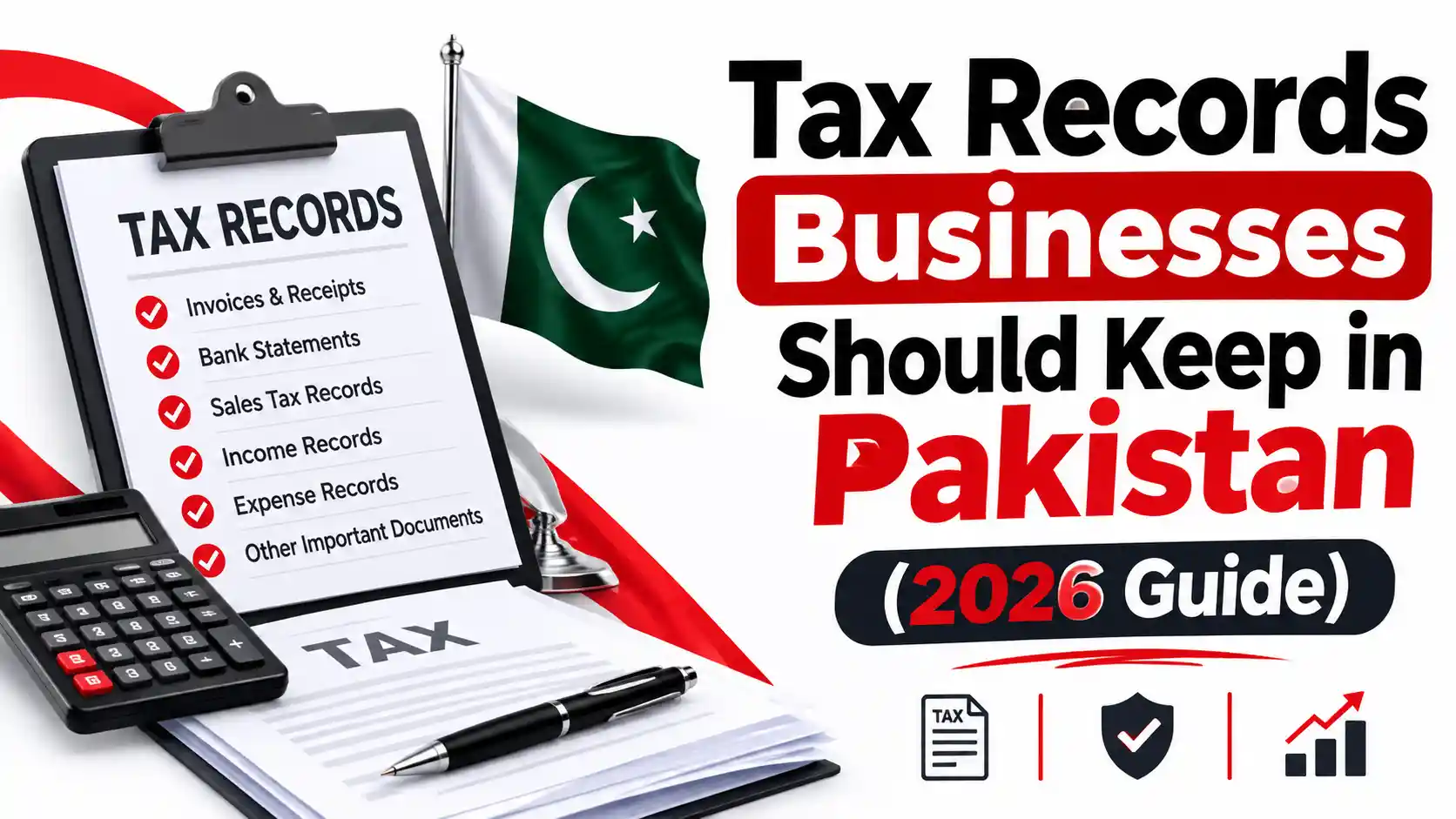
A business should keep ten groups of records: accounting books, sales records, purchase and expense records, bank records, payroll records, withholding tax records, sales tax records, inventory and asset records, returns and correspondence, and registration and company documents. The table below is a quick map, and the sections that follow explain each group. For a monthly routine around these groups, see the monthly tax return guide for businesses.
| Record group | Typical documents | Why it matters |
|---|---|---|
| Accounting books | General ledger, cash book, journal entries, trial balance | Core evidence of income and expenses |
| Sales records | Sales invoices, cash memos, sales register, credit notes | Proves taxable income and output tax |
| Purchases and expenses | Purchase invoices, vouchers, utility bills, rent agreements | Supports deductions and input tax |
| Bank records | Bank statements, cheque copies, payment advices | Shows payment mode and cash flow |
| Payroll | Salary sheets, appointment letters, tax deduction records | Supports salary expense and withholding |
| Withholding tax | Deduction records, certificates, payment challans, statements | Proves tax deducted and deposited |
| Sales tax | Sales and purchase registers, returns, input tax workings | Supports every sales tax return |
| Inventory and assets | Stock registers, fixed asset register, depreciation schedule | Supports cost of sales and depreciation |
| Returns and notices | Filed returns, acknowledgements, notices, orders | Proves filing and tracks disputes |
| Registration and company documents | NTN and STRN records, incorporation papers, deeds | Establishes legal identity and compliance |
What Core Accounting Records Should Businesses Maintain?
Businesses should maintain a general ledger, a cash book or bank book, journal entries, a trial balance and annual financial statements. These books record every sum received and spent, and the Income Tax Rules require them in a form that lets the business income be worked out. The corporate tax guide for Pakistan shows where these figures flow into the return.
In practice, a full set of books includes:
- A general ledger with a clear chart of accounts.
- A cash book and a bank book, or a daily record of receipts, sales, payments, purchases and expenses.
- Journal entries with narrations and supporting references.
- A monthly trial balance, plus the annual balance sheet, profit and loss statement and cash flow statement.
- Where relevant, an income and expenditure statement and notes to the accounts.
The size of the business decides how formal this must be. Under Rule 30, as reported when FBR updated it in December 2023, businesses with smaller income and new taxpayers may keep serially numbered invoices, a daily record of receipts and payments and purchase vouchers. Wholesalers, distributors, dealers, commission agents and larger businesses must add a cash or bank book and a general ledger, and manufacturers above the prescribed turnover must keep a fuller set. Thresholds are revised from time to time, so check the current Rules, and use the business AOP calculator if you operate as an association of persons.
What Sales and Income Records Should a Business Keep?
A business should keep every sales invoice, cash memo and receipt, a sales register, credit and debit notes, and records of export or zero-rated supplies. The Income Tax Rules expect serially numbered and dated documents showing the business name, address, NTN and STRN (if any), the description, quantity and value of goods or services, and customer details for larger transactions. Retailers working with a point-of-sale system should read the guide to FBR POS integration for Tier-1 retailers.
FBR’s own guidance on the record of sales says it should show the description, quantity and value of goods or services, the customer’s name and address, and the tax charged. At the end of each month, the registered person adds up the sales tax shown and carries it to the sales tax account as output tax. Matching your monthly totals to the return is the easiest way to avoid errors, as the common errors in sales tax filing guide explains.
Other income streams need their own proof. Rental income needs tenancy agreements and rent receipts, and the rental income tax guide lists what to retain. Online sellers and freelancers should keep platform statements and payment records, and the e-commerce tax guide explains how withholding applies to them.
What Purchase and Expense Records Does FBR Expect?
FBR expects purchase invoices, vouchers for expenses, import documents and supporting agreements. Its sales tax guidance says the record of purchases and imports should show the description, quantity and value, the supplier’s name, address and registration number, and the tax paid. The FBR list of other records adds invoices, credit and debit notes, bank statements, inventory records, utility bills, salary and labour bills, rental agreements, sale and purchase agreements and lease agreements.
Supplier details deserve special care. Since the Finance Act 2025, a share of expenditure linked to purchases from suppliers without an NTN can be disallowed, so verify each supplier before you pay. The NTN verification guide and the guide to the Active Taxpayer List show how to check a supplier’s status. Save a dated screenshot or printout of each check.
For every expense, aim to keep four things together: the invoice or bill, the proof of payment, the contract or purchase order where one exists, and a note explaining the business purpose. Importers and exporters should also keep customs and shipping papers, including documents filed through platforms such as Pakistan Single Window. If you are trying to cut avoidable tax cost lawfully, the guide to reducing tax liability explains why documented expenses are the foundation.
Which Bank and Payment Records Are Required?
Keep all bank statements for accounts used by the business, cheque books and counterfoils, payment advices, online transfer confirmations and tax payment receipts. FBR lists bank statements among the records a registered person should keep, and they are often the first document an officer asks for. Statements let an officer test whether your declared sales and expenses match actual money movement, a point covered in the wealth statement reconciliation guide.
Payment mode is part of the evidence. Section 21 of the Income Tax Ordinance restricts deductions in certain cash and non-banking channel cases, and section 73 of the Sales Tax Act ties input tax claims to banking channel payments. Paying through the banking system and keeping the matching statement protects both claims. Banks are also increasingly involved in reporting: FBR’s circular on the Finance Act 2026 describes a new requirement for banks to upload prescribed data on very large accounts to a central data hub for cross-matching, so personal and business transactions should never be mixed.
Tax payment evidence needs its own folder. Keep every PSID, challan and computerised payment receipt, and match each one to the return it supports. The guides to FBR PSID payment and paying income tax online show the steps.
What Payroll and Employee Records Should Companies Maintain?
Companies should maintain employment contracts or appointment letters, monthly salary sheets, a payroll register, proof of salary payments, and records of tax deducted from each employee. FBR also lists salary and labour bills among the documents a business should keep, and salary tax deducted under section 149 needs a clear audit trail. The salary tax calculator helps check deductions against the current slabs.
Employers should also keep a copy of every salary tax certificate they issue, because employees rely on it for their own returns. The salary tax certificate guide explains what the certificate shows and how it ties to the employer’s NTN. Keep leave, bonus, allowance and benefit records too, because perquisites affect taxable salary. The income tax slabs for salaried individuals show how the 2026-27 changes apply.
Which Withholding Tax Records Must Be Kept?
Any business that deducts or collects tax must keep a record of each deduction, the payment of that tax to the government and the statements and certificates that follow. For each transaction, record the payee’s name and NTN, the nature of the payment, the gross amount, the rate, the tax withheld, the payment receipt and the date deposited. The FBR withholding tax rates chart for 2026-27 helps confirm the correct rate, and the withholding tax calculator speeds up the working.
The record set normally includes:
- A withholding register by payee and by section.
- Proof of deposit for every payment of tax withheld.
- A copy of each certificate issued to a supplier or employee, and the process to get a tax withholding certificate online.
- A copy of each withholding statement filed under section 165.
- Certificates received from customers who withheld tax from your payments.
Accuracy here is closely watched. FBR’s circular on the Finance Act 2026 says a new penalty applies where a person claims credit for tax withheld in excess of the amount verifiably deducted and deposited, so reconcile each customer certificate to IRIS before claiming credit. Errors in this area are common, as the guide to withholding tax compliance mistakes explains.
What Sales Tax Records Should Registered Businesses Keep?
A sales tax registered business must keep a record of sales, a record of purchases and imports, a record of payments and receipts, and records of zero-rated and exempt supplies. These are the categories on FBR’s sales tax records pages, and the records must be kept in English or Urdu. The Finance Act 2026 also amended section 23 so that tax invoices must be issued for exempt supplies as well as taxable ones, and so that a verifiable FBR invoice number is required from a date to be notified by the Board. The guide to registering for sales tax covers the starting steps.
The practical record set includes:
- A sales register and a purchase register reconciled monthly to the return.
- Copies of every sales tax return and its attachments, kept electronically.
- Input tax workings, including the supplier invoice number, date, STRN and tax amount.
- Credit notes, debit notes and records of returns or adjustments.
- Evidence for zero-rated supplies such as exports.
- Payment challans and bank statements for tax paid.
FBR says the electronic sales tax return and its attachments must be kept in electronic form and produced to the officer on demand with supporting documents, and its page notes a delay penalty if production is delayed beyond 15 days. Supplier mismatches carry real cost, so check the monthly versus quarterly filing guide to be sure of your filing frequency.
Which Inventory, Fixed Asset and Depreciation Records Are Needed?
Businesses should keep stock registers, periodic inventory counts, a fixed asset register and a depreciation schedule. Inventory records support cost of sales and sales tax adjustments, while asset records support depreciation claims under section 22 of the Income Tax Ordinance. The Income Tax Rules have long expected stock-in-trade records for traders and stock registers supported by gate records for manufacturers, so check Rule 30 for your category. The guide to corporate tax planning strategies shows why asset records influence the tax bill.
A good fixed asset register records the asset description, date of purchase, supplier, cost, location, depreciation method, accumulated depreciation and disposal details. Keep the purchase invoice, import papers and proof of payment with it. As good practice (not a legal minimum), keep asset documents for as long as you hold the asset and for the retention period after disposal, because claims made in later years rely on the original cost evidence.
Sales tax registered manufacturers and traders should also keep production and stock movement records, because adjustments depend on them. The tax planning strategies for businesses guide explains how these records support lawful planning.
Which Tax Returns, Notices and Correspondence Should Be Kept?
Keep every filed return and its annexures, filing acknowledgements, payment receipts, withholding statements, wealth statements where applicable, and every notice, order and reply. FBR’s income tax return guidance says persons with taxable income are bound to keep their return records for six years. A complete return file lets you answer a notice quickly, and the FBR notice response guide shows how to use it.
Correspondence matters just as much as the return itself. Save the notice, the proof of service date, your reply, hearing records and the final order. If a dispute continues, the guide to appealing a tax assessment explains why the whole file must stay intact until the matter ends. Keep any exemption or reduced-rate certificate too, as described in the tax exemption certificate process.
For companies, the Finance Act 2026 added a file-format rule. From tax year 2026, the financial statements filed with the return must be in an electronically readable format, and FBR’s circular says statements furnished as image files, scanned documents or password-protected files are treated as blank or incomplete under the penalty provision. Keep a native, searchable copy of the audited accounts, not just a scan. If corrections are needed, see how to correct mistakes in an FBR income tax return.
Which Registration and Company Documents Should Businesses Retain?
Retain the NTN registration, STRN and any provincial registrations, trade licences, and the documents that created the business. For a company, that means the certificate of incorporation, memorandum and articles of association, SECP filings, statutory registers and board and shareholder minutes. For a partnership, it means the signed partnership deed and any amendments, and the partnership deed format and registration guide explains what a deed should contain.
These documents rarely expire, so treat them as permanent records. They prove who owns the business, who may sign, and when each registration began. The step-by-step business registration process lists the registrations a new business typically collects. Foreign-owned companies should also keep the records described in the guide to registering a company with foreign directors.
How Long Should Businesses Keep Tax Records in Pakistan?
For income tax, keep records for six years after the end of the tax year to which they relate. For sales tax, keep them for six years after the end of the tax period. Companies must keep books of account for at least ten financial years. In every case, if proceedings are pending, records should be kept until those proceedings finish. The monthly tax filing deadlines guide helps you date each record set correctly.
| Record type | Minimum retention | Legal basis |
|---|---|---|
| Income tax accounts, documents and records | Six years after the end of the tax year; until final disposal if proceedings are pending | Section 174(3), Income Tax Ordinance, 2001; Rule 29(4), Income Tax Rules, 2002 |
| Sales tax records and electronic returns | Six years after the end of the tax period | Section 24, Sales Tax Act, 1990, as stated on FBR’s retention page |
| Company books of account | At least ten financial years | Section 220, Companies Act, 2017 |
| Electronic sales tax invoices (where a business is notified) | Six years on electronic media | Sales Tax Rules, Chapter XIV, read with section 24 |
| Punjab services sales tax records | Five years after the end of the tax period or until final decision, as published by PRA | Section 32, Punjab Sales Tax on Services Act, 2012 (confirm the current text) |
Retention periods run from the end of the tax year or tax period, not from the day you file. For example, the tax year 2026 runs from 1 July 2025 to 30 June 2026, so the six-year period for those income tax records runs to 30 June 2032. A sales tax return for July 2026 relates to a tax period ending on 31 July 2026, so its records should be kept until at least 31 July 2032. A company with a December year-end that closed its accounts on 31 December 2025 reaches the six-year income tax mark on 31 December 2031. The FBR tax calculator guide is useful for working through year-specific figures.
These are legal minimums. It is good practice, not a legal rule, to keep incorporation papers, share records, deeds and asset documents for much longer.
Can FBR Ask for Old Business Records?
FBR can ask for records within the retention period, and it may ask for older records where proceedings are already pending. The Supreme Court held in April 2022 that a taxpayer cannot be compelled to produce records for a tax year beyond the six-year period in section 174(3), as Business Recorder reported. The same ruling tied the period to Rule 29(4) of the Income Tax Rules. For the notice side of this question, read how to handle tax notices from FBR.
There is an important exception. The proviso to section 174 keeps the duty to maintain records alive while proceedings are pending. Business Recorder’s report on a later Supreme Court ruling explains that a case under challenge before a legal forum is enough to dilute the six-year timeframe until the matter is resolved. In practice, once a notice, audit or appeal starts, stop any routine deletion of the related years and keep everything until the matter closes.
The safest approach is a written retention schedule that records which years are under review. If you receive a notice for an older year, do not ignore it. Check the dates and the pending-proceedings position with an adviser, using the FBR audit response guide as your first reference.
Are Digital and Electronic Tax Records Accepted in Pakistan?
Yes, electronic records are accepted, provided they are complete, readable, secure and producible on demand. FBR’s sales tax guidance expects the electronic return and attachments to be kept electronically and produced with supporting documents, and sales tax rules for electronic invoices require retention on electronic media for six years. The Punjab Revenue Authority has also said it places no restriction on keeping records in electronic form if they allow ready ascertainment of tax. Start with the digital accounting services guide if you are moving from paper.
Electronic does not mean informal. A reliable electronic record set has these features:
- A system that keeps an audit trail of who entered or changed each entry.
- Native, searchable files for financial statements and ledgers, not only scanned images.
- Regular backups stored separately from the main system.
- Clear naming, so an officer can find a document by date, party and type.
- Access controls so records cannot be altered after closing.
Digital invoicing is the clearest example. Where FBR has notified a business, invoices must be issued through its computerised system and the electronic record must be retained for six years. The FBR IRIS registration guide and the explanation of IRIS 2.0 features show how your portal records connect to your own books. If portal access ever fails, see the IRIS login problems and solutions.
What Changed in 2026? Finance Act 2026 Developments That Affect Record Keeping
The Finance Act 2026, effective from 1 July 2026 unless otherwise provided, pushes record keeping towards electronic systems and faceless enforcement. The changes below come from FBR’s Circular No. 02 of 2026-27 on the Income Tax Ordinance, dated 8 September 2026, which you can read on FBR’s website. A full summary of the budget is in the top tax changes for 2026-27.
- Electronic resources and integration (section 174(5)). The Board may require any person or class of persons to install and use an electronic resource, or to act as an integrated enterprise. A new penalty applies for failure: 1% of turnover or Rs 1 million, whichever is higher, for the first default, and Rs 2 million for each subsequent quarterly default.
- Expense disallowance. Section 21 now disallows 3% of expenditure for a person who fails to install the required electronic resource, and section 64D offers a tax credit equal to 10% of the amount invested in it, against normal tax.
- Faceless regime. Audits, assessments and appeals can be conducted through a National Faceless Centre, with hearings held electronically.
- Electronic filing and readable statements. Returns must be filed electronically on IRIS, and company financial statements must be in an electronically readable format from tax year 2026.
- Re-audit powers. The Commissioner may direct a re-audit of accounts by an accountant, or a revaluation of inventory by a cost accountant, in complex cases.
- Penalties. Penalties against serial numbers 8 and 10 of section 182 have been substantially enhanced, and a new entry covers excess withholding credit claims. Confirm the final amounts in the current text, because the FBR section 182 page may not show the latest figures.
On the sales tax side, the Finance Act 2026 requires tax invoices for exempt supplies and a verifiable FBR invoice number from a date to be notified. It also tightened section 33: failure to integrate a business with the Board’s system can attract a penalty of Rs 1 million, then up to Rs 5 million if the default continues for a month, and FBR may seal the premises. New entries cover simulated invoices and unmatched input tax. Commentary on the enacted Act also reports higher minimum penalties, many moving from Rs 10,000 to Rs 50,000, so check section 33 as currently in force. The FBR digital invoicing guide covers integration in more detail.
How Do Provincial Sales Tax Records Differ From Federal Records?
Provincial services tax records follow the law of the province where the service is provided, and retention periods may differ from the federal six years. The Punjab Sales Tax on Services Act, 2012 requires registered persons to keep records in English or Urdu at their business premises or registered office, and, as published on the Punjab Revenue Authority’s portal, section 32 sets retention at five years after the end of the tax period or until final decision in any proceedings. Provincial laws are amended often, so confirm the current wording. The PRA registration process for service providers explains the registration side.
Sindh, Khyber Pakhtunkhwa and Balochistan have their own services tax laws, administered by the Sindh Revenue Board, the Khyber Pakhtunkhwa Revenue Authority and the Balochistan Revenue Authority. In Sindh, a 2024 amendment widened the scope of records a registered person must keep so that liability in Sindh can be reconciled with records from other provinces. For Sindh, see the SRB tax filing guide for businesses. For Punjab, the Punjab sales tax filing guide covers returns and supporting documents.
A business that sells goods and provides services may fall under both regimes. In that case, keep federal and provincial records separately, label each by authority, and apply the longer retention period to any record that supports both.
What Is the Difference Between Accounting Records, Tax Records and NTN and STRN Documents?
Accounting records capture the financial story of the business, while tax records prove what was declared and paid to the tax authority. Both overlap, but they are not identical. NTN documents relate to income tax registration, and STRN documents relate to sales tax registration. Keeping them apart prevents confusion, and the FBR registration requirements guide explains why each number exists.
| Point of comparison | Accounting records | Tax records |
|---|---|---|
| Main purpose | Manage the business and produce financial statements | Prove tax declared, deducted and paid |
| Typical examples | Ledger, cash book, trial balance, balance sheet | Returns, withholding certificates, challans, notices |
| Main legal source | Companies Act, 2017 and accounting standards | Income Tax Ordinance, Sales Tax Act and Rules |
| Retention | Ten financial years for companies | Usually six years |
| Point of comparison | Income tax records | Sales tax records |
|---|---|---|
| Identifier | NTN | STRN (and NTN) |
| Core documents | Books, vouchers, returns, withholding records | Sales and purchase registers, invoices, sales tax returns |
| Retention anchor | End of the tax year | End of the tax period |
These records feed each other. A sales invoice supports both the income tax return and the sales tax return, so a mismatch in one place often triggers questions in the other. A closer look at filer, late filer and non-filer status shows how filing records affect your standing.
Do Small Businesses Need to Maintain Tax Records in Pakistan?
Yes. There is no exemption from record keeping for small businesses, but the minimum records are lighter. Under the Income Tax Rules, smaller businesses and new taxpayers keep serially numbered invoices or cash memos, a daily record of receipts, sales, payments and expenses, and vouchers for purchases and expenses. Where each sale is very small, one cash memo per day may be enough. The income tax return guide for SMEs explains how these records feed a return.
The Finance Act 2026 also widened section 99B, the special procedure for small traders and shopkeepers, to cover the rate and payment of tax, including fixed tax, filing of return and audit. If you may qualify, check the current procedure before assuming you can skip records, because eligibility depends on the notified conditions. The guide to registering a sole proprietorship is a sensible first step for a new small business.
A simple spreadsheet is acceptable if it is complete, dated and backed by documents. Freelancers, startups and software houses face the same duty, and the guides for freelancer NTN registration and startup tax consultancy show the starting point.
How to Organise and Maintain Business Tax Records Step by Step
Use one folder structure, capture documents daily, reconcile monthly and archive annually. A simple system you actually follow beats a complex one you abandon. The monthly compliance checklist fits naturally around these steps.
- Set a folder structure. Create one top folder per tax year, with sub-folders for sales, purchases, bank, payroll, withholding, sales tax, assets, returns and correspondence.
- Capture every document on the day. Scan or photograph bills and receipts, save the native file for anything issued electronically, and name each file by date, party and amount.
- Number and register invoices. Issue serially numbered sales invoices, and log every purchase invoice in a purchase register.
- Reconcile the bank monthly. Match the bank statement to the cash book and investigate every unexplained credit or debit.
- Reconcile sales tax monthly. Tie the sales and purchase registers to the return, and verify each supplier’s registration before claiming input tax.
- Reconcile withholding against IRIS. Compare your withholding register and certificates with the data on the portal before filing.
- Count stock and update assets quarterly. Record the date, quantity and value, and update the fixed asset register for additions and disposals.
- Build an annual pack. At year-end, file the trial balance, financial statements, return, annexures, acknowledgements and payment proofs in one folder.
- Back up in two places. Keep one copy on site and one copy separately, and test that you can open it.
- Keep a retention schedule. Record the earliest date each year’s records may be destroyed, and mark any year under notice, audit or appeal as locked.
Reconciliation is what turns documents into proof. Bank reconciliation confirms cash, tax reconciliation links accounting figures to the return, and the audit trail shows who recorded what and when. If you want to see how a clean reconciliation protects you in a dispute, the guide to explaining source of income under section 111 shows what officers look for.
Which Software and Tools Help With Tax Record Management?
Microsoft Excel, cloud accounting tools such as QuickBooks, Xero and Sage Accounting, and full ERP systems can all hold tax records if they keep an audit trail and allow exports. The right choice depends on volume. A small shop may manage with Excel and a disciplined folder system, while a growing company needs software that links sales, purchases, stock and bank feeds. The guide on which accounting software suits a small business compares the main considerations.
When you choose software, check these points:
- It produces a general ledger, trial balance, aged receivables and payables, and tax reports you can export.
- It records who changed what, and when.
- It supports backups and secure access for staff and your adviser.
- For sales tax, it can work with FBR’s invoicing system through a licensed integrator where your business is notified.
- It lets you attach scanned documents to the entry they support.
The FBR IRIS portal is not accounting software. It holds your filings and portal data, but your books must still exist independently. A point-of-sale system is also not a full ledger, so export its sales to your accounts and reconcile them. The FBR POS integration guide explains where retail systems connect to FBR.
What Happens If Business Tax Records Are Lost?
If records are lost, act quickly: list what is missing, rebuild it from third-party sources, document the loss, and get advice before you respond to any notice. The duty to maintain records stays with the taxpayer, so loss is not a defence on its own. A calm, documented reconstruction is far better than silence, and the guide on incomplete initial records of organisations explains why gaps need a plan.
Useful reconstruction sources include:
- Bank statements, which can be requested again from the bank.
- Duplicate invoices and statements from suppliers and customers.
- Copies of returns, payment receipts and withholding data from your IRIS account.
- Certificates held by customers who withheld tax from your payments.
- SECP filings and other public registry records.
Write a short, dated note explaining what was lost, when and how you discovered it, and how you rebuilt the record. This does not guarantee a particular outcome, but it shows good faith. If a notice has already arrived, the guide to what to do if you receive an FBR tax notice gives the first steps.
What Happens If a Business Does Not Maintain Tax Records?
The business can face penalties, disallowed expenses, higher assessed income and, in some cases, a loss of input tax credit. Under section 182 of the Income Tax Ordinance, as shown on FBR’s penalty page, failing to maintain required records attracts a penalty of Rs 10,000 or 5% of the tax on income, whichever is higher. Failing to issue a cash memo, invoice or receipt carries Rs 5,000 or 3% of the tax involved. Failing to produce records after a section 177 notice attracts Rs 25,000, Rs 50,000 and Rs 100,000 for the first, second and third notices. These are the amounts shown on the page, and the Finance Act 2026 enhanced several entries, so confirm the current figures.
Penalties are only part of the risk. Without records, an officer may reject expenses, assess higher income through an amended assessment, or treat unexplained credits as undeclared income. On the sales tax side, missing invoices can mean inadmissible input tax, assessments based on best judgement and penalties under section 33. A business that cannot prove a deduction usually cannot claim it, which is why the guide to avoiding late tax filing penalties is only half the story.
There is some procedural protection. Under section 182(2), no penalty is payable unless a written order is passed after the person has had an opportunity to be heard. If you disagree with an order, the tax appeal process explained outlines your options. To limit exposure before any notice arrives, keep an audit-ready folder for each year with the return, trial balance, reconciliations, key contracts and payment proofs.
What Are the Common Mistakes in Business Tax Record Keeping?
The most common mistakes are counting retention from the filing date, mixing personal and business transactions, paying large sums in cash without proof, and not checking supplier registration. Each one is easy to prevent with a routine, and most appear in the common tax mistakes freelancers make, which also apply to small firms.
- Counting the six years from the day the return was filed instead of the end of the tax year or tax period.
- Deleting records for a year that is already under notice, audit or appeal.
- Keeping only a scan of the financial statements, with no native, readable file.
- Claiming input tax or withholding credit without matching it to supplier or portal data.
- Using unnumbered or handwritten invoices that cannot be tied to a register.
- Mixing personal spending with business accounts, which makes both unreliable.
- Forgetting to record zero-rated and exempt supplies.
- Ignoring provincial records for service income.
- Losing data when a staff member or accountant leaves, because files sat on a personal device.
- Treating the IRIS portal as the only copy of a return.
A short monthly review catches most of these. The guide to common errors in FBR returns and IRIS forms shows what to check before you submit.
Do Business Tax Record Requirements Differ in Karachi, Lahore, Islamabad, Rawalpindi and Other Cities?
The federal rules on income tax and sales tax records are the same in every city. What changes is the provincial or territorial authority for services tax and the practical support available nearby. Businesses in Lahore, Rawalpindi, Faisalabad, Multan and Sialkot deal with the Punjab Revenue Authority for services tax, businesses in Karachi deal with the Sindh Revenue Board, and businesses in Peshawar deal with the Khyber Pakhtunkhwa Revenue Authority. In Islamabad, FBR generally administers tax on services for the Capital Territory. Confirm your registration position before filing.
Baco Consultants publishes city-focused guides that help owners find the right support, including pages on the best tax consultant in Lahore, the best tax consultant in Karachi, the best tax consultant in Rawalpindi, the best tax consultant in Islamabad and the best tax consultant in Faisalabad. Use these as starting points, then match your registrations to the right authority.
Why Choose Baco Consultants for Business Tax Record Keeping in Pakistan
Business tax records touch several laws at once, so it helps to work with a firm that publishes and applies guidance across FBR, SECP and provincial topics. Baco Consultants’ blog covers sales tax, withholding, notices, corporate compliance and registration in Pakistan, and its site offers online tools such as the corporate compliance calculator alongside service pages for registration and filing work.
If you want to know who you would be working with, the About page is the place to start. The aim of this guide is the same as the aim of the firm’s other resources: to explain the rule, show the source and help you act with confidence, without making claims that cannot be verified.
Frequently Asked Questions
What tax records should businesses keep in Pakistan?
Keep accounting books, sales and purchase invoices, bank statements, payroll and withholding records, sales tax registers, tax returns, payment receipts and contracts. The business tax compliance guide shows how they fit together.
How long should businesses keep tax records in Pakistan?
Keep income tax and sales tax records for six years after the end of the tax year or tax period, and company books of account for at least ten financial years. Keep them longer if proceedings are pending. The filing deadlines guide helps with dating.
Can FBR ask for old business records?
FBR can ask for records within the retention period, and for older years where proceedings are already pending. The Supreme Court has said records beyond six years cannot be demanded otherwise. See the FBR notice response guide.
What happens if a business does not maintain tax records?
It can face penalties under section 182, disallowed expenses, higher assessed income and, for sales tax, inadmissible input tax. The late filing penalty calculator shows related costs.
Do small businesses need to maintain tax records in Pakistan?
Yes, but the minimum set is lighter, usually numbered invoices, a daily record of receipts and payments, and vouchers. Read the small business accounting guide.
Can I maintain business tax records digitally?
Yes, if the records are complete, readable, secure and producible on demand, and sales tax records are in English or Urdu. Keep native files for financial statements. The digital accounting services guide explains the options.
Are electronic invoices valid for tax purposes?
Yes, and where FBR has notified a business, invoices must be issued through its system and kept electronically for six years. The FBR digital invoicing guide covers the process.
What is the difference between NTN and STRN?
The NTN is the National Tax Number used for income tax registration, and the STRN is the sales tax registration number. Each has its own records. See the NTN registration step-by-step guide.
Are bank statements necessary for tax filing?
They are not attached to every return, but FBR lists them among records to keep, and they are the main proof of payment mode and cash flow. The wealth statement guide shows how statements are used.
Should businesses keep employee salary records?
Yes. Keep salary sheets, proof of payment and tax deducted for each employee, plus the certificates issued. The salary tax certificate guide explains the certificate.
What records are required for a sales tax audit?
Be ready with sales and purchase registers, invoices, returns and attachments, input tax workings, payment receipts and bank statements. Section 25 of the Sales Tax Act deals with audit, and the sales tax filing checklist lists the documents.
What happens if business records are lost?
Rebuild them from bank, supplier, customer and portal sources, document the loss, and seek advice before replying to a notice. The guide to handling FBR notices explains the next steps.
Can FBR reject undocumented business expenses?
Yes. Expenses that cannot be supported by documents or proof of payment can be disallowed. The guide to reducing tax liability shows why documented deductions matter.
What accounting records should a private limited company maintain?
A company should keep books of account that give a true and fair view, including the ledger, cash and bank books, registers, vouchers and financial statements, for at least ten financial years under section 220 of the Companies Act, 2017. See the private limited company registration guide.
Conclusion
Good tax records answer three questions before anyone asks them: what did the business earn, what did it spend, and what tax was paid. The core rule is simple. Keep income tax and sales tax records for six years after the end of the relevant tax year or period, keep company books for at least ten financial years, and keep everything until any pending proceedings are finished. The tax compliance guide for 2026 ties these duties to your wider obligations.
The direction of travel is also clear. The Finance Act 2026 expects more electronic resources, faceless proceedings and machine-readable statements, so the best time to organise records is before a notice arrives, not after. A monthly routine, supplier checks, reconciliations and a retention schedule will cover most of the risk, and the guide to the benefits of becoming a tax filer shows what a clean compliance record gives you in return.
Related Articles


Leave a Comment
No approved comments yet. Be the first to share your thoughts!